JUMA , CALESTOUS
- 4 Min Read
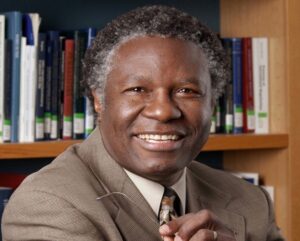
PHOTO CAPTION: Calestous Juma.
Calestous Juma (9 June 1953 – 15 December 2017) was a renowned Kenyan scientist, policy scholar, and global thought leader in science, technology, and innovation for sustainable development. He is widely recognized for shaping international thinking on how scientific innovation can drive economic growth, agricultural transformation, and sustainable development, particularly in Africa and other developing regions.
Calestous Juma was born on 9 June 1953 in western Kenya, in the Busia region, to John Kwada Juma, a farmer, and Clementina Nabwire, a trader. He grew up near Port Victoria along the shores of Lake Victoria. He had a supportive family environment that valued education and hard work, which played a crucial role in shaping his future interests in science, innovation, and development. Juma was married to Alison Field-Juma and they had one son, Eric Juma.
He attended Port Victoria Secondary School before enrolling at Egoji Teachers’ Training College in 1974. After qualifying as a teacher, he taught science in Mombasa, Kenya.
During this period, Juma developed a strong interest in science communication and journalism. He began writing for the Daily Nation newspaper and, in 1978, became Africa’s first full-time science and environment correspondent, a pioneering role that helped bring scientific and environmental issues into mainstream public discourse in Kenya.
In 1979, Juma joined the Environment Liaison Centre, a Nairobi-based non-governmental organization, where he worked as a researcher and editor on issues related to environmental governance and development policy.
In 1982, he was awarded a full scholarship to study at the University of Sussex in the United Kingdom. He earned an MSc in Science, Technology and Industrialization in 1983, followed by a DPhil (PhD) in Science and Technology Policy in 1987.
In 1988, Juma founded the African Centre for Technology Studies (ACTS) in Nairobi, Africa’s first science and technology policy think tank. Through ACTS, he played a pivotal role in advancing policy-oriented research on innovation, intellectual property, environmental management, and economic development.
ACTS produced influential studies, including Innovation and Sovereignty, which contributed to the development of Kenya’s industrial property legislation and helped shape national approaches to intellectual property management. Under Juma’s leadership, ACTS also conducted landmark research on economic reform and environmental sustainability in Africa,
Juma was elected to several prestigious scientific academies, including the Royal Society (UK), the US National Academy of Sciences, the World Academy of Sciences, and the African Academy of Sciences. He authored several influential books, including Innovation and Its Enemies: Why People Resist New Technologies (2016) and The New Harvest: Agricultural Innovation in Africa (2015).
His work helped shape the understanding of how technological innovation drives economic and social development, especially in Africa, and he was widely respected as a policy adviser to governments and international bodies. Juma also played a key role in global development initiatives. He co-chaired the African Union High-Level Panel on Modern Biotechnology and served as chair of the Global Challenges and Biotechnology initiative at the U.S. National Academy of Sciences. He contributed to United Nations initiatives focused on achieving the Millennium Development Goals through science, technology, and innovation.
Although Juma was not primarily known for inventing specific technologies, his enduring impact lay in his intellectual leadership, policy influence, and advocacy. He consistently emphasized the role of innovation, scientific capacity-building, and institutional reform as drivers of sustainable development.
Juma’s work significantly influenced agricultural policy, biotechnology governance, and innovation systems across Africa and beyond. He advised national governments, regional bodies, international organizations, and private-sector actors, helping shape policies that integrated scientific knowledge into development planning.
He was also deeply committed to capacity building, stressing the importance of education, research institutions, and skilled human capital in fostering long-term development. Through his teaching, mentorship, and public engagement, he inspired generations of scholars, policymakers, and practitioners working at the intersection of science, technology, and development.
Calestous Juma passed away on 15 December 2017 in Cambridge, Massachusetts, USA, at the age of 64.
Juma’s legacy lives on through his contributions to development policy, innovation studies, and his influence on generations of scholars and policymakers. His foundational work linking science and technology to sustainable development continues to shape policy debates globally.
EA EDITORS