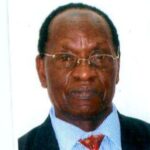
ODHIAMBO, THOMAS RISLEY
- 3 Min Read

PHOTO CAPTION: Thomas R. Odhiambo.
Thomas Risley Odhiambo (February 4, 1931 – May 26, 2003), a recipient of the Albert Einstein Medal in 1979, was a renowned Kenyan entomologist who founded what became the International Centre of Insect Physiology and Ecology (ICIPE) in 1967 at the University of Nairobi, where he taught. The centre was started to help African farmers combat harmful insects.
Thomas was born in Mombasa, Kenya. He was the first of ten children of a telegraph officer and his wife, who hailed from the Nyanza Province in western Kenya. He excelled at the Maseno Primary School managed by the Church Missionary Society (CMS), scoring first in the country in the national Kenya Preliminary Examination of 1945. This earned him a much sought-after place in Maseno’s secondary school, and thereafter to the famous Makerere University College in 1950, where he studied biology (entomology, soil biology, and nematology).
He began his working life in 1953 in Uganda as a junior officer in the Ministry of Agriculture before proceeding to Queens College at the University of Cambridge in 1959, where he first enrolled for a Natural Science Tripos. Six years later, and armed with both a PhD in Insect Physiology (1965) with specialisation on the reproductive physiology of the desert locust, and an MA in Natural Science, he returned to Kenya in 1965.
Thomas joined the University of Nairobi in 1965, where he taught Entomology for 10 years before taking an early retirement to devote his full research career at the International Centre of Insect Physiology and Ecology (ICIPE). He was the first professor of entomology, the first head of the entomology department and the first dean of the University of Nairobi. Prof. Odhiambo proposed the establishment of an Africa insect research centre that would train young researchers from Africa and across the globe. This led to the formation of ICIPE which is now a centre for scientific research and training in Africa and collaborates with over 200 national systems, research institutes and universities around the world.
During his 25-year tenure as director, the centre became an independent research organisation where more than 150 African scientists were trained under his vision of development in Africa through scientific advancement, especially insect control. Prof. Odhiambo was also a pioneer in researching how to control insects without using synthetic chemicals.
He was a member of many national and international scientific societies. He was a Fellow of the Italian National Academy of Sciences (the “Academy of the Forty”), Fellow of the Pontifical Academy of Sciences, Foreign Fellow of the Indian National Science Academy, Vice President and Founder Fellow of the Third World Academy of Sciences, and President and Founder Fellow of the African Academy of Sciences.
He was the Chairman of The Kenya National Academy of Sciences (KNAS). He also published over 100 scientific papers and books, mainly in the field of Comparative Insect Endocrinology, and more specifically in the area of Hormonal Control of Insect Reproduction.
His achievements were recognised with numerous awards. He received the Albert Einstein Medal in 1979, an honorary doctorate of science from the University of Oslo in 1986, and in 1987 he and former Senegalese President Abdou Diouf became the inaugural recipients of the Africa Prize for Leadership for the Sustainable End of Hunger, awarded by The Hunger Project in New York.
Prof. Odhiambo passed away on May 26, 2003 in Nairobi, Kenya, from liver cancer. His death came just three weeks after his diagnosis. Remembered as one of Africa’s greatest scientists, he combined intellectual brilliance with a vision for development through science, leaving a legacy that continues to shape agricultural research and food security across the continent.
EA EDITORS