MVABAZA, THOMAS LEVI
- 3 Min Read
Thomas Levi Mvabaza was born in Peddie, near Grahamstown, Cape Province (d. 1955). He was educated at both St. Matthew’s College, Middledrift, and Zonnebloem, Cape Town. He first worked in Port Elizabeth, and then moved to Johannesburg.

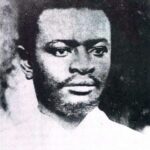
PHOTO CAPTION: Thomas Levi Mvabaza. SOURCE: EA Library.
There he met a number of progressive young men with whom he later established a company to print and publish a weekly English-Xhosa newspaper, Momo Wa Bantu, early in 1910. The newspaper’s charter was: “The unifying of Africans into one people, and further to improve and expedite the education of the African children.” The newspaper was immediately well received by the African public.
In 1911, Mvabaza’s Momo Wa Bantu amalgamated with another newspaper, Abantu-Batho, founded by Pixley ka L. Seme, one of the founders of the African National Congress (ANC), and the second black South African to qualify in England as a barrister. In 1912, the newspaper became the official organ of the South African Native National Congress, as the African National Congress was known in 1912. Mvabaza was its managing editor.
Mvabaza was also one of the founding fathers of the African National Congress. He was a member of the Transvaal Native Organisation before the formation of the South African Native National Congress, and became a prominent figure in the African National Congress from its founding in 1912. He was a member of both the 1914 deputation to Britain, and the 1919 deputation to both Britain and Versailles, sent to protest the passage of the 1913 Native Land Act. His presence in these delegations, and leadership therein guaranteed his stature in the ANC and the African community at large.
In 1918, he was arrested as one of several alleged instigators of the Johannesburg “bucket strike.” He participated in the meetings of the All African Convention in the mid-1930s, and together with others he urged the revival of the African National Congress during a period of relative quiescence in the mid- to later 1930s. In the early 1940s he served on the executive of the Transvaal African National Congress. He also served as a member of the National Anti-Pass Council in 1944.
Mvabaza was a member of the Pimville Advisory Board from its inception. He was a businessman at Klipspruit, and died in Johannesburg in 1955.
As one of that small stratum of highly educated and relatively prosperous Africans in the early twentieth century, Mvabaza played an important role as a journalist, educator and political spokesperson. He was survived by his wife and three children.
MOLAPETENE RAMUSI