
MAKEBA, MIRIAM
- 5 Min Read
Miriam Makeba (March 4, 1932 — November 10, 2008) was a South African-born singer who became known as Mama Africa, one of the world’s most prominent Black African performers in the 20th century, known for becoming the first African artist to globally popularise African music. Makeba’s powerful voice and charismatic stage presence catapulted her to international stardom. She was one of the most visible and outspoken opponents of South Africa’s apartheid regime from the 1960s till its dismantling in the early 1990s.
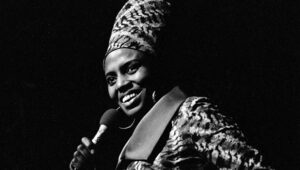
PHOTO CAPTION: Miriam Makeba. SOURCE: europeana.
Miriam Makeba was born on 4 March 1932 in the small township of Prospect, near Johannesburg, South Africa. The daughter of a Swazi sangoma (traditional healer) and a Xhosa teacher, she grew up in Sophiatown, a segregated Black township outside Johannesburg, and began singing in a school choir at an early age.
The blend of traditional African music and drumming from her Swazi heritage and Western classical music from her Xhosa background strongly influenced her interests and ultimate musical career. After the early death of her father, Miriam was forced to work, and for a short spell she also did housework. But she had already noticed that “music was a type of magic” which could elevate her from the poverty that surrounded her.
As a young woman, Makeba joined a local choir and quickly gained recognition for her talent. She began performing with the famous South African group Manhattan Brothers and later formed her all-female group, the Skylarks. These early successes as a professional vocalist laid the groundwork for her eventual international fame.
The key to her international success was a small singing part in the film Come Back Africa, a dramatised documentary on black life directed covertly by Lionel Rogosin. When the film was finished, Rogosin invited her to attend a screening at the 1959 Venice film festival, where she became an instant celebrity. She was flown, via London, to New York, where she appeared on television and played at the Village Vanguard jazz club.
The calypsonian Harry Belafonte took her under his wing and guided her through her first solo recordings. African standards such as Pata Pata and the Click Song, which she first performed with the Skylarks, formed the basis of her repertoire and remained the most popular songs throughout her career.
One of the most significant moments in Makeba’s career came in 1963 when she addressed the United Nations General Assembly, urging world leaders to support the fight against apartheid. This powerful speech showed her as an influential advocate for human rights and justice. Makeba continued to use her music to spread awareness, with songs like “Soweto Blues” and “Ndodemnyama we Verwoerd” (Beware, Verwoerd), which directly critiqued the apartheid system and its architects.
After the Sharpeville massacre in 1960, Miriam heard that her mother had died, but her own South African passport had been revoked and she was prevented from returning home for the funeral. Thus began 30 years of exile. Her life in the US continued to unfold like a showbiz dream. She was recording and touring, and meeting all the stars, from Bing Crosby to Marlon Brando: the young newcomer was also staggered to find herself appearing along with Marilyn Monroe at the famous birthday celebration for John F Kennedy.
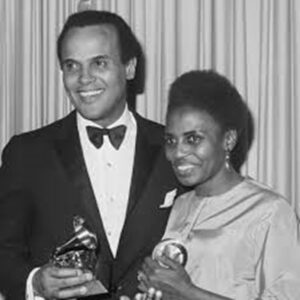
PHOTO CAPTION: Miriam Makeba and Harry Belafonte holding their Grammys award for Best Folk Record (1966).
In 1966, she became the first African artist to win a Grammy Award, sharing the honour with Harry Belafonte for their album “An Evening with Belafonte/Makeba“. She was also the first black woman to have a Top-Ten worldwide hit with Pata Pata in 1967. In total, she recorded four albums in the USA. It was in the United States that she also recorded her famous Qogothwane (The “Click” Song).
In 1991, following the release of Nelson Mandela from prison and the subsequent dismantling of apartheid, Makeba could finally return home to South Africa. Upon her return to South Africa, Makeba founded the Makeba Centre for Girls that continues to provide housing, professional counselling and support, practical vocational training and life skills development for orphaned girls, and the Makeba Rehabilitation Centre, providing critical support to young women who had been victims of abuse and drug addiction.
In 2001 the United Nations Food and Agriculture Organisation appointed Makeba as a Goodwill Ambassador for advocating for food security and sustainable development.
In 2005, Makeba announced her retirement from the mainstream music industry, but she continued to make appearances and perform smaller shows. Throughout her career, Makeba insisted that her music was not intentionally political. In an interview with the British Times, she said: “I’m not a political singer. I don’t know what the word means. People think I consciously decided to tell the world what was happening in South Africa. No! I was singing about my life, and in South Africa, we always sang about what was happening to us, especially the things that hurt us.”
Makeba died in 2008 at the age of 76 after suffering a heart attack shortly after a 30-minute performance at a concert held in support of the Italian writer Roberto Saviano near the southern Italian town of Castel Volturno. She left behind a profound legacy of music, activism, and global inspiration. Over the course of her career, she recorded 30 original albums and 19 compilation albums, cementing her place as one of Africa’s most influential musical figures.
EA EDITORS