OLATUNJI, BABATUNDE
- 3 Min Read
Babatunde Olatunji (April 7, 1927 – April 6, 2003) was a Nigerian drummer, educator, recording artist, and cultural ambassador widely regarded as the father of African drumming in the United States.
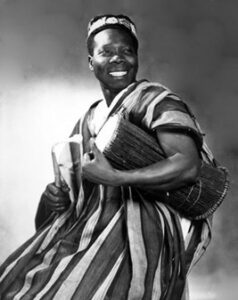
PHOTO CAPTION: Babatunde Olatunji SOURCE: EA Library.
Born Michael Babatunde Olatunji in Ajido, a coastal village near Lagos, Nigeria, he was raised in a culturally rich Yoruba environment where drumming, song, and dance were integral to daily life.
In 1950, he received a Rotary International scholarship to study at Morehouse College in Atlanta, Georgia. There, he earned a B.A. in Political Science with a minor in Sociology in 1954.
Initially aspiring to become a diplomat, Olatunji instead found himself informally educating fellow students about Africa, correcting widespread misconceptions and introducing them to African musical traditions.
In 1953, he organised what is considered one of the first public African dance concerts in the United States. He later enrolled at New York University’s Graduate School of Public Administration and International Relations, supporting himself through factory and construction work while performing African music in New York.
Olatunji’s professional breakthrough came in 1958 when he collaborated with arranger Raymond White at Radio City Music Hall. The following year, Columbia Records released Drums of Passion, which brought African percussion into mainstream American consciousness.
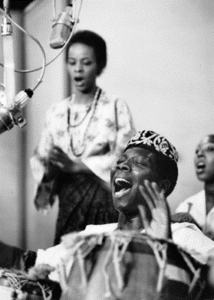
PHOTO CAPTION: Rhythm unleashed by Olatunji in live performance. SOURCE: Olatunji.com
During the early 1960s, he appeared on major television programmes such as The Ed Sullivan Show and The Tonight Show, and performed at venues including Birdland alongside prominent jazz musicians such as John Coltrane, Dizzy Gillespie, and Quincy Jones. His ensemble helped pioneer what would later be termed Afro-jazz.
In 1965, he founded the Olatunji Center for African Culture in Harlem, offering affordable classes in African music, dance, language, and history, and hosting performances by leading artists of the era. Despite financial challenges that led to its closure in 1984, the centre became an important hub for African diasporic cultural education.
After Columbia ended his recording contract in 1966, Olatunji focused extensively on teaching, holding positions at institutions including the Elma Lewis School of Fine Arts in Boston and Kent State University.
In the mid-1980s, drummer Mickey Hart of the Grateful Dead, who had first encountered Olatunji as a child, helped reintroduce him to wider audiences and produced later recordings. Olatunji also developed an influential pedagogical system based on Yoruba phonetics (“gun, go, do, pa, ta”) to teach drum language and rhythm.
He collaborated on the Grammy Award-winning album Planet Drum (1991). His writings include Musical Instruments of Africa (1965) and his autobiography, The Beat of My Drum (2002). Olatunji died on April 6, 2003, one day before his seventy-sixth birthday.
His lasting legacy lies in his role as a cultural bridge-builder who transformed global understanding of African rhythm and affirmed, in his own words, that “the whole world revolves in rhythm.”
EA EDITORS