ZEWAIL, AHMED HASSAN
- 5 Min Read
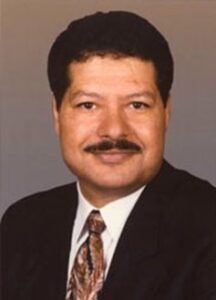
PHOTO CAPTION: A photo of Ahmed Zewail.
Ahmed Hassan Zewail (1946–2016) was an Egyptian-American scientist celebrated as the “Father of Femtochemistry.” He became the first science Nobel laureate from the Arabic-speaking world. He was a professor at the California Institute of Technology (Caltech), where he pioneered the use of ultrafast lasers to capture chemical reactions in femtoseconds, one quadrillionth of a second. This groundbreaking discovery revolutionised chemistry, earning him the 1999 Nobel Prize in Chemistry and Egypt’s highest honour, the Order of the Nile.
Ahmed Hassan Zewail was born in Damanhur, the ‘City of Horus,’ about 60 km from Alexandria in Egypt, on February 26, 1946. However, he spent his childhood along the Rosetta branch of the Nile Delta in the city of Dessouque, home to the famous mosque, Sidi Ibrahim. His father, Hassan, was a civil servant and businessman, while his mother, Rawhia Dar, was a stay-at-home mom who dedicated her life to taking care of her children, to whom he remained close throughout his life.
As a high school student, he was fascinated by the mathematics of chemistry and spared no effort in achieving his dream. He used the summer vacation to read in preparation for next year’s semester. His motivation to study was not only due to a sense of duty, but he was well aware that enthusiasm would help him achieve his dream at a faster rate.
Ahmed’s tendencies towards scientific subjects became more apparent. He was fond of solving mathematical problems in mathematics, physics, and mechanics. He felt the pleasure of victory each time he was able to solve a difficult question.
Aside from his studies, he engaged in extracurricular activities. In high school, he also learned photography.
After high school, he went ahead to receive his bachelor’s and master’s degrees from Alexandria University. He graduated from the Faculty of Science at Alexandria University in the summer of 1967, earning a BSc. in Chemistry with honours. He was then appointed a demonstrator (“Moeid”) in the Chemistry Department of the Faculty of Science at Alexandria University.
He moved to the USA to pursue doctoral research with Robin Hochstrasser at the University of Pennsylvania. While working on novel spectroscopies, including optically detected magnetic resonance, he completed his doctorate in 1974. At the age of 27, he was awarded a PhD in Chemistry.
After graduating, he moved to the University of California in 1974 to conduct postdoctoral research on coherence and energy transfer in solids with Charles B. Harris at UC Berkeley. In 1976, he joined the faculty of the California Institute of Technology (Caltech) in Pasadena and stayed there for the rest of his career. At Caltech, he became the director of the Physical Biology Center for Ultrafast Science and Technology and was named the “Linus Pauling Professor of Chemistry” in 1995. Zewail’s work at Caltech earned him a Nobel Prize in 1999.
Zewail’s professional journey flourished at the California Institute of Technology (Caltech), where he served as a professor of chemistry and physics. It was here that he made history by pioneering the field of “femtochemistry.” Ahmed achieved great success in discovering the world of atoms at a close range and was able to photograph molecules during their formation or dissociation, which occurs within several femtoseconds, using ultrafast lasers to observe chemical reactions occurring in femtoseconds, thus one quadrillionth of a second. Ahmed was just over 40 years old at that time when he made this phenomenal discovery.
This innovation allowed scientists to watch the movement of atoms in real time as chemical bonds were broken and formed, a discovery that revolutionised the study of chemistry and physics. His contributions earned him the name of the “Father of Femtochemistry.”
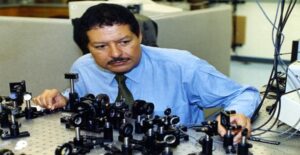
PHOTOCAPTION: Ahmed Zewail in his Lab. Caltech, USA, 1986. SOURCE: Caltech.
The Royal Swedish Academy cited Zewail “for showing that it is possible with rapid laser technique to see how atoms in a molecule move during a chemical reaction. Because reactions can take place in a millionth of a billionth of a second, Zewail’s research has, with state-of-the-art lasers, made it possible to observe and study this motion for the first time, thus allowing scientists to probe nature at its fundamental level.” He received the Nobel Prize for this Discovery.
As a native Egyptian, he was honoured with the Order of the Nile, the highest award given by Egypt. Ahmed Zewail received the Order of the Nile in 1999, the same year he was awarded the Nobel Prize in Chemistry
In 2009, he was appointed to the Advisory Science Council to the United States under the administration of former President Barack Obama. While he served in the advisory council, he raised awareness of the need to invest in fundamental research in science and mathematics. He believed that this initial investment would facilitate economic development and provide political stability in the United States. Ahmed’s key role in the council inspired ex- president Barack Obama to start a new programme of Science Envoys for the United States and Muslims.
In 2012, Zewail established the Zewail City of Science and Technology (ZCST) to serve as a building space for budding young scientists. This placed Egypt on the global scientific map. With the support of the Egyptian authorities, this giant project provided the platform for distinguished scientific figures, Nobel laureates, and other specialists from abroad to cooperate with Zewail towards the success of this project.
In 2005, in collaboration with his colleagues, he invented a four-dimensional electron microscope and patented it. He donated this 4-D electron microscope to ZCST to advance it projects.
 Zewail died in 2016 at the age of 70, at his home near Pasadena, California, after losing a battle with cancer.