GHANA EMPIRE (c. 300–1240 CE)
- 44 Min Read
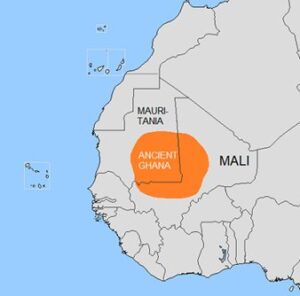
PHOTO CAPTION: The map shows the location of the ancient empire of Ghana. SOURCE: EA Library.
OVERVIEW
The Ghana Empire, traditionally known by the Soninke name Wagadu, was one of the earliest major states to emerge in the western Sahel and is generally regarded as the first of the great medieval West African empires. It developed within the historical region often referred to as the Western Sudan, a term used by historians and geographers for the broad savanna belt stretching across parts of West Africa south of the Sahara. This region should not be confused with the modern Republic of Sudan in northeastern Africa.
The empire emerged over several centuries, probably reaching political prominence by the early first millennium CE and flourishing particularly between about the eighth and eleventh centuries. At its height, its influence extended across parts of what are today southeastern Mauritania, western Mali and eastern Senegal. Its strategic location between the Sahara and the agricultural lands to the south enabled it to benefit enormously from the expanding trans-Saharan trade that connected West Africa with North Africa and the wider Mediterranean world.
Despite sharing its name with the modern Republic of Ghana, the Ghana Empire was not located within the territory of present-day Ghana. The modern country adopted the name Ghana at independence in 1957 as a deliberate reference to the historical achievements and political heritage of the medieval West African state. The historical Ghana Empire itself was situated considerably farther north and west, in the western Sahel.
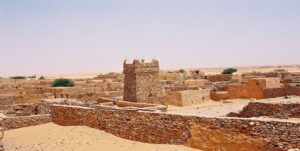
PHOTO CAPTION: Overview of Ancient Ghana Empire. SOURCE: EA Library.
ORIGIN AND EARLY HISTORY
The Ghana Empire, also known as Wagadou, was the first great empire to emerge in the western Sudan and is regarded as one of the earliest and most influential civilizations in West African history. It developed between the 4th and 8th centuries CE through the gradual unification of various Soninke clans living in the Sahel, the semi-arid region between the Sahara Desert and the Niger and Sénégal Rivers. This unification created a strong and stable political organization capable of defending its people, expanding its territory, and controlling the lucrative trade routes that crossed the Sahara Desert.
The empire derived its strength from its favourable geographical location. Situated between the rich goldfields of West Africa and the salt mines of the Sahara, Ghana became the principal link between sub-Saharan Africa and the Mediterranean world. Merchants travelling across the Sahara transported gold, salt, ivory, kola nuts, leather, and other valuable commodities. By controlling these important trade routes and imposing taxes on goods entering and leaving its territory, the rulers of Ghana accumulated enormous wealth and transformed their kingdom into one of the richest states in medieval Africa.
The name “Ghana” was not the original name of the empire but rather the royal title of its kings. In the Soninke language, the title is commonly interpreted to mean “Warrior King,” reflecting the military strength and authority of the empire’s rulers. The people themselves referred to their kingdom as Wagadou, while Arab geographers and Muslim merchants who visited or wrote about West Africa called it Ghana, the name by which the empire became known throughout history.
The Ghana Empire was located primarily in what is now southeastern Mauritania and western Mali, although its influence extended into parts of present-day Senegal. From this strategic position, it controlled the major caravan routes that connected the forests and gold-producing regions of West Africa with the commercial centres of North Africa. Camel caravans carrying goods regularly crossed the Sahara, bringing North African merchants into contact with the people of Ghana. These commercial exchanges also facilitated the spread of new ideas, technologies, and religious beliefs.
According to oral traditions and archaeological evidence, the Soninke people gradually developed a centralized political system under the leadership of a powerful king. The empire’s rulers established their capital at Kumbi Saleh, which eventually became one of the largest and wealthiest cities in West Africa. The city consisted of two distinct sections: the royal city, where the king, his court, and government officials resided, and a separate commercial quarter inhabited largely by Muslim merchants from North Africa. This arrangement reflected both the political authority of the Soninke rulers and the importance of international trade.
As trade expanded, the rulers of Ghana introduced an efficient system of taxation and administration. Taxes were collected on imported and exported goods, particularly gold and salt, providing the government with substantial revenue. This wealth enabled the kings to maintain a large and well-trained army, build their capital, and protect trade routes from bandits and rival states. Military strength also allowed Ghana to conquer neighbouring territories and extend its influence across much of the western Sudan.
The empire reached its greatest prosperity between the 9th and 11th centuries CE, becoming the dominant political and economic power in West Africa. During this period, Ghana controlled extensive territories and numerous subordinate kingdoms that paid tribute to its rulers. The empire’s prosperity attracted merchants, scholars, and travellers from across North Africa and the Islamic world.
One of the most important sources of information about the Ghana Empire comes from Arab scholars and geographers, including Al-Bakri, who wrote detailed descriptions of the empire in the 11th century. Although he never visited Ghana himself, Al-Bakri relied on the accounts of merchants and travellers to describe its wealth, powerful monarchy, prosperous markets, and extensive trade networks. His writings portray Ghana as a well-organized state whose rulers commanded great respect and possessed considerable riches.
Although the rulers of Ghana maintained their traditional African religious beliefs, they welcomed Muslim merchants into the empire because of the economic benefits they brought. As a result, Islam spread gradually among traders and residents of the commercial towns, while the royal court and much of the rural population continued to practise indigenous African religions. This peaceful coexistence of different religious traditions contributed to the empire’s stability and commercial success.
The rise of the Ghana Empire marked the beginning of large-scale state formation in West Africa. Its centralized government, strong military, effective taxation system, and control of the trans-Saharan trade laid the foundations for the later emergence of the Mali and Songhai Empires, both of which inherited many of Ghana’s political, economic, and commercial traditions.
By the end of the 11th century, however, Ghana began to experience increasing challenges from external invasions, shifting trade routes, environmental pressures, and internal political weaknesses. Although its influence gradually declined during the 12th century, the empire’s achievements in governance, trade, and state-building left a lasting legacy that shaped the history of West Africa for centuries. Today, the Ghana Empire is remembered as the first great empire of the western Sudan and one of the earliest centres of political organization, commerce, and civilization in sub-Saharan Africa.
POLITICAL ORGANIZATION AND GOVERNANCE
The Ghana Empire developed one of the earliest and most effective systems of government in West Africa. Its political success rested on strong centralized leadership, an efficient administrative structure, a powerful military, and effective control of the trans-Saharan trade routes. These institutions enabled the empire to maintain law and order, expand its territory, protect commerce, and exercise authority over a vast region for several centuries.
The supreme ruler of the empire bore the royal title “Ghana,” which is commonly interpreted to mean “Warrior King.” The king was regarded as the highest political, military, judicial, and religious authority in the empire. He was responsible for making laws, directing military campaigns, settling disputes, collecting tribute, appointing officials, and maintaining peace throughout the kingdom. His authority was widely respected, and he was regarded as both the protector of the people and the symbol of the empire’s unity and prosperity.
The king ruled from the imperial capital of Kumbi Saleh, where he presided over a magnificent royal court. According to Arab writers, the royal palace was richly decorated and surrounded by impressive buildings that reflected the wealth and prestige of the empire. The court served as the centre of government, where ambassadors, merchants, provincial rulers, and foreign visitors came to pay tribute, seek justice, or negotiate diplomatic and commercial agreements.
One of the king’s most important responsibilities was the administration of justice. He personally heard important cases, settled disputes among his subjects, and ensured that law and order were maintained throughout the empire. The Ghanaian legal system was based primarily on customary laws and traditional Soninke practices, although Muslim communities living in the commercial towns often settled personal and commercial disputes according to Islamic law. This dual legal system allowed different religious communities to coexist peacefully while respecting each other’s traditions.
Although the king possessed extensive powers, he did not govern alone. He was assisted by a council of advisers made up of senior officials, members of the royal family, military commanders, religious leaders, and trusted elders. This council advised the king on important matters such as warfare, diplomacy, taxation, succession, and the administration of the empire. Their experience and wisdom helped ensure continuity and stability in government.
To administer its vast territories effectively, the Ghana Empire adopted a decentralized system of provincial administration. The empire was divided into provinces and tributary states, each governed by local chiefs or governors. Many conquered territories were allowed to retain their own rulers, provided they recognized the authority of the Ghana king, paid annual tribute, and supplied soldiers when required. This arrangement enabled the empire to govern a large and culturally diverse population without constant military intervention.
Tributary rulers enjoyed a degree of local autonomy but remained accountable to the central government. They were responsible for collecting taxes, maintaining security, administering justice within their territories, and ensuring loyalty to the king. If a provincial ruler rebelled or refused to pay tribute, the king could send his army to restore order and replace the disobedient leader.
The Ghana Empire maintained a large and disciplined military, which was essential to its political organization and survival. Historical accounts suggest that the empire could mobilize tens of thousands of soldiers during times of war. The army consisted mainly of infantry armed with spears, bows and arrows, swords, and shields, while cavalry units were used where horses could be maintained. The military protected trade routes, defended the empire against external attacks, suppressed rebellions, and expanded Ghana’s territory through conquest.
Military strength also enabled the empire to control the profitable trans-Saharan trade routes, which formed the backbone of its economy. The government stationed soldiers along important caravan routes to ensure the safety of merchants travelling across the Sahara Desert. This protection encouraged trade and increased government revenue through taxes collected on imported and exported goods.
Taxation formed another important aspect of Ghana’s political administration. The government imposed customs duties on goods entering and leaving the empire, particularly gold, salt, copper, and other valuable commodities. Merchants were required to pay taxes before conducting business, while conquered states paid tribute in the form of goods, livestock, or precious metals. These revenues financed the royal court, maintained the army, supported government officials, and funded public administration.
Diplomacy was another key feature of Ghana’s political system. The empire maintained peaceful relations with neighbouring kingdoms and established commercial and diplomatic ties with North African Muslim states. As trade expanded, foreign merchants and ambassadors regularly visited Kumbi Saleh to negotiate trade agreements and strengthen political relationships. These diplomatic connections enhanced Ghana’s international reputation and promoted economic growth.
By the eleventh century, the increasing presence of Muslim merchants had also influenced the administration of the empire. Although the kings continued to practise traditional African religion, they recognized the value of educated Muslim officials. Many Muslims served as interpreters, scribes, accountants, financial administrators, and diplomatic advisers. Because they were literate in Arabic, they kept official records, managed commercial transactions, prepared correspondence, and facilitated communication with foreign merchants and rulers. Their expertise greatly improved the efficiency of government administration without undermining the empire’s indigenous political institutions.
The Ghana Empire’s system of governance was characterized by a careful balance between central authority and local autonomy. While the king exercised supreme power, provincial rulers retained responsibility for local administration, provided they remained loyal to the empire. This flexible administrative structure enabled Ghana to govern a large and ethnically diverse population while maintaining political stability for several centuries.
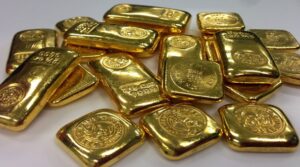
PHOTO CAPTION: Bars of Gold. SOURCE: EA Library.
ECONOMIC SYSTEM
The Ghana Empire, often referred to as the “Land of Gold,” became one of the wealthiest states in medieval Africa through its control of the trans-Saharan trade. Rather than controlling all the gold mines directly, the empire dominated the major trade routes linking the gold-producing regions of West Africa with the salt mines of the Sahara and the markets of North Africa. Gold, salt, ivory, kola nuts, and other commodities were exchanged for textiles, copper, beads, horses, and luxury goods brought by North African and Arab merchants.
The empire also benefited from its own natural resources, particularly gold from the Bambuk region and iron ore, which supported local industries and trade.
The economy of the Ghana Empire was one of the most sophisticated and prosperous in early West Africa. Its prosperity rested on a combination of long-distance trade, gold production, agriculture, livestock rearing, craft industries, taxation, and control of strategic commercial routes. The empire’s geographical position between the Sahara Desert and the gold-producing regions farther south gave its rulers an exceptional advantage in the trans-Saharan trade. By regulating this commerce and taxing merchants who passed through its territory, Ghana accumulated considerable wealth and emerged as a major economic power between the eighth and eleventh centuries.
Gold and the Gold Trade
Gold was the most important commodity in the economy of the Ghana Empire. The empire itself controlled access to important gold-producing areas, although many of the richest goldfields lay farther south of the core territory. Gold from regions such as Bambuk and surrounding areas entered the commercial networks controlled by Ghana and was transported northward through the trans-Saharan trade.
Gold was valuable not only because of its beauty but also because it was widely accepted in long-distance commerce. North African and Mediterranean merchants had a strong demand for West African gold, which was exchanged for salt, textiles, copper, horses, and other commodities.
One distinctive feature of Ghana’s economic system was the royal regulation of gold. According to medieval Arabic accounts, the king claimed ownership of gold nuggets, while ordinary merchants were generally permitted to trade in gold dust. This policy has often been described as a means of controlling the supply of gold in circulation. By reserving larger gold nuggets for the monarchy while allowing gold dust to circulate commercially, the rulers could exercise greater control over this valuable resource and strengthen the financial position of the state.
Salt Trade
Salt was another essential commodity in the Ghanaian economy. Although salt deposits existed in the Sahara, it was relatively scarce in the wetter regions farther south. It was therefore highly valued for food preservation, human consumption, and other purposes.
Large quantities of salt were transported southward across the Sahara by camel caravans and exchanged for gold and other products. Ghana’s rulers benefited from this trade by taxing merchants and regulating commercial activities within their territory. The exchange of gold from the south for salt from the north became one of the defining features of the trans-Saharan economy.
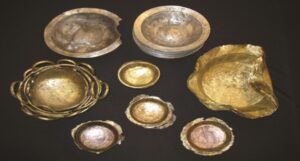
PHOTO CAPTION: Brass workings as medium of exchange. SOURCE: EA Library.
Copper and Other Commodities
Copper was another valuable commodity traded within the region. It was imported into West Africa from North African and Saharan sources and was used for ornaments, tools, household objects, and other purposes. Copper may also have functioned as a medium of exchange in some commercial transactions, alongside other forms of payment such as gold dust.
Other commodities circulating through Ghana’s markets included:
- Ivory
- Kola nuts
- Leather and animal hides
- Ostrich feathers
- Iron products
- Textiles
- Beads
- Agricultural produce
- Livestock
The diversity of commodities demonstrates that Ghana’s economy was not dependent on gold alone. Rather, it formed part of a broad commercial network connecting different ecological zones of West Africa with North Africa.
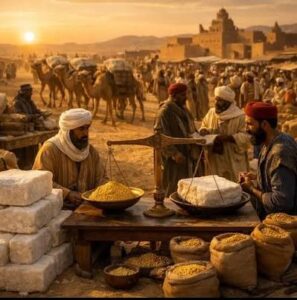
PHOTO CAPTION: Merchants trading in Ghana Empire. SOURCE: EA Library.
Trans-Saharan Trade
The trans-Saharan trade was the principal source of Ghana’s international wealth. The empire occupied a strategically important position along routes crossing the Sahara and connecting West African producers with merchants from North Africa.
Before the widespread use of camels, desert travel was extremely difficult. The increasing use of camel caravans made it possible for merchants to transport large quantities of goods across the Sahara. Caravans travelled between commercial centres in North Africa and West African markets, carrying salt, copper, textiles, horses, and manufactured goods southward and returning with gold, ivory, and other African products.
Ghana’s rulers did not necessarily control every stage of this vast trading system. Rather, their power came largely from controlling territory through which major trade routes passed, protecting commercial activity, and taxing merchants and goods moving through the empire.
Taxation and Customs Duties
One of the most important ways in which the Ghanaian government generated revenue was through customs duties and taxes on trade. Merchants entering or leaving the empire were required to pay duties on the goods they carried. According to medieval accounts, taxes could be imposed on both imports and exports.
These revenues provided the government with the resources necessary to maintain the royal court, support officials, finance the military, and administer the empire. The taxation of commerce therefore created a mutually beneficial relationship: merchants gained access to protected markets and secure trade routes, while the state received revenue from commercial activity.
Agriculture
Although long-distance trade was central to Ghana’s wealth, agriculture remained the foundation of everyday economic life. The majority of the population lived in rural communities and depended on farming for food and livelihoods.
Farmers cultivated crops suited to the Sahelian environment, including millet, sorghum, beans, and other grains and vegetables. Agriculture was particularly important around areas with access to rivers, seasonal streams, and fertile soils.
The agricultural population produced food not only for local consumption but also for markets in growing towns. Agricultural surpluses helped support urban populations, soldiers, merchants, artisans, and the royal court.
Livestock and Pastoralism
Livestock rearing was another important component of the economy. Communities kept cattle, sheep, goats, and other animals. Livestock provided meat, milk, leather, hides, and other useful products.
Pastoral groups also participated in regional trade, exchanging animals and animal products for agricultural goods, salt, textiles, and other commodities. Livestock could also serve as a measure of wealth and social status.
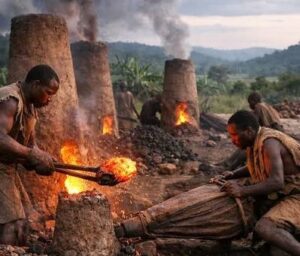
PHOTO CAPTION: Iron smelting in the Ghana Empire. SOURCE: EA Library.
Craft Production and Manufacturing
The Ghana Empire also supported a variety of craft industries. Skilled artisans produced goods for domestic consumption and trade. Blacksmiths manufactured agricultural implements, weapons, knives, and other iron tools. Potters produced cooking vessels, storage containers, and household utensils, while leatherworkers processed hides into clothing, bags, footwear, and other products.

PHOTO CAPTION: Skilled blacksmiths transformed raw iron into essential tools. SOURCE: EA Library.
Goldsmiths and other metalworkers produced jewellery, ornaments, and decorative objects. Weavers and textile workers produced cloth for clothing and commercial exchange.
Craft specialization contributed to the growth of urban markets and provided employment for large sections of the population.
Markets and Commercial Centres
Markets were essential to the functioning of the Ghanaian economy. They brought together farmers, pastoralists, artisans, merchants, and consumers, allowing people to exchange goods produced in different ecological regions.
The capital, Kumbi Saleh, developed into a major commercial centre. The city was particularly important because it brought together the political authority of the royal court and the commercial activities of Muslim and other long-distance merchants.
The commercial section of the city was home to foreign merchants, particularly Muslims from North Africa and other parts of the Islamic world. Their presence strengthened Ghana’s connections with the wider trans-Saharan economy.
The Role of the King in the Economy
The king played a central role in regulating the empire’s economy. His authority extended to trade, taxation, natural resources, markets, and the protection of commercial routes. The royal control of gold nuggets was particularly significant because it demonstrated the monarchy’s interest in regulating the most valuable commodity in the economy.
The king also used revenue from taxation and trade to maintain a strong army. The army protected the empire’s territory and trade routes, suppressed rebellions, and helped secure the commercial environment upon which Ghana’s prosperity depended.
Economic Relationship with North Africa
Ghana’s economic influence extended far beyond West Africa. Its gold attracted merchants from Morocco, Algeria, and other parts of North Africa, while North African traders brought salt, copper, textiles, horses, and manufactured goods southward.
These commercial relationships also encouraged the movement of people, ideas, technologies, languages, and religious beliefs. Muslim merchants introduced Islamic cultural influences into Ghana’s urban centres, while West African commodities, especially gold, became increasingly important in the wider economy of the Islamic world.
Economic Importance and Legacy
The economic system of the Ghana Empire was based on a successful combination of local production and international commerce. Agriculture and livestock supported the population, while artisans supplied tools and manufactured goods. At the same time, control over strategic trade routes enabled the monarchy to benefit from the enormous trans-Saharan trade in gold, salt, copper, ivory, and other commodities.
The government’s ability to tax trade, regulate gold, protect merchants, and administer commercial centres generated the wealth necessary to sustain a powerful state. This economic model contributed significantly to Ghana’s political strength and helped establish it as the first great empire of the western Sudan.
The commercial institutions developed under Ghana also provided an important foundation for the later Mali and Songhai Empires. The continued importance of gold, salt, taxation, caravan trade, and commercial cities in these later empires demonstrates the enduring economic legacy of Ghana’s civilization.
SOCIAL STRUCTURE AND DAILY LIFE
The Ghana Empire had a well-organized social structure that contributed to its political stability, economic prosperity, and cultural development. Society was organized into a clear hierarchy, with each social group performing specific political, economic, and social functions. Although social status often depended on birth and occupation, individuals could also gain wealth and influence through trade, military service, or government appointments. This structured society enabled the empire to function efficiently and maintain order across its vast territories.
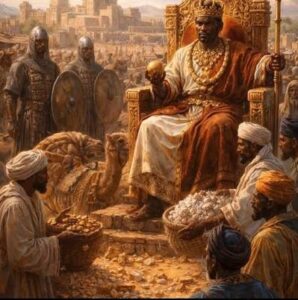
PHOTO CAPTION: The Ghana Empire was founded on a well-organised system of government. SOURCE: EA Library.
At the top of the social hierarchy was the king, who bore the royal title “Ghana” or “Warrior King.” The king was regarded as the supreme political, military, judicial, and religious authority. He was responsible for governing the empire, administering justice, protecting trade routes, leading military campaigns, and maintaining peace and security. The king lived in a magnificent royal palace at Kumbi Saleh, surrounded by members of the royal family, court officials, guards, and attendants. His wealth and authority were symbols of the empire’s strength, and he was treated with great respect by both his subjects and foreign visitors.
Immediately below the king were the royal family, nobles, and senior government officials. These included provincial governors, military commanders, judges, tax collectors, and advisers who assisted in administering the empire. Provincial governors supervised local administration, collected tribute, maintained law and order, and ensured loyalty to the central government. Military commanders organized the empire’s defence and protected the important trans-Saharan trade routes from invasion and bandit attacks.
An influential group within Ghanaian society consisted of merchants and traders. Because the empire controlled the trans-Saharan trade, merchants accumulated considerable wealth and social status. They traded valuable commodities such as gold, salt, ivory, leather, kola nuts, copper, and textiles with merchants from North Africa and other parts of West Africa. Muslim merchants, many of whom settled in the commercial districts of Kumbi Saleh and other trading centres, also served as interpreters, accountants, and advisers because of their literacy and commercial expertise.
Farmers and herders formed the largest section of the population and constituted the backbone of the empire’s economy. Most people lived in rural villages where they cultivated crops such as millet, sorghum, beans, rice, and vegetables. The fertile lands along rivers and seasonal rainfall supported agricultural production, while pastoral communities raised cattle, sheep, goats, and camels. Livestock provided meat, milk, hides, and transport and were also regarded as symbols of wealth and social status.
Skilled artisans and craftsmen occupied an important place in Ghanaian society. Blacksmiths produced farming tools, weapons, and household implements that were essential for agriculture and warfare. Goldsmiths crafted jewellery and ornaments from the empire’s abundant gold resources, while leatherworkers, potters, weavers, carpenters, and woodcarvers manufactured clothing, footwear, pottery, furniture, baskets, and decorative objects. Many of these products were sold in local markets or exchanged through regional and trans-Saharan trade networks.
At the lower end of the social hierarchy were slaves and servants. Many enslaved people were prisoners captured during wars, while others became enslaved because of debt or as punishment for certain crimes. They worked mainly in agriculture, domestic service, mining, construction, and the care of livestock. Some served in the households of wealthy families or the royal court, while others worked on farms or assisted in commercial activities. Although slavery existed within the Ghana Empire, its nature often differed from later forms of plantation slavery, as some enslaved persons could acquire property, marry, or eventually obtain their freedom under certain circumstances.
Family life was the foundation of Ghanaian society. Most people lived in extended family households, where several generations shared responsibilities for farming, raising children, and caring for elderly relatives. Respect for parents and elders was deeply rooted in society because they preserved traditions, settled family disputes, and transmitted cultural knowledge to younger generations. Marriage was highly valued and often strengthened social ties between families and communities.
Women played vital roles in both the family and the economy. They managed households, prepared food, cared for children, fetched water and firewood, and participated actively in farming. Women also engaged in local trade by selling agricultural produce, pottery, cloth, and other goods in village and urban markets. In some communities, women became successful traders and contributed significantly to household income and the local economy.
Most people lived in round or rectangular houses constructed from mud bricks with thatched roofs, using locally available materials that suited the climate of the Sahel. Homes were usually grouped into family compounds surrounded by courtyards where cooking, weaving, food processing, and other daily activities took place. Larger settlements developed around markets, administrative centres, and trading routes.
Daily life revolved around agriculture, livestock rearing, trade, hunting, fishing, craft production, and family responsibilities. Men generally undertook activities such as farming, hunting, herding, long-distance trading, and military service, while women combined household duties with farming, food processing, weaving, pottery, and market trading. Children assisted their parents with domestic chores and agricultural work while learning practical skills and cultural traditions from older family members.
Markets played a central role in everyday life. They were not only places where people bought and sold goods but also important centres for social interaction, communication, and cultural exchange. Merchants, farmers, artisans, and travellers gathered regularly to exchange products, share news, settle disputes, and participate in festivals and ceremonies. The bustling markets of Kumbi Saleh and other towns reflected the prosperity and cosmopolitan character of the empire.
Religion also influenced daily life. While the royal court and most rural communities continued to practise traditional African religions, Muslim merchants living in commercial towns observed Islamic customs and built mosques for worship. The peaceful coexistence of indigenous beliefs and Islam encouraged tolerance and strengthened commercial relations with North Africa.
Education was primarily informal and based on oral tradition. Parents, elders, and professional storytellers known as griots taught children the history, customs, laws, moral values, and traditions of their people. Through songs, poems, proverbs, and storytelling, griots preserved the history of the kingdom and passed it from one generation to the next. In Muslim communities, children also attended Qur’anic schools where they learned to read and write Arabic and studied Islamic teachings.
Overall, the social structure and daily life of the Ghana Empire reflected a well-organized and prosperous society built upon strong family values, productive agriculture, thriving commerce, skilled craftsmanship, and cultural diversity. Every social group from kings and nobles to farmers, merchants, artisans, and labourers played an important role in sustaining the empire’s political stability and economic success. This harmonious organization of society was one of the key factors that enabled the Ghana Empire to flourish as the first great civilization of the western Sudan for several centuries.

PHOTO CAPTION: Traditional Worship in Ghana Empire. SOURCE: EA Library.
RELIGION AND BELIEF SYSTEMS
The religious and belief systems of the Ghana Empire (Wagadu) were diverse and reflected the interaction between indigenous West African traditions and the growing influence of Islam. The majority of the population followed indigenous religious traditions centred on a supreme creator, spiritual beings, sacred places, ancestors and various forms of ritual practice. At the same time, Islam became increasingly influential, particularly among merchants, scholars and sections of the urban population. Rather than immediately replacing indigenous beliefs, Islam existed alongside them for several centuries, creating a religiously diverse society.
Indigenous Religious Traditions
Before and during the rise of Islam, the Soninke and neighbouring peoples of Wagadu practised indigenous religious traditions that recognised a supreme creator together with a range of spiritual powers associated with nature, ancestors, communities and particular places. The precise beliefs and names of deities varied, and much of the evidence comes from later oral traditions and external accounts, so it is important not to impose a rigid or uniform religious system on the entire population.
Spiritual forces were believed to influence important aspects of life, including agriculture, rainfall, fertility, health, warfare and political prosperity. Sacred groves, rivers, hills and other natural features could have religious significance. Rituals and offerings were performed to maintain harmony between the human community and the spiritual world.
Ancestor Veneration
Ancestors occupied an important place in indigenous religious life. They were commonly regarded as continuing members of the community who could influence the welfare and fortunes of their descendants. Respect for ancestors was therefore connected to family identity, social authority and community traditions.
Rituals associated with ancestors could include offerings, prayers, commemorative ceremonies and other forms of observance. Such practices helped reinforce family relationships and social continuity while linking living generations with those who had gone before them.
The Religious Role of the King
The ruler of Ghana, known by the title Ghana, possessed not only political and military authority but also important ritual and religious responsibilities. Kingship was closely connected with the spiritual well-being of the state, and the prosperity of the kingdom was believed to depend partly upon the ruler’s ability to maintain proper relationships with the spiritual powers recognised by society.
The king therefore participated in ceremonies and rituals intended to secure rainfall, agricultural fertility, protection, military success and the general welfare of the kingdom. His religious responsibilities reinforced his political legitimacy and helped present kingship as an institution with both earthly and spiritual dimensions.
This religious role should not, however, be understood as evidence that the king was necessarily regarded as a god. Rather, the ruler functioned as an important intermediary between the political community and the spiritual order within the indigenous religious framework.
The Arrival and Growth of Islam
Islam reached the western Sudan primarily through trans-Saharan commercial networks, rather than through a single military invasion. Muslim merchants, scholars and travellers from North Africa and the Sahara established contacts with the Ghana Empire as long-distance trade expanded. These interactions became particularly important from the eighth and ninth centuries onwards.
The original statement that Muslim “invaders entered the empire in the mid-600s CE” should therefore be treated with caution. Although Arab-Muslim expansion into North Africa began in the seventh century, there is insufficient evidence to describe this as a Muslim invasion of the Ghana Empire during the mid-seventh century. Islam’s early presence in Ghana was more closely associated with trade, migration and the establishment of Muslim merchant communities.
Muslim merchants were attracted to Ghana because of its strategic position within the gold and trans-Saharan trade. Some settled permanently in commercial centres and established communities that maintained connections with North Africa and other parts of the Islamic world.
Religious Tolerance and Coexistence
One of the notable characteristics of Ghana was the coexistence of Islam with indigenous religious traditions. The ruling establishment did not immediately impose Islam on the wider population. Instead, Muslim communities appear to have been permitted to practise their religion while the royal court and much of the indigenous population continued to observe established religious traditions.
This arrangement was practical as well as political. Muslim merchants were important participants in the trans-Saharan economy, and maintaining a favourable environment for them helped the Ghanaian rulers benefit from international commerce. Muslim traders and scholars could also provide valuable services as scribes, interpreters, diplomats and advisers.
The result was a religiously plural society in which Islam became particularly prominent in commercial and urban settings while indigenous traditions remained deeply rooted in the wider population.
Muslim Communities and Mosques at Koumbi Saleh
Koumbi Saleh, the principal urban centre associated with Ghana, became an important meeting place for Muslim merchants and indigenous communities. Archaeological evidence indicates the presence of a substantial settlement and extensive commercial activity, although some traditional claims concerning the exact number and character of its mosques should be treated cautiously.
The often-repeated statement that Koumbi Saleh contained twelve mosques comes from interpretations of medieval accounts and later historical reconstructions, but the archaeological evidence does not allow us to establish this figure with certainty. It is safer to state that Muslim communities and places of worship were established in the city, demonstrating the growing presence of Islam within Ghana’s commercial centres.
Islam and the Ruling Elite
Islam appears to have had a particularly strong influence among merchants and sections of the urban elite. Muslim scholars and traders possessed literacy in Arabic and maintained connections with Islamic centres across the Sahara and North Africa. Their knowledge made them useful to the royal administration, especially in areas such as record-keeping, diplomacy, correspondence and commercial transactions.
However, the presence of Muslim officials at the royal court did not mean that the Ghanaian monarchy had become fully Islamic. Medieval Arabic accounts suggest that indigenous religious practices remained important at the royal court even while Muslim communities lived within the kingdom.
This coexistence illustrates an important feature of the political history of medieval West Africa: Islam could become influential within a state without immediately displacing indigenous religious institutions and practices.
The Almoravid Movement and Religious Change
The Almoravids, a reformist Islamic movement that emerged among Sanhaja Berber communities of the western Sahara, became an important political and religious force in the eleventh century. Their expansion affected the wider political and commercial environment in which Ghana operated.
The traditional account that the Almoravids captured Koumbi Saleh in 1076 and converted the empire to Islam is now regarded as too simplistic. Medieval Arabic sources associate the Almoravid expansion with the weakening of Ghana, but the nature and extent of Almoravid military intervention in Ghana remain debated among historians. There is also insufficient evidence to conclude that the Almoravids simply conquered the entire Ghana Empire in 1076.
Nevertheless, the eleventh century witnessed significant political and religious changes in the western Sahel. The expansion of Almoravid influence, the increasing importance of Muslim commercial networks and changing patterns of trans-Saharan trade contributed to the growing prominence of Islam in the region.
Religion, Society and Cultural Interaction
The coexistence of indigenous religions and Islam contributed to broader cultural exchange within Ghana. Muslim communities introduced or strengthened the use of Arabic literacy, Islamic scholarship and connections with the wider Islamic world. Through trade and intellectual contacts, ideas concerning law, education, administration and commerce circulated between West Africa and North Africa.
At the same time, indigenous religious traditions remained important to the social and political organisation of local communities. Rather than viewing the two religious systems as completely separate, it is more accurate to recognise a long period of interaction, adaptation and coexistence.
CULTURAL AND INTELLECTUAL LIFE
The Ghana Empire, or Wagadu, was not only an important political and commercial power but also a significant centre of cultural interaction, knowledge exchange and intellectual development in medieval West Africa. Its strategic position between the Sahara and the lands farther south placed it at the crossroads of African commercial and cultural networks. Through long-distance trade, migration and contact with Muslim merchants and scholars from North Africa, the empire became a meeting point where indigenous Soninke traditions interacted with Islamic influences and ideas from across the Sahara.
Indigenous Soninke Cultural Heritage
The cultural foundations of the Ghana Empire were rooted in the traditions of the Soninke people, whose language, social institutions, oral traditions and religious practices shaped the character of Wagadu. As with many pre-literate societies, knowledge was transmitted extensively through oral traditions, including stories, genealogies, proverbs, praise poetry and accounts of political and social events.
Oral tradition played an important role in preserving knowledge of ancestral lineages, royal authority, community origins, moral values and customary practices. Elders and other custodians of tradition served as repositories of collective memory, passing knowledge from one generation to another. These traditions were not simply forms of entertainment; they helped communities understand their history, reinforce social responsibilities and preserve cultural identity.
The later Wagadu traditions and epics associated with the Soninke provide an important example of how historical memory surrounding the ancient kingdom was preserved and transmitted. Although such traditions were recorded in later periods and cannot be treated as straightforward contemporary accounts of medieval Ghana, they remain valuable sources for understanding the cultural memory and worldview associated with Wagadu.
Cultural Exchange through Trans-Saharan Trade
Ghana’s participation in trans-Saharan commerce created opportunities for sustained cultural exchange. Merchants travelling between West Africa and North Africa carried much more than gold, salt and other commodities. They also transmitted languages, religious ideas, literary traditions, technologies, commercial practices and forms of knowledge.
The movement of people across the Sahara connected communities in the western Sahel with North African and wider Islamic societies. Muslim merchants and scholars who settled in Ghanaian towns became important intermediaries between different cultural worlds. Their presence introduced new intellectual and administrative traditions while also exposing West African societies to developments taking place elsewhere in the Islamic world.
Consequently, the commercial importance of Ghana contributed to its emergence as a cultural crossroads, where African and Islamic traditions encountered and influenced one another.
The Influence of Islam and Arabic Literacy
One of the most significant intellectual influences on Ghana was the gradual expansion of Islam. Muslim communities were established particularly in commercial centres, where merchants required networks of trust, contracts, correspondence and legal knowledge extending across the Sahara.
Islam brought with it the use of Arabic as a written language, providing new possibilities for record-keeping, correspondence, scholarship and diplomacy. Muslim scholars and literate officials could serve the royal administration as scribes, interpreters and advisers. Arabic literacy also strengthened Ghana’s connections with the wider Islamic world.
It is important, however, not to suggest that Ghana possessed a fully developed Islamic educational system comparable to the later scholarly centres of Timbuktu and Djenné. The evidence for intellectual life in Ghana is considerably more limited. Rather, Ghana should be understood as an early stage in the development of the intellectual and commercial networks that later contributed to the flourishing of Islamic scholarship in West Africa.
Indigenous and Islamic Knowledge Systems
The intellectual environment of Ghana was characterised by the coexistence of indigenous knowledge systems and Islamic learning. Indigenous communities possessed extensive practical knowledge concerning agriculture, animal husbandry, metallurgy, environmental management, medicine, architecture and trade. Much of this knowledge was transmitted orally and through apprenticeship.
Farmers developed knowledge of soils, rainfall patterns, crops and seasonal cycles; pastoral communities possessed specialised knowledge of livestock and grazing environments; artisans transmitted technical skills through generations; and healers drew upon knowledge of medicinal plants and other natural resources.
Islamic scholars and merchants, meanwhile, contributed knowledge associated with Arabic literacy, Islamic law, religious scholarship, mathematics, commerce and administration. These different knowledge traditions did not necessarily exist in opposition. Their interaction created opportunities for adaptation and exchange, particularly in urban and commercial environments.
Koumbi Saleh as a Cultural Meeting Point
Koumbi Saleh, the principal urban centre associated with the Ghana Empire, was an important centre of cultural and commercial interaction. Archaeological evidence indicates that the settlement contained substantial residential and commercial areas and participated in long-distance trade.
Medieval Arabic accounts describe a significant Muslim community associated with the city. The commonly repeated description of Koumbi Saleh as having a strictly divided “Muslim quarter” and “royal quarter” should be treated with some caution, since archaeological interpretations of the city’s layout remain debated. Nevertheless, there is strong evidence that Muslim merchants lived and worshipped within the wider urban environment while the indigenous political establishment maintained its own traditions.
This arrangement illustrates Ghana’s capacity to accommodate different cultural and religious communities within an interconnected commercial centre. Muslim merchants could participate in long-distance trade while the indigenous ruling establishment retained its political and religious authority.
Administration and Intellectual Skills
The growth of commerce encouraged the development of specialised skills in accounting, negotiation, diplomacy and administration. Muslim merchants and literate specialists could assist with written transactions and communication with trading partners beyond the Sahara.
The ability to maintain commercial relationships across considerable distances required sophisticated knowledge of weights, measures, prices, commodities, contracts and exchange practices. The Ghanaian state also needed officials capable of collecting taxes and customs duties and managing relations with merchants and subordinate communities.
These administrative practices demonstrate that the empire’s economic success depended upon more than access to natural resources. It required institutions and specialised knowledge capable of organising and regulating a complex political and commercial system.
Architecture and Urban Culture
The growth of settlements such as Koumbi Saleh reflected the development of an increasingly sophisticated urban culture. Buildings were constructed using locally available materials and techniques adapted to the Sahelian environment. Residential structures, commercial spaces and public areas supported the activities of a population engaged in agriculture, crafts, trade and administration.
Urban centres brought together people from different backgrounds, including farmers, pastoralists, merchants, artisans, political officials, religious specialists and travellers. Markets therefore functioned not only as places of economic exchange but also as spaces for social interaction and the transmission of cultural practices.
Music, Oral Tradition and Performing Arts
Music, storytelling, praise poetry and other forms of oral performance were important elements of cultural life. Oral specialists helped preserve collective memories, genealogies and accounts of important people and events.
Such traditions were particularly important in societies where written records were limited. Music, rhythm, poetry and storytelling provided effective means of transmitting historical knowledge, ethical principles and cultural values. These traditions subsequently became important components of the broader cultural heritage of Mande-speaking peoples.
Cultural Diversity and Religious Coexistence
The cultural life of Ghana reflected the interaction of indigenous African traditions with Islam. Indigenous religious practices remained important among the wider population and within the political establishment, while Islam gained influence among Muslim merchants and some members of the urban and elite communities.
Rather than producing an immediate cultural replacement, these interactions resulted in a prolonged period of adaptation and coexistence. Muslim communities maintained their religious practices, while the indigenous population continued to observe established customs and traditions. The Ghanaian rulers appear to have recognised the economic and diplomatic advantages of accommodating Muslim merchants without necessarily abandoning indigenous institutions.
This pattern of cultural interaction became an important characteristic of later West African states, including Mali and Songhai.
DECLINE AND FALL
The Ghana Empire (Wagadu) reached the height of its political and economic influence between approximately the ninth and eleventh centuries, when it exercised authority over a substantial area of the western Sahel and occupied a strategically important position within the trans-Saharan trading system. Its rulers derived considerable revenue from the taxation and regulation of commerce, while its military and political institutions enabled the state to maintain influence over neighbouring communities. From the late eleventh century onwards, however, Ghana’s power gradually weakened. The decline was not the result of a single event but of a combination of political, economic, environmental and external pressures that unfolded over several generations.
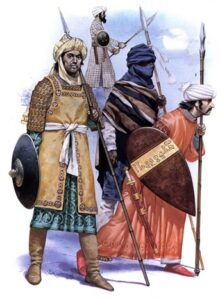
PHOTO CAPTION: The Almoravids. SOURCE: EA Library.
The Almoravid Expansion
The role of the Almoravids, a reformist Islamic movement that emerged among Sanhaja Berber communities of the western Sahara, has traditionally occupied a prominent place in explanations of Ghana’s decline. Earlier historians commonly claimed that the Almoravids invaded Ghana, captured and destroyed Koumbi Saleh in 1076 CE, and forced the population to convert to Islam. According to this interpretation, the Almoravid conquest brought about the rapid collapse of the empire.
Modern scholarship, however, regards this interpretation as too simple and problematic. The evidence for a complete Almoravid conquest and destruction of the Ghana Empire in 1076 is limited, and the surviving Arabic sources do not provide sufficient evidence for the traditional narrative in its entirety. The Almoravid movement certainly transformed the political and religious environment of the western Sahara and Sahel, but Ghana’s decline cannot confidently be attributed to a single Almoravid conquest.
The Almoravid expansion nevertheless formed part of a wider process of political change. Their rise affected Saharan trade networks, regional alliances and the balance of power between different states and communities. These developments placed additional pressures on Ghana at a time when its own political authority was already facing challenges.
Changes in Trans-Saharan Trade
Because Ghana’s prosperity was closely connected to trans-Saharan commerce, changes in the organisation and direction of trade could have significant consequences for the empire.
Ghana did not necessarily control the principal gold-producing regions directly. Instead, much of its economic strength came from its strategic position between the Sahara and the gold-producing areas farther south, allowing its rulers to regulate and tax merchants crossing their territory. As political conditions changed, however, alternative commercial routes and centres became increasingly important.
The emergence of other trading centres and changes in the organisation of Saharan commerce gradually reduced Ghana’s ability to monopolise or regulate trade as effectively as it had done during its period of greatest prosperity. As commercial networks shifted, the economic foundations that had supported the central government became less secure.
This process should not be understood as the sudden disappearance of trade. Trans-Saharan commerce remained highly important. Rather, Ghana’s relative position within those networks changed, weakening one of the principal sources of royal revenue and political influence.
Political Fragmentation and Weakening of Central Authority
Internal political developments also contributed to Ghana’s decline. The empire governed a large and diverse territory in which subordinate communities and local rulers possessed varying degrees of autonomy. Maintaining political cohesion required a strong central monarchy supported by military power, administrative institutions and economic resources.
As the resources available to the royal government declined, its ability to collect tribute, enforce political authority and maintain military control over distant territories may also have weakened. Rival leaders and subject communities had greater opportunities to assert their independence, reducing the effective extent of Ghanaian authority.
The weakening of central power did not necessarily mean that the entire state collapsed simultaneously. Instead, Ghana appears to have experienced a gradual contraction of political influence, with territories and communities increasingly operating beyond the effective control of the royal court.
Environmental and Agricultural Pressures
Environmental factors may also have contributed to the empire’s difficulties. Ghana’s economy depended not only on long-distance trade but also on agriculture and livestock production, which supported much of its population.
The Sahel is characterised by considerable climatic variability, and fluctuations in rainfall could affect agricultural yields, pasture availability and access to water. Periods of environmental stress could therefore place pressure on communities and increase competition for productive land and other resources.
It is difficult, however, to establish a single environmental event as the cause of Ghana’s decline. The available evidence suggests that environmental pressures should be considered one factor among several, rather than as a definitive explanation for the empire’s political transformation.
The Rise of Competing Powers
The weakening of Ghana created opportunities for other political centres to expand their influence. Among the most important was the Sosso Kingdom, which emerged as a significant regional power in the period following Ghana’s decline. The Sosso, associated with the broader Soninke and Mande political environment, challenged existing centres of authority and competed for control of territories and trade networks.
The emergence of the Sosso illustrates an important feature of Ghana’s decline: political power did not simply disappear. Instead, authority was redistributed among competing states and ruling groups across the western Sahel.
The subsequent rise of the Mali Empire in the thirteenth century marked an even more significant transformation. Under Sundiata Keita, Mali defeated the Sosso at the Battle of Kirina, traditionally dated to about 1235, and established itself as the leading power in the western Sudan. Mali subsequently incorporated or brought under its influence many territories and commercial networks that had previously been associated with Ghana and other regional states.
The Decline of Koumbi Saleh
The changing fortunes of Ghana were reflected in the history of Koumbi Saleh, which gradually lost its importance as the political and commercial centre of the region.
Archaeological evidence suggests that the settlement did not simply disappear immediately following a single military attack. Rather, its decline appears to have occurred within a broader process of political and economic transformation. As trade routes changed and Ghana’s political authority diminished, the city’s economic importance also declined.
The eventual abandonment or severe contraction of Koumbi Saleh symbolised the end of an era in which Ghana had occupied a central position in the western Sahelian trading system.
Ghana’s Absorption into the Emerging Mali World
By the thirteenth century, Ghana was no longer the dominant political power of the western Sudan. The expansion of Mali fundamentally altered the regional balance of power. Although the precise nature and timing of Mali’s control over former Ghanaian territories remain difficult to establish, Mali eventually became the principal imperial power in the region.
It is therefore more accurate to describe Ghana’s end as a long process of political contraction and absorption into new regional power structures rather than as a sudden collapse on a particular date. Elements of Ghanaian political culture, commercial practices and Soninke traditions continued within the societies that succeeded it.
Continuity after the Empire
The decline of Ghana did not mean the disappearance of the Soninke people or their cultural traditions. Communities associated with the former empire continued to inhabit the western Sahel and participate in regional commerce.
Likewise, political and economic practices developed during Ghana’s period of prominence influenced subsequent West African states. The importance of controlling trade routes, taxing commerce, maintaining military forces and managing relationships between central rulers and local communities remained characteristic of later empires.
The transition from Ghana to the Sosso and subsequently Mali therefore represents a process of political succession and transformation rather than a complete rupture. The knowledge, commercial connections and cultural traditions that had developed under Ghana continued to shape the history of the western Sudan.
Conclusion
The decline of the Ghana Empire was a gradual and multifaceted process rather than the consequence of one invasion or event. The rise of the Almoravids contributed to changes in the political and commercial environment, but the traditional claim that the Almoravids simply conquered and destroyed Ghana in 1076 is no longer considered an adequate explanation.
Changes in trans-Saharan trade, weakening central authority, competition from emerging political powers, possible environmental pressures and the gradual redistribution of economic and political influence all contributed to Ghana’s decline. The rise of the Sosso and, ultimately, the Mali Empire accelerated the transformation of the western Sahel’s political landscape.
By the thirteenth century, Ghana had ceased to be the dominant imperial power of the region. Nevertheless, its legacy endured. Its experience of state formation, commercial regulation, taxation, military organisation, urban development and cultural interaction helped establish important precedents for the later empires of Mali and Songhai. Ghana’s decline was therefore not simply the end of an empire but part of a broader historical transition that contributed to the emergence of successive centres of political and economic power in medieval West Africa.
EA EDITORS