THE KANEM–BORNU EMPIRE (c. 9th century–1893 CE)
- 8 Min Read
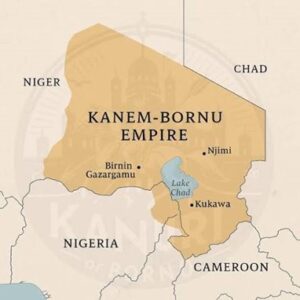
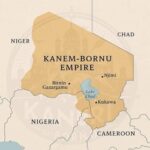
PHOTO CAPTION: The Map of Kanem-Bornu Empire. SOURCE: EA Library.
OVERVIEW
The Kanem–Bornu Empire traces its origins to around the 9th century CE, when the Kanembu people founded the Kingdom of Kanem east of Lake Chad.
The Kanem–Bornu Empire was one of Africa’s longest-lived pre-colonial states, maintaining political continuity for about a millennium despite relocating its political center from Kanem to Bornu during the late 14th century. It flourished for over one thousand years, from around the 9th century until 1893, making it one of Africa’s most enduring civilizations. The empire was centered around Lake Chad, covering parts of present-day Nigeria, Niger, Chad, Cameroon, and extending at times into Libya, Algeria, and Sudan. Its strategic location along the trans-Saharan trade routes enabled it to become a major commercial, political, and cultural center linking North Africa with sub-Saharan Africa.

PHOTO CAPTION: Lake Chad. SOURCE: EA Library.
Throughout its history, Kanem–Bornu developed a strong system of government, maintained a powerful military, and established close links with the Islamic world. It became renowned for its administrative efficiency, military strength, economic prosperity, and contributions to Islamic learning. The empire reached its greatest height during the reign of Mai Idris Alooma (c. 1571–1603), whose reforms strengthened every aspect of the state. Although it eventually declined because of internal conflicts, changing trade patterns, and foreign invasions, its influence continued to shape the political and cultural development of Central and West Africa.
ORIGIN AND EARLY HISTORY
The origins of the Kanem–Bornu Empire date back to around the 9th century CE, when the Kanembu people established the Kingdom of Kanem east of Lake Chad.
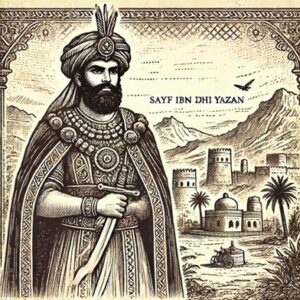
PHOTO CAPTION: Sayf ibn Dhi Yazan. SOURCE: EA Library.
The kingdom was ruled by the Sayfawa Dynasty, whose rulers claimed descent from the legendary Arab hero Sayf ibn Dhi Yazan, a tradition that enhanced the legitimacy and prestige of the royal family.
The kingdom expanded steadily through conquest, diplomacy, and control of trade routes. By the 11th century, the ruler Mai Humai officially embraced Islam, making it the state religion. This marked a turning point in the empire’s political, economic, and cultural development, strengthening its ties with North Africa and the wider Muslim world.
During the 13th and early 14th centuries, Kanem reached considerable power. However, repeated attacks by the Bulala people, combined with internal succession disputes, weakened the kingdom. Around the late 14th century (c. 1396), the Sayfawa rulers migrated west of Lake Chad and established a new capital in Bornu. Instead of disappearing, the empire successfully reorganized itself, giving rise to the Kanem–Bornu Empire, which continued the traditions and institutions of the earlier Kanem kingdom.
POLITICAL ORGANIZATION AND GOVERNANCE
Kanem–Bornu developed one of the most sophisticated systems of government in pre-colonial Africa. The empire was headed by the Mai, who served as both the supreme political leader and the religious head of the state. His authority was regarded as sacred, and he exercised control over administration, justice, diplomacy, taxation, and military affairs.
The Mai governed with the assistance of a council of senior officials, nobles, military commanders, judges, and provincial governors. The empire was divided into provinces, each administered by officials appointed by the Mai. These governors collected taxes, maintained law and order, supervised trade, and ensured loyalty to the central government.
The greatest ruler of Kanem–Bornu was Mai Idris Alooma (c. 1571–1603). During his reign, he introduced important administrative reforms that improved efficiency throughout the empire. He strengthened the judicial system by enforcing Islamic (Sharia) law, improved tax collection, expanded diplomatic relations with North African states, and built roads, wells, and fortified settlements. His leadership transformed Kanem–Bornu into one of the strongest and most centralized states in Africa.
ECONOMIC SYSTEM
The prosperity of Kanem–Bornu depended largely on trans-Saharan trade, agriculture, livestock keeping, fishing, taxation, and tribute from conquered territories. Its strategic location near Lake Chad placed it at the crossroads of major trade routes connecting Central Africa with North Africa.
Merchants transported salt, horses, textiles, copper, glass beads, and luxury goods into the empire, while exports included slaves, ivory, ostrich feathers, natron, leather goods, kola nuts, and agricultural products. Customs duties collected from merchants generated substantial revenue for the state.
Agriculture formed the economic foundation of rural communities. Farmers cultivated millet, sorghum, beans, wheat, and vegetables, using the fertile soils around Lake Chad. Fishing supplied food for local populations, while cattle, sheep, goats, and camels were raised for meat, milk, transport, and trade. Skilled craftsmen also produced leather products, woven cloth, pottery, metal tools, and weapons, contributing to both domestic consumption and long-distance trade.
SOCIAL STRUCTURE AND DAILY LIFE
Kanem–Bornu society was highly organized and hierarchical. At the top stood the Mai and the royal family, followed by nobles, military officers, religious leaders, and wealthy merchants. Below them were artisans, farmers, fishermen, herders, and traders who formed the majority of the population. Enslaved people occupied the lowest social position and worked in agriculture, households, and military service.
Most families lived in extended households where relatives shared farming, livestock rearing, and domestic responsibilities. Men generally engaged in farming, trading, warfare, and herding, while women managed households, processed food, cared for children, and participated in local markets and craft production.
Urban centers such as Ngazargamu, the capital of Bornu, became thriving centers of commerce, administration, and Islamic education. Markets attracted merchants from across Africa, creating a vibrant and multicultural society where goods, languages, and ideas were exchanged.

PHOTO CAPTION: Islamic worship. SOURCE: EA Library.
RELIGION AND BELIEF SYSTEMS
Religion played a central role in the political and social life of Kanem–Bornu. Islam became the official religion during the 11th century and increasingly shaped governance, education, law, and diplomacy. The rulers sponsored the construction of mosques, Islamic schools (madrasas), and centers of learning where scholars taught the Qur’an, Islamic law, Arabic grammar, and theology.
Arabic became the language of government, scholarship, diplomacy, and record-keeping. Many rulers performed the pilgrimage (Hajj) to Mecca, strengthening diplomatic and religious ties with other Muslim states.
Despite the spread of Islam, many rural communities continued to practice traditional African religions. These indigenous beliefs emphasized reverence for ancestors, spirits, and natural forces. For many centuries, Islamic and traditional beliefs coexisted, particularly outside the major towns.
CULTURAL AND INTELLECTUAL LIFE
Kanem–Bornu was an important center of Islamic civilization in Central Africa. Education was highly valued, especially among the ruling class and religious scholars. Islamic schools promoted literacy, while Arabic manuscripts preserved knowledge of history, religion, administration, and law.
The empire maintained close intellectual and commercial links with Egypt, Tripoli, and other parts of North Africa. Scholars, merchants, and pilgrims exchanged ideas that enriched the empire’s cultural life.
Scientific and technological achievements included improvements in military organization, fortified cities, road construction, water supply systems, and agricultural techniques. Mai Idris Alooma introduced better military equipment, including the expanded use of cavalry, firearms obtained through trade, and well-organized military camps. These innovations strengthened the empire’s security and enhanced its regional influence.
Kanem–Bornu also contributed significantly to African history through its administrative efficiency, written records, diplomatic relations, and long tradition of political stability that lasted for centuries.
DECLINE AND FALL
The decline of the Kanem–Bornu Empire occurred gradually over more than a century.
18th Century: The Empire began to weaken because of internal political struggles, succession disputes, corruption, and the growing independence of provincial rulers. At the same time, trans-Saharan trade declined as European Atlantic trade became more important, reducing government revenue.
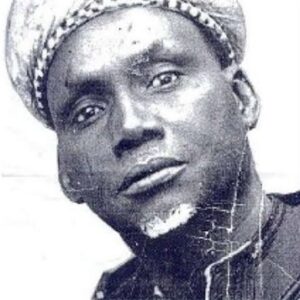
PHOTO CAPTION: Usman dan Fodio. SOURCE: EA Library.
Early 19th Century (1804–1808): The Fulani Jihad, led by Usman dan Fodio, conquered several territories formerly controlled by Bornu. Although the scholar and military leader Muhammad al-Kanemi successfully resisted the Fulani and restored some stability, the authority of the Sayfawa Dynasty came to an end.
Mid-19th Century: Continued civil wars, economic decline, and repeated attacks from neighbouring groups further weakened the empire. Political unity became increasingly difficult to maintain.
1893: The final blow came when the Sudanese warlord Rabih az-Zubayr invaded and conquered Bornu, bringing an end to the independent Kanem–Bornu Empire after more than one thousand years of existence.
Although the empire ceased to exist as an independent state, its legacy survived in its contributions to political organization, Islamic scholarship, long-distance trade, and cultural exchange. The history of Kanem–Bornu remains a powerful example of African state formation, resilience, and civilization, and its influence can still be seen in the cultures and institutions of the Lake Chad region today.
EA EDITORS