LUNDA EMPIRE
(c. 1665–1887 CE)
- 15 Min Read
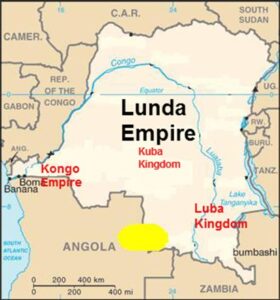
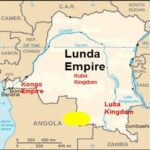
PHOTO CAPTION: Map of Lunda Empire. SOURCE: EA Library.
OVERVIEW
The Lunda Empire was one of the most powerful and influential pre-colonial states of Central Africa. It flourished between the seventeenth and nineteenth centuries across a vast area corresponding broadly to parts of present-day Democratic Republic of the Congo, north-eastern Angola and north-western Zambia. Its strategic geographical position placed it at the intersection of important commercial routes linking Central and Southern Africa. This location, together with its agricultural resources, mineral wealth and political organization, enabled the Lunda state to develop considerable economic and political influence.
The emergence and expansion of the Lunda Empire were associated with the institution of the Mwata Yamvo, also rendered Mwaant Yaav, as the supreme political authority and symbol of unity. The Lunda political system combined central authority with considerable local autonomy. Chiefs and local rulers administered their communities while recognizing the authority of the Mwata Yamvo and fulfilling obligations such as the payment of tribute. This flexible structure enabled the Lunda to incorporate diverse communities without requiring the complete destruction of existing political institutions.
The economic foundations of the empire rested on agriculture, hunting, fishing, craft production, natural resources and long-distance trade. Lunda-controlled territories possessed valuable resources, particularly copper and salt, while the empire participated in the exchange of ivory, agricultural products, manufactured goods and enslaved people. These activities generated wealth and strengthened the political authority of the ruling establishment.
Lunda society was sustained by strong kinship structures, respect for lineage and age, religious beliefs, oral traditions and communal institutions. Storytelling, proverbs, praise poetry, music, dance and ceremonies served not only cultural purposes but also preserved historical memory and transmitted political and moral knowledge. The empire consequently became an important centre of cultural interaction, influencing neighbouring societies, including the Luba.
The significance of the Lunda Empire therefore extended beyond territorial expansion. It demonstrated the capacity of pre-colonial African societies to construct large political systems, administer geographically dispersed communities, organize long-distance commerce and develop sophisticated bodies of practical and indigenous knowledge.
ORIGIN AND EARLY HISTORY
The origins of the Lunda Empire are associated with interactions among several Central African communities, particularly those connected with the Luba. Rather than emerging solely through a single military conquest, the Lunda state developed through political alliances, cultural interaction, marriage relationships and the gradual integration of different communities. Oral traditions are particularly important to understanding this formative period because they preserve accounts of the origins of Lunda political authority and the establishment of its ruling institution.
According to Lunda traditions, the foundation of the political order was closely associated with a marriage alliance between a Luba prince and a Lunda royal woman. The union helped establish political legitimacy and provided a basis for bringing different groups together under a common authority. From this political and dynastic tradition emerged the institution of the Mwata Yamvo, or Mwaant Yaav, who became the supreme political and spiritual leader of the Lunda.
Early Lunda expansion was gradual. Diplomacy, alliances, tribute arrangements and political incorporation were important mechanisms through which the state extended its influence. Local rulers could retain considerable authority over their communities provided that they acknowledged the supremacy of the Mwata Yamvo and fulfilled their obligations to the central authority. Such an arrangement allowed the Lunda to incorporate communities with different political and cultural traditions while avoiding continuous warfare.
Economic opportunities also contributed to early expansion. The Lunda occupied an important position along routes through which commodities such as copper, salt and ivory circulated. Control over these networks enhanced the resources available to political leaders and provided additional incentives for neighbouring communities to establish relationships with the Lunda state. Economic power consequently reinforced political authority.
Oral traditions, proverbs and ceremonial practices played an important role in preserving memories of the empire’s origins. They commemorated rulers, transmitted political values and reinforced the legitimacy of the ruling institution. Historical knowledge was therefore embedded within the cultural life of the society rather than being dependent exclusively upon written records.
The early history of the Lunda Empire thus illustrates a process of political consolidation based on kinship, alliance-building, cultural integration, diplomacy and economic opportunity. These mechanisms provided the foundation for the subsequent expansion of Lunda influence across Central Africa.
POLITICAL ORGANIZATION AND GOVERNANCE
The Lunda Empire developed a highly structured political system capable of exercising authority over a large and diverse territory. At the centre of the system was the Mwata Yamvo/Mwaant Yaav, who held supreme political and spiritual authority. The ruler represented political unity and derived legitimacy from lineage, tradition, ritual and established political institutions.
Beneath the supreme ruler was a hierarchy of chiefs and local rulers responsible for administering different territories. These officials maintained law and order, collected tribute and ensured that their communities remained loyal to the central authority. Members of the royal family and other influential individuals could occupy important administrative positions, creating a network through which the central government exercised influence across distant territories.
A particularly important feature of Lunda political organization was the combination of centralized authority and local autonomy. The Mwata Yamvo remained the supreme authority, but local leaders retained responsibility for governing their own communities. They were generally permitted to maintain their positions provided that they recognized the authority of the central ruler, paid tribute and respected the political order.
This arrangement provided an effective means of governing a geographically extensive and culturally diverse empire. Rather than attempting to impose identical institutions throughout the entire territory, the Lunda political system accommodated existing local structures. This flexibility contributed to the empire’s ability to expand and maintain political relationships over considerable distances.
The ruler was assisted by elders and advisers who contributed to decision-making in matters of justice, diplomacy and succession. Their participation reflected the importance of collective wisdom and established political traditions. Governance was consequently not simply a matter of personal rule but involved institutions and customary procedures through which authority was exercised.
Succession followed established customs involving royal lineage and the approval of important political figures. Because succession was central to the continuity of the state, established procedures were important in maintaining political stability. Nevertheless, succession disputes later became one of the factors contributing to the empire’s weakening.
Tribute was another major component of the political system. Subject or allied territories supplied goods such as ivory, copper, food and labour to the central authority. Tribute strengthened the economic position of the royal court while simultaneously reinforcing political relationships between the centre and subordinate territories.
The Lunda political system therefore demonstrated an important principle of pre-colonial statecraft: central authority could coexist with substantial local autonomy. This helped the empire govern diverse communities while preserving the authority and prestige of the Mwata Yamvo.
ECONOMIC SYSTEM
The economy of the Lunda Empire was diverse and closely connected to its political organization and geographical environment. Agriculture formed the foundation of everyday economic life, while hunting, fishing, craft production, resource extraction, tribute and long-distance commerce provided additional sources of livelihood and wealth.
Agriculture was the principal economic activity for much of the population. Farmers cultivated crops including millet, sorghum, cassava and yams. Production was largely organized at family and community levels, providing food for household consumption as well as surpluses that could be exchanged in local and regional markets. Agricultural production therefore contributed both to food security and to commercial activity.
Hunting and fishing supplemented agricultural production. Hunting supplied meat, skins and other animal products, while fishing provided food and commodities such as dried fish. These activities were especially important because they enabled communities to make use of the varied ecological resources available in forests, rivers and savanna environments.
Long-distance trade was one of the most important sources of Lunda economic influence. The empire’s location between Central and Southern Africa enabled it to participate in extensive networks of exchange. Important commodities included copper, salt, ivory and enslaved people, while goods from other regions, including cloth and beads, entered Lunda commercial networks.
Copper and salt were particularly valuable resources. Copper was used in tools, ornaments and trade, while salt was important for consumption and food preservation. Control over these resources strengthened the economic position of the Lunda state and increased its attractiveness as a centre of exchange.
The tribute system provided another important economic mechanism. Subject territories and local chiefs supplied agricultural produce, natural resources and labour to the central authority. Tribute helped sustain the royal court and reinforced political dependence while allowing resources to circulate between different parts of the empire.
Markets existed at local and regional levels. They served as places where agricultural products, crafts and imported goods were exchanged. Beyond their economic importance, markets encouraged interaction among communities and helped integrate the empire’s diverse population into wider networks of production and exchange.
The Lunda economic system was therefore multifaceted and interconnected. Agriculture sustained the population, natural resources generated valuable commodities, markets encouraged exchange, and long-distance trade strengthened the empire’s regional influence.
SOCIAL STRUCTURE AND DAILY LIFE
Lunda society was hierarchically organized, with different groups occupying distinct political, economic and social positions. At the apex was the Mwata Yamvo, whose authority was both political and spiritual. The royal court functioned as an important centre of administration and cultural life.
Below the supreme ruler were members of the royal family, nobles and chiefs. These groups participated in government, decision-making, law enforcement and tribute collection. Their position gave them influence over local administration and access to the political institutions of the empire.
The majority of the population consisted of farmers, hunters, traders and artisans. Farmers were particularly important because agricultural production sustained communities and generated surpluses for exchange. Artisans produced textiles, pottery, metal goods, carvings and other objects, while traders connected communities through internal and external commerce.
Enslaved people occupied a subordinate position within the social hierarchy. They were often prisoners of war or people incorporated into Lunda society through conquest and performed domestic, agricultural and other labour-intensive tasks. The source also indicates that some enslaved people could eventually be absorbed into the wider community, suggesting that social status could, in some circumstances, be subject to change.
Family and community provided the foundation of everyday social life. Extended family structures were important, while elders exercised authority and provided moral and social guidance. Age and lineage were highly respected, and knowledge, customs and values were transmitted between generations. Villages served as basic settlement units where people lived, worked and participated in communal activities.
Daily activities varied according to occupation and environment. Farming, hunting, fishing, craft production and trade occupied much of the population. Markets provided opportunities not only for economic exchange but also for social interaction and communication.
Cultural activities were integrated into everyday life. Births, marriages, harvests, initiations and other important events were marked by music, dance, storytelling and ceremonies. Such activities strengthened community bonds while transmitting historical memory and shared values.
The social organization of the Lunda Empire was therefore based on a combination of hierarchy, kinship, occupation, community cooperation and cultural tradition. Each social group contributed to the functioning and continuity of the wider political system.
RELIGION AND BELIEF SYSTEMS
Religion occupied an important position in Lunda society and influenced political authority, social organization and everyday life. Lunda religious thought emphasized a close relationship between the visible world of human beings and a spiritual realm. Spiritual beliefs provided explanations of life, authority, morality and the relationship between people and their environment.
At the centre of the belief system was a supreme creator associated with the origin of life and the universe. Although the supreme being was respected, communication with the spiritual world commonly took place through intermediary spiritual forces, including lesser deities and ancestral spirits.
Ancestor veneration was particularly important. Ancestors were understood to remain connected with the living and could provide protection, guidance or punishment. Families and communities therefore honoured their ancestors through offerings, prayers and rituals. Such practices strengthened the importance of lineage and reinforced obligations between generations.
Religious ceremonies marked important events such as harvests, initiation rites and the installation of political leaders. These ceremonies could involve sacrifices, music, dance and symbolic actions intended to preserve harmony between the human and spiritual worlds. Religious specialists, including priests and diviners, played roles in conducting ceremonies and interpreting spiritual messages.
Religion was closely connected with political legitimacy. The Mwata Yamvo was not merely a political ruler but also possessed spiritual significance. His authority was reinforced through religious traditions and rituals, and he was understood as having a mediating relationship between the people and the spiritual realm.
The natural environment also had spiritual significance. Rivers, forests, animals and other elements of the natural world could be associated with spiritual forces. Such beliefs encouraged particular forms of respect for the environment and shaped how people interacted with natural resources.
Lunda religion was consequently not separated from political, social or economic life. Spirituality, ancestral identity, political authority, morality and environmental relationships formed interconnected aspects of the Lunda worldview.
CULTURAL AND INTELLECTUAL LIFE
The cultural and intellectual life of the Lunda Empire was sustained through oral traditions, artistic expression, ceremonial practices, systems of social knowledge and institutions of political education. Knowledge was transmitted largely through interpersonal and community-based forms rather than depending exclusively on written documentation.
Oral tradition was particularly important. Elders, storytellers and other custodians of knowledge transmitted histories, laws, customs and political traditions through stories, proverbs and praise poetry. These forms preserved memories of rulers and important events while educating younger generations about social responsibilities and cultural values.
Praise poetry and oral narratives could also reinforce political legitimacy by commemorating the achievements and qualities of rulers. Historical knowledge was therefore closely connected to political authority and collective identity.
Music and dance occupied an important place in cultural expression. Drumming, singing and coordinated dancing accompanied festivals, religious ceremonies and royal occasions. They served several functions, including entertainment, communication, spiritual expression and the strengthening of communal solidarity.
Lunda artisans produced a wide range of material objects, including woven textiles, pottery, metal tools and decorative items. These objects could have practical, aesthetic and symbolic meanings. Craft traditions were transmitted within families and specialized groups, allowing technical knowledge and artistic skills to survive across generations.
Ceremonies and festivals further strengthened collective identity. Initiation rites, royal installations and harvest celebrations brought communities together and linked religious practice with political authority, social education and cultural expression.
The intellectual life of the Lunda was also visible in its systems of governance, law, diplomacy and conflict resolution. Knowledge about leadership and social organization was accumulated through experience and transmitted through established traditions. Elders and leaders were respected as repositories of wisdom whose guidance contributed to social order and political stability.
The Lunda intellectual tradition can therefore be understood as a broad system of practical, historical, moral, political and environmental knowledge. Its preservation through oral transmission demonstrates that the absence of extensive written records should not be equated with an absence of intellectual traditions.
DECLINE AND FALL
The decline of the Lunda Empire resulted from a combination of internal weaknesses and external pressures rather than from a single event. By the nineteenth century, the empire’s ability to maintain centralized authority over its extensive territories had increasingly weakened.
One major factor was political instability and succession disputes. The empire’s political system depended heavily on the authority and legitimacy of the Mwata Yamvo. Disagreements over succession weakened the royal court and reduced the ability of the central government to maintain unity among the empire’s territories.
The empire’s extensive territorial expansion also became a liability. Governing a large territory containing numerous communities was difficult in an environment where communication and transportation were limited. Distant local rulers increasingly exercised independent authority, weakening their loyalty to the centre.
External military pressure intensified these internal difficulties. The rise of the Chokwe was particularly significant. During the nineteenth century, Chokwe expansion placed increasing pressure on Lunda territories and resulted in the loss of important political centres and trade routes.
Changes in regional and international commerce also affected the Lunda economy. The expansion of the slave trade and changing European demand disrupted established patterns of inland commerce. Portuguese and other external traders operating through Atlantic networks increasingly influenced regional trade, weakening some of the Lunda’s previous control over commercial routes.
The empire also experienced increasing political fragmentation. Subordinate territories, including the Kazembe region, gradually asserted greater independence. The loss of these territories reduced the resources and political influence available to the central authority and made coordinated resistance to external pressures more difficult.
By the late nineteenth century, the combined effects of succession disputes, political fragmentation, overexpansion, economic disruption and external military pressure had severely weakened the Lunda state. The empire consequently lost control over much of its territory and ceased to function as a unified political entity.
The collapse of the Lunda Empire should therefore be understood as a process of gradual political and economic weakening. Its decline nevertheless did not erase its historical significance. Lunda political institutions, cultural traditions, systems of authority and patterns of regional interaction continued to influence Central African societies beyond the formal end of the empire.
This version can also be developed further into a full Encyclopaedia Africana Volume IV-style entry, with separate sections on Geography; Science, Technology and Indigenous Knowledge Systems; Major Achievements and Contributions; Legacy; and a scholarly Conclusion.
EA EDITORS