KINGDOM OF KONGO (c.1390–1914 CE)
- 14 Min Read
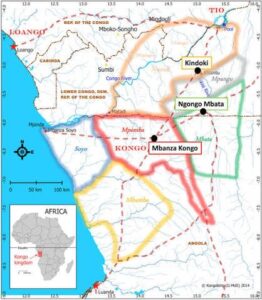
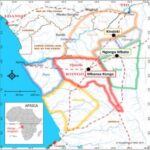
PHOTO CAPTION: Map of the KIngdom of Kongo.
OVERVIEW
The Kingdom of Kongo was one of the most influential and highly organised states of medieval and early modern west-central Africa. It occupied a substantial territory encompassing parts of present-day Angola, the Democratic Republic of the Congo and the Republic of the Congo. Its political and cultural centre was Mbanza Kongo, the royal capital, which became known as San Salvador following Portuguese intervention. At its height in the sixteenth century, the kingdom extended for more than 600 kilometres, reaching the Kwango River to the east, the Dande River to the south and the Kwilu River to the north. Its population may have exceeded two million.
The kingdom developed a sophisticated political system headed by the manikongo, supported by provincial governors and tributary communities. Its economy was based on agriculture, regional and long-distance trade, skilled craftsmanship, metalworking and the production of highly valued raffia textiles. Copper, ivory, salt, cattle hides, pottery and other commodities circulated through its trading networks, while nzimbu shells served as an important medium of exchange.
Kongo society was hierarchical and organised around extended family groups known as kanda. It followed a predominantly matrilineal system in which descent, inheritance, property and political authority were transmitted through the maternal line. Religious life centred on belief in a supreme creator, spiritual forces known as Nkisi, and the continuing influence of ancestors. Specialist religious practitioners, known as Nganga, served as intermediaries between the physical and spiritual worlds.
The kingdom also developed a distinctive cultural tradition expressed through sculpture, textiles, fashion, religious practices and political symbols. Contact with Portugal from the late fifteenth century brought Christianity, new forms of diplomacy and intensified international trade, but also increasing European interference and involvement in the trade in enslaved people. The resulting political tensions, succession disputes, warfare and Portuguese intervention gradually weakened the kingdom. The Battle of Mbwila in 1665 marked a decisive turning point, after which Kongo ceased to function effectively as a unified kingdom.
Despite its eventual political decline and incorporation of its territories into European colonial structures, the historical and cultural legacy of Kongo remains significant. The traditions of the Bakongo people, the history of Mbanza Kongo, and the kingdom’s achievements in governance, commerce, art, religion, diplomacy and technology testify to the complexity of African civilisation before colonial rule.
ORIGIN AND EARLY HISTORY
Traditional accounts place the foundation of the Kingdom of Kongo around 1390 and attribute its establishment to Lukeni lua Nimi. Other historical accounts place the formation of the kingdom in the fifteenth century, indicating some uncertainty concerning the precise date of its emergence. Nevertheless, the development of Kongo can be understood as part of a broader process of political consolidation among communities in west-central Africa.
The Bakongo, the principal people of the kingdom, originally occupied a relatively narrow territory south of the Congo River, stretching from the area of modern Kinshasa towards Matadi in the lower Congo. Through a combination of conquest, political alliances and treaties, the emerging kingdom expanded its influence and incorporated neighbouring communities, including the Bambata, Mayumbe, Basolongo, Kakongo, Basundi and Babuende.
This process of expansion transformed Kongo from a relatively local political formation into a substantial regional state. By the sixteenth century, its territory had expanded considerably, covering an area of more than 600 kilometres between major rivers and commercial zones. The kingdom’s geographical position gave it access to important inland and coastal trade routes and enabled it to establish itself as a major political and commercial power.
European contact became an important turning point in Kongo’s history. Portuguese explorer Diogo Cão reached the mouth of the Congo River between 1482 and 1484 and established diplomatic contact with the kingdom. Subsequent relations involved diplomacy, trade, Christianity and increasing Portuguese influence. These contacts initially offered Kongo opportunities for international relations and access to new goods and technologies, but eventually contributed to political instability and economic exploitation.
In 1491, the reigning manikongo, Nzinga a Nkuwu, and his son, Mvemba a Nzinga, were baptised by Portuguese missionaries and adopted the Christian names João I and Afonso I respectively. João I thus became the first Christian king of Kongo. When Afonso I ascended the throne in 1507, he played a major role in institutionalising Christianity within the kingdom and became associated with the title “The Apostle of Kongo.”
POLITICAL ORGANIZATION AND GOVERNANCE
The Kingdom of Kongo was governed by a centralised monarchy headed by the manikongo. The king exercised supreme political authority and was also regarded as possessing important judicial and spiritual powers. His authority extended beyond the capital to the provinces and tributary territories that constituted the wider kingdom.
The manikongo appointed regional governors to administer the provinces. These governors performed important political and economic functions, including the collection of tribute from the territories under their authority. Tribute could consist of millet, ivory, palm wine, animal skins and other valuable commodities. These goods were presented to the king during elaborate annual ceremonies in Mbanza Kongo.
The relationship between the king and provincial authorities was based on mutual obligations. Governors provided tribute and recognised the authority of the manikongo, while the monarch offered military protection, gifts and political legitimacy. The king’s spiritual status further strengthened the political system, as he was regarded as a connection between the political community and the spiritual realm.
Royal authority was represented through distinctive symbols, including a ceremonial headdress, royal stool, drum and jewellery made from materials such as ivory and copper. These objects reinforced the prestige and sacred character of kingship.
Military power was another important foundation of political authority. The king maintained a substantial force, including soldiers stationed at the capital and contingents distributed among the provinces. During periods of war, additional troops could be mobilised from tributary territories. This military structure enabled the kingdom to defend its territories, enforce political authority and respond to external threats.
However, political stability depended heavily on the strength of the monarchy and the cooperation of competing political interests. After the death of Afonso I, disputes over succession created a prolonged struggle between rival factions, particularly the Kimpanzu and Kinlaza. These conflicts gradually weakened central authority and provided opportunities for external intervention.
ECONOMIC SYSTEM
The economy of the Kingdom of Kongo was diverse and supported by agriculture, regional trade, craftsmanship, metalworking and access to strategically important commercial routes. The Congo River and surrounding regions provided important channels through which goods moved between inland communities and coastal traders.
Among the commodities traded were copper, ivory, salt and cattle hides. Metalworking was particularly important, and the kingdom became known for the production and exchange of copper and other valuable materials. The production of raffia textiles and pottery also contributed significantly to the economy.
The Kongo people were highly skilled artisans. Weavers, potters and metalworkers produced a wide variety of goods for domestic consumption, political purposes and trade. Raffia textiles were especially important and were valued both within the kingdom and beyond its borders. The production of these textiles demonstrates the existence of specialised knowledge and sophisticated techniques for processing natural fibres.
Trade was facilitated by the use of nzimbu shells as currency. These shells, particularly those obtained from Luanda Island, served as a standardised medium of exchange. Their increasing use contributed to the development of a more monetised economy and facilitated commercial transactions over greater distances.
Kongo’s strategic geographical position was also fundamental to its economic strength. By controlling important trade routes, the kingdom was able to regulate the movement of goods between inland producers and coastal merchants. This strengthened the authority of the state and contributed to Kongo’s emergence as a major commercial power in west-central Africa.
European contact transformed the nature of Kongo’s economy. From the late fifteenth century, trade with the Portuguese increased, and the trade in enslaved people became increasingly prominent. What had initially been a dynamic regional economy gradually became affected by the demands and political interests associated with the expanding Atlantic economy.
SOCIAL STRUCTURE AND DAILY LIFE
Kongo society was highly organised and hierarchical. At the apex stood the manikongo, who combined political, judicial and spiritual authority. Below the monarch were members of the nobility and political elite, followed by commoners and enslaved people. This hierarchy influenced access to political authority, economic resources and social status.
The basic social organisation of many communities was the kanda, an extended family group whose members traced their descent from a common ancestor. The kanda provided an important framework for social identity, kinship, inheritance and political relationships.
Kongo society was predominantly matrilineal. Inheritance, property and political authority were generally transmitted through the maternal line. Although men frequently occupied leadership positions, women could also exercise considerable authority within communities. The role of women was therefore important not only in family life and economic production but also in aspects of political organisation.
Daily life differed between rural communities and major urban centres. In rural areas, women were primarily involved in agricultural production, while men commonly cleared land, hunted and collected materials used in the production of goods such as cloth and palm wine. These complementary economic roles supported household survival and the wider economy of the kingdom.
Urban life was particularly developed in Mbanza Kongo, the royal capital. The city served as the political and social centre of the kingdom and was the residence of the king and members of the elite. Portuguese visitors during the 1490s reportedly regarded the city as impressive and comparable to contemporary European towns. Its size, organisation and concentration of political authority reflected the sophistication of Kongo’s state system.
RELIGION AND BELIEF SYSTEMS
Religion occupied a central position in the spiritual and social life of the Kongo people. Their indigenous belief system recognised a supreme creator and a complex spiritual world in which unseen forces influenced human affairs and the natural environment.
Among the most important spiritual forces were the Nkisi. These forces were associated with natural elements and objects and could be invoked for protection, healing and justice. Spiritual practices therefore formed an integral part of everyday life rather than existing separately from political, social and economic activities.
Ancestors also occupied a central position in Kongo spirituality. They were respected and venerated as continuing members of the community who could act as intermediaries between the living and the spiritual world. Individuals and communities offered prayers, libations and sacrifices to honour ancestors and seek their guidance, protection and favour.
Religious specialists known as Nganga played an important role in maintaining communication between the physical and spiritual worlds. They performed rituals, interpreted spiritual signs, provided healing and offered advice to individuals and communities. Their activities helped communities understand and respond to spiritual forces believed to influence human wellbeing.
The arrival of Christianity in the late fifteenth century introduced a major new religious influence.
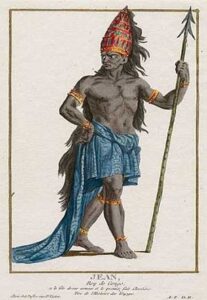
PHOTO CAPTION: Nzinga a Nkuwu (João I), the first Christian King of Kongo. SOURCE: EA Library.
The baptism of Nzinga a Nkuwu and his son in 1491 marked an important stage in the Christianisation of the kingdom. Under Afonso I, Christianity became more firmly established within the political and social structures of Kongo.
Christianity did not simply replace indigenous religious traditions. Its interaction with existing Kongo beliefs contributed to the development of forms of Afro-Christian religious expression in which Christian beliefs and practices interacted with indigenous African traditions.
CULTURAL AND INTELLECTUAL LIFE
The cultural life of the Kingdom of Kongo was characterised by a shared language, artistic traditions, specialised craftsmanship, distinctive forms of dress and sophisticated knowledge of materials and production techniques. The different Kongo communities were linked by the Kikongo language and shared many cultural practices despite variations among individual groups.
Sculpture was one of the most highly developed forms of Kongo artistic expression. Skilled sculptors produced representations of human beings and animals, paying close attention to facial features, bodily form, musculature, personal adornment and scarification. These works were often produced for political and social elites, including the king.
The importance of Kongo art extends beyond its aesthetic qualities. Sculptural works provide evidence of sophisticated knowledge of human anatomy, clothing, hairstyles, body decoration and social identity. They therefore constitute valuable sources for understanding Kongo society, fashion and material culture.
Textile production also demonstrates significant technological and intellectual knowledge. Kongo artisans transformed raffia and pineapple fibres into textiles and structured garments through specialised processes of preparation, weaving and design. Their ability to manipulate natural fibres reveals an important body of indigenous technological knowledge.
Kongo material culture also reflected advanced design and fashion traditions. Artistic representations of women’s clothing, head coverings and body adornment provide evidence of aesthetic preferences and sophisticated textile traditions. Prestige objects, including the mpu, or ceremonial cap, demonstrate the relationship between material production, status and political authority.
Metalworking was another important area of technical knowledge. The Kongo people smelted copper and gold and traded these materials alongside raffia cloth, pottery and other products. Their craftsmanship therefore contributed not only to cultural expression but also to the economic and political strength of the kingdom.
The kingdom’s military organisation likewise reflected practical knowledge and technological adaptation. Its forces included large numbers of archers drawn from the general male population and specialised heavy infantry equipped with swords and shields. Military contingents were stationed in the capital and provinces, while additional forces could be mobilised from tributary territories when required.
DECLINE AND FALL
The decline of the Kingdom of Kongo resulted from a combination of internal political conflict, succession disputes, warfare and increasing Portuguese intervention. During the reign of Afonso I, the kingdom remained relatively strong and economically self-sufficient. Afonso recognised the growing influence of Portugal and attempted to regulate Portuguese activities in order to preserve the integrity of his kingdom.
His death, however, created a major political vacuum. Rival factions competed for control of the monarchy, particularly the Kimpanzu and Kinlaza. The resulting succession disputes weakened the authority of the central government and undermined the political unity of the kingdom.
Around 1568, the kingdom was temporarily overrun by rival warriors identified in the source as the Jagas. Álvaro I Nimi a Lukeni, who ruled from 1568 to 1587, succeeded in restoring Kongo with Portuguese assistance. In return, Portuguese settlers were permitted to establish themselves at Luanda, then part of Kongo territory. This development contributed to the establishment of the Portuguese colonial presence that eventually became part of Angola.
Relations between Kongo and the Portuguese subsequently deteriorated. Portuguese forces and interests in Angola became increasingly associated with incursions into Kongo territories and the capture of enslaved people. Kongo responded by attempting to regain control of parts of Angola and imposing heavier taxation. These tensions eventually developed into open warfare.
A decisive confrontation occurred at the Battle of Mbwila on 29 October 1665. Portuguese forces defeated the Kongo army and killed the reigning manikongo, António I Nvita a Nkanga. Although the Kingdom of Kongo continued to exist after the battle, it no longer operated as a unified political state.
The death of António I intensified the struggle between the Kimpanzu and Kinlaza factions. Civil war continued through much of the seventeenth century. Pedro IV Agua Rosada Nsamu a Mvemba of Kibangu, who ruled from 1696 to 1718, eventually negotiated an arrangement intended to preserve the territorial bases of the competing factions while rotating the kingship among them. Although this arrangement temporarily restored a degree of stability, it was considerably weaker than the earlier provincial system and eventually broke down.
During the nineteenth century, Portuguese intervention again became decisive. Portugal supported Pedro V Agua Rosada Lelo’s installation as king in 1859. Under considerable pressure, Pedro V eventually ceded his territory to Portugal, which incorporated it into Angola. A subsequent revolt against Portuguese rule was suppressed, marking the final collapse of the Kongo kingdom as an independent political entity.
CONCLUSION
The Kingdom of Kongo occupies an important place in the history of precolonial Africa. Its political institutions, economic networks, artistic traditions, indigenous knowledge systems and diplomatic relations demonstrate the sophistication of African states before European colonial rule.
Its history also provides an important example of the complex consequences of early African-European interaction. Contact with Portugal introduced Christianity and new diplomatic and commercial opportunities, but it also intensified the trade in enslaved people and eventually contributed to foreign political and economic interference.
The legacy of Kongo survives particularly through the Bakongo people, their language, cultural traditions, religious practices and artistic heritage. Mbanza Kongo, the historic capital, remains an important symbol of this heritage and is recognised as a UNESCO World Heritage Site.
The history of Kongo therefore represents not simply a story of political decline, but a record of African state formation, innovation, commerce, intellectual achievement, cultural creativity and resistance to external domination. Its experience provides valuable evidence of the complexity and dynamism of African civilisation before and during the early period of European colonial expansion.
EA EDITORS