LUBA EMPIRE
(c. 1585–1889 CE)
- 19 Min Read
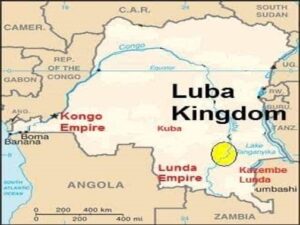
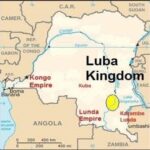
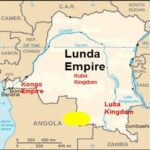
PHOTO CAPTION: The Luba kingdom around 1700. SOURCE: J. Vansina.
OVERVIEW
The Luba Empire was one of the most significant pre-colonial political formations in Central Africa. It developed from the societies inhabiting the Upemba Depression and surrounding savanna-woodland regions of what is now the Democratic Republic of the Congo (DRC). At its height, the Luba political system exercised influence over a large area of the central and southern Congo region and became an important centre of political organization, commerce, cultural production and indigenous knowledge.
The geographical setting of the Luba state was particularly favourable to the development of complex communities. The Upemba Depression, with its marshes, grasslands, rivers and lakes, supported fishing, agriculture, hunting and settlement. The upper Congo and Lualaba river systems provided routes of movement and communication, while access to copper, iron, salt and other resources encouraged specialized production and exchange.
The development of the Luba state was closely associated with the consolidation of communities that had previously participated in regional economic networks. Fishing communities exchanged dried fish for metal tools and other commodities, while metalworkers depended upon traders for copper and charcoal. Over time, these relationships encouraged specialization, interdependence and the growth of larger settlements.
Around the sixteenth century, political consolidation resulted in the emergence of a kingdom associated with Kongolo Maniema and his nephew Kalala Ilunga. The institution of sacred kingship, represented by the Mulopwe, became central to Luba political organization. The kingdom combined royal authority, territorial administration, kinship networks, spiritual institutions and systems of tribute.
Luba political organization was distinctive in its combination of central authority and mechanisms that restrained royal power. The Bambudye, a powerful association of custodians of political and historical knowledge, played an important role in advising and, where necessary, checking the king. The political order was therefore not based simply on unrestricted personal authority but on an institutional and moral conception of kingship.
The Luba economy rested primarily on agriculture, fishing and hunting but was closely integrated into extensive regional trade. Salt, copper, iron, raffia, palm oil, fish and agricultural products circulated between different ecological zones. These networks contributed to the wealth of ruling elites and helped connect Luba communities with wider Central African commercial systems.
The Luba legacy extends beyond the historical kingdom itself. Luba political institutions, artistic traditions, oral historical systems, languages and religious concepts have continued to contribute to the cultural heritage of the Democratic Republic of the Congo and surrounding regions.
ORIGIN AND EARLY HISTORY
The origins of the Luba Empire can be understood against the background of long-term settlement and economic development in the Upemba Depression. Archaeological evidence indicates that the region had supported fishing communities since approximately the fifth century. These communities were not isolated. They participated in exchange relationships through which dried fish could be exchanged for metalworking tools and other commodities.
The development of metallurgy transformed these relationships. Metalworkers obtained copper and charcoal through trading networks and produced tools and other objects in return for fish, agricultural products and manufactured goods. The circulation of these commodities encouraged specialization and increased economic interdependence among communities.
As trade intensified, villages and settlements increasingly cooperated in order to benefit from larger commercial networks. Economic prosperity encouraged population growth and contributed to the emergence of larger settlements and centres of political influence.
Around 1585, according to the supplied historical account, Kongolo Maniema united these communities and established the Luba Kingdom. Together with his nephew Kalala Ilunga, he expanded the kingdom’s political influence and strengthened its institutions. Mwibele served as the capital and remained an important centre of political authority until the decline of the kingdom.
The kingdom subsequently expanded into the southern grasslands. Its sphere of influence extended across a substantial portion of the central Congo savanna, linking communities across a broad geographical area. Although these societies maintained distinctive local identities and institutions, they were connected through political, economic, linguistic and cultural relationships.
Three principal subdivisions of the Luba are identified in the source:
- Luba-Shankaji, associated particularly with Katanga;
- Luba-Bambo, associated with Kasai; and
- Luba-Hemba, associated with northern Katanga and southern Kivu.
These groups remained historically, linguistically and culturally interconnected, while also maintaining relationships with other communities in the Congo region.
The formation of the Luba state therefore represented a process of political consolidation built upon earlier economic, cultural and social interactions. The development of centralized authority did not erase local identities but incorporated them into a wider political and cultural system.
POLITICAL ORGANIZATION AND GOVERNANCE
The political organization of the Luba state has been described as a “pyramid of pyramids”, reflecting the way political authority was structured through nested systems of kinship, territorial administration and sacred leadership.
At the village level, households were organized through patrilineal relationships. Villages themselves were connected through lineage relationships, while districts were administered by titled chiefs whose authority was associated with their relationship to local spiritual forces or vidye.
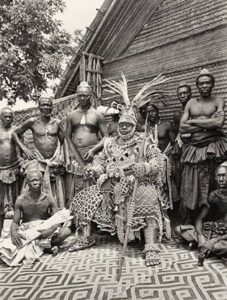
PHOTO CAPTION: The Mulopwe (Emperor) of the Luba Empire. SOURCE: EA Library.
At the apex of the political system was the Mulopwe, the sacred king or emperor. The institution of kingship, known as Bulopwe, combined political, ritual and ancestral authority. The king’s legitimacy was derived from lineage, sacred traditions and the perceived connection between political authority and the spiritual world.
The political structure did not, however, mean that the king exercised unlimited personal power. The royal office was embedded within institutions, councils, ritual responsibilities and customary principles. Although the kingship was normally transmitted through the royal line, Luba political thought presented the office as transcending any single lineage. The king stood above competing political interests while remaining connected through kinship to important territorial leaders.
The king was surrounded by a royal household and numerous titled officials. These officials performed specialized political, judicial, military, ritual and administrative functions.
Among the important offices were:
- Twite – a senior military and political official representing the king in secular matters;
- Nabanza – custodian of royal regalia and supervisor of important rituals;
- Lukanga – senior judicial official;
- Mwana Mwilamba – head of the army;
- Mwine Lundu – custodian of tradition and the unwritten constitution;
- Fumwa Pamba Diyumbi – keeper and maker of charms and royal diviner; and
- Ndalamba – queen-mother with important ritual responsibilities.
Territorial administration was entrusted to bilolo, high-ranking regional governors responsible for kibrvindji, or regions. These officials were generally selected from ruling families within the districts and confirmed by the royal court.
The central government supervised tribute collection, military organization and relations between different territories. The king received advice through institutions including the tshidie, or general council, and the Tshihangu, or court.
An especially significant institution was the Bambudye, a closed association that helped the king govern. The Bambudye was not simply an administrative body. It was also a custodian of historical and constitutional knowledge and functioned as an important institutional check on royal power.
Local courts reproduced aspects of the organization of the royal court. Local chiefs possessed sacred objects and maintained relationships with territorial spirit cults, often associated with ancestral traditions. This gave local authorities their own sources of legitimacy and meant that centrifugal political forces remained important within the kingdom.
The Luba system consequently combined centralized kingship, territorial administration, kinship, sacred authority, councils and institutional checks on political power. This complexity enabled the kingdom to maintain coherence while accommodating considerable regional diversity.
ECONOMIC SYSTEM
The Luba economy was based upon a combination of agriculture, fishing, hunting, craft production, metallurgy and regional trade. Different ecological zones supplied different resources, creating an interconnected economic system rather than a collection of isolated communities.
Agriculture provided a major foundation of subsistence. Communities cultivated crops including millet, sorghum, yams, cassava and maize. Agricultural production supported households and communities while also generating surpluses that could enter regional markets.

PHOTO CAPTION: The Katanga Plateau, north of Kolwezi, Congo (Democratic Republic). SOURCE: EA Library.
Fishing was particularly important in the Upemba Depression and along the Lualaba and other waterways. Fish provided a major source of food and became an important commodity of exchange. Dried fish could be transported to communities further inland and exchanged for metal tools, agricultural products and other goods.
Hunting supplemented farming and fishing. Forest and savanna environments provided game, while hunting also supplied hides and other useful materials.
Regional trade connected different ecological and productive zones. According to the source, commodities moved through the Luba region from several directions. Raffia and palm oil came from northern areas; fish came from the Lualaba; copper and salt came from southern areas; and mbafu oil came from the central southern region.
Metallurgy was particularly important to the economic system. Iron tools improved agricultural production, while copper was valued for its practical, decorative and commercial uses. Metalworkers became important specialists within the wider economy.
Trade also linked Luba communities with wider Central African networks. Earlier commercial relationships connected the Upemba region with Central and East Africa and, through extended networks, with areas reaching towards the Indian Ocean.
The ruling elite exercised considerable influence over important commodities such as salt, copper and iron. Control over strategic resources and commercial exchanges provided political leaders with economic leverage and helped consolidate royal authority.
Tribute was another important mechanism of redistribution. Territorial authorities supplied the royal centre with goods, food and labour. The collection and redistribution of resources strengthened the relationship between the centre and peripheral communities.
The Luba economy therefore rested on a combination of subsistence production, specialized craftsmanship, resource control and commercial exchange. Its strength was derived partly from the economic interdependence of communities occupying different ecological environments.
SOCIAL STRUCTURE AND DAILY LIFE
Luba society was organized through a combination of kinship, political rank, occupation, religious authority and territorial affiliation. Social relationships were closely connected to political organization, and lineage provided an important basis for identity and authority.
At the top of the political and social hierarchy was the Mulopwe, whose position combined sacred and political authority. He was supported by nobles, titled officials and local chiefs. The holders of important political offices were regarded as possessing forms of sacred or supernatural legitimacy, reinforcing the obligations of loyalty and respect towards the royal institution.
The ruling elite also benefited from control over important economic resources and trade commodities, particularly salt, copper and iron. Economic power therefore reinforced political authority.
An especially distinctive group was the Mbudye, often described as the “memory men”. They were custodians of Luba historical knowledge and traditions. Through oral transmission, they preserved genealogies, poems, epics, historical narratives and accounts concerning rulers and ordinary people.
The Mbudye occupied a privileged position. Their responsibilities gave them access to different parts of the kingdom, including the royal court, and their knowledge was regarded as having spiritual and political significance.
For the wider population, daily life revolved around farming, fishing, hunting, craft production, trade and family life. Communities lived in villages, often organized around kinship relationships. Extended families and lineage groups provided important frameworks for social cooperation and identity.
Luba communities combined agricultural and forest-based livelihoods. People cultivated crops such as cassava and maize, while hunting and gathering remained important. Small livestock could also be kept. Fishing was particularly significant in communities located near rivers and other waterways.
Traditional settlements included linear villages with rectangular houses and thatched roofs. The organization of settlements reflected both environmental adaptation and social relationships.
Women and men participated in different but complementary areas of economic and cultural life. Initiation practices, including women’s initiation rites and circumcision, marked important stages in the transition to adulthood. Associations relating to hunting, medicine and spiritual activities also contributed to social organization.
Language provided another important dimension of Luba identity. Two principal Bantu languages are identified with Luba communities:
- Tshiluba (Luba-Kasai), widely spoken in the Kasai regions and used in educational and church settings; and
- Kiluba (Luba-Katanga), spoken principally in south-eastern areas of the DRC, including communities around Kabongo, Kamina, Luena, Lubudi, Malemba Nkulu, Mulongo, Manono and Kaniama.
Social life was consequently sustained through kinship, economic cooperation, initiation, language, oral tradition, political institutions and shared cultural practices.
RELIGION AND BELIEF SYSTEMS
Religion was deeply integrated into Luba political, social and intellectual life. Luba religious thought recognized relationships between the Supreme Being, spiritual forces, ancestors, human beings and the natural world.
The religious system identified three principal spiritual forces:
- Leza, the Supreme God;
- Mikishi or bavidye, representing various spirits; and
- Bankambo, the ancestors.
These spiritual forces were understood as participating in the moral and social order of the community. Communication between human beings and the spiritual realm could occur through religious specialists, ritual practices, dreams and divination.
Important religious specialists included the kitobo or nsengha, associated with priestly functions; the nganga, associated with healing; and the mfwintshi, regarded within the belief system as an embodiment of harmful or evil spiritual forces.
Religious practice included prayer, songs, dances, sacrifices, libations, purification rites and rites of passage. These practices connected individuals and communities with the spiritual world and helped maintain social and moral harmony.
Dreams were regarded as an important means through which spiritual messages could be received. Lubuko, or divination, provided another means of seeking explanations for misfortune, illness or other troubling events and of obtaining guidance concerning important decisions.
A central ethical concept was bumuntu, or authentic personhood. Bumuntu was associated with possessing a “good heart”, dignity, moral conduct and appropriate relationships with others. It provided a framework for understanding what constituted proper human behaviour and therefore influenced both social relationships and political leadership.
The concept of Bulopwe, or sacred kingship, placed the Mulopwe within the spiritual order. Nevertheless, the king was not regarded as identical with the Supreme God. His authority was sacred but not understood as unlimited or purely personal.
Political power was instead governed by customary principles and the Kishila-kya-bankambo, understood as an oral constitution rooted in ancestral will. The king was expected to govern according to these principles and to protect the welfare of the people.
The Bambudye played an important role in preserving these traditions and checking royal authority. According to the supplied account, the institution could even remove a ruler who seriously abused his authority.
Luba religion therefore provided more than a system of worship. It supplied an ethical and constitutional framework for political authority, emphasizing ancestral accountability, responsible leadership, moral conduct and the welfare of society.
CULTURAL AND INTELLECTUAL LIFE
The Luba developed a rich cultural and intellectual tradition expressed through art, oral history, political institutions, religious knowledge and systems of symbolic representation.
Art occupied a particularly prestigious position in Luba society. Artists and craftsmen could enjoy elevated social status and receive material rewards for their work. Wood carving and stone sculpture were among the principal artistic forms.
The tools used by artists could themselves communicate social status. Wood carvers, for example, carried an adze over the right shoulder as a symbol of prestige, while stonemasons could wear a sharp conical chisel at the belt as an indication of their occupation and standing.
Luba artistic production varied considerably across the extensive territories of the kingdom. Different regions developed distinctive artistic styles, reflecting local materials, traditions and cultural preferences.
Much Luba art was associated with the royal court and possessed political and sacred significance. Objects could represent authority, ancestry, leadership, fertility, spiritual power or historical memory. Ivory and copper inlays were sometimes incorporated into prestigious objects, increasing their material and symbolic value.
One of the greatest intellectual achievements of Luba society was the systematic preservation of historical knowledge through oral tradition.
The Mbudye served as custodians of this knowledge. They memorized and transmitted accounts of royal genealogies, political institutions, historical events, traditions and moral principles. Historical knowledge was therefore treated as a specialized body of intellectual expertise requiring training and institutional preservation.
The Mbudye system also demonstrates that historical knowledge in an oral society could be highly organized. Memory was not simply individual recollection; it was institutionalized and connected to political authority.
Poetry, epics, narratives, songs and performances helped preserve collective memory. Through these forms, successive generations learned about rulers, ancestors, political principles and social responsibilities.
The political institutions of the Luba were themselves expressions of intellectual achievement. Knowledge of governance, diplomacy, law, succession, ritual and conflict resolution was developed and transmitted through institutions such as the royal court, councils and Bambudye.
Luba intellectual life thus encompassed historical memory, political philosophy, ethics, religious thought, artistic symbolism and practical knowledge.
SCIENCE, TECHNOLOGY AND INDIGENOUS KNOWLEDGE SYSTEMS
The Luba developed practical systems of knowledge in response to the demands of agriculture, metallurgy, fishing, hunting, settlement and trade.
Metallurgy was particularly important. Ironworking enabled the production of agricultural tools and weapons, supporting both food production and defence. Copperworking also contributed to the production of objects for practical, decorative, symbolic and commercial purposes.
The development of metallurgy was connected to earlier regional trade networks. Metalworkers obtained copper and charcoal through exchange and transformed these materials into useful objects. This demonstrates an indigenous understanding of materials, production processes and specialized craftsmanship.
Agricultural knowledge was also important. Luba communities developed an understanding of soils, seasonal cycles, crop cultivation and land use. Crops such as millet, sorghum, yams, cassava and maize were cultivated according to local environmental conditions.
Fishing communities possessed specialized knowledge of rivers, lakes, fish species, fishing techniques and preservation methods. The production of dried fish enabled communities to preserve food and participate in long-distance exchange.
The Luba also possessed extensive environmental knowledge. Their livelihoods depended upon the ability to combine agriculture with fishing, hunting and gathering across different ecological zones. Such practices required knowledge of seasonal patterns, animal behaviour, vegetation and water systems.
Craft specialization extended beyond metallurgy. Wood carving, stoneworking, weaving, pottery and other forms of material production required technical knowledge transmitted between generations.
Political and religious institutions also represented systems of specialized knowledge. The Mwine Lundu, for example, was associated with the preservation of tradition and the unwritten constitution, while the Fumwa Pamba Diyumbi possessed specialized ritual and divinatory knowledge.
The Mbudye tradition further demonstrates the sophistication of Luba knowledge systems. The systematic memorization and transmission of historical information constituted an intellectual technology through which collective memory was preserved over generations.
Luba science and technology should therefore be understood broadly as encompassing metallurgy, agriculture, environmental management, fishing, craft production, architecture, medicine, divination, historical memory and political knowledge.
DECLINE AND FALL
The decline of the Luba Kingdom began increasingly from the nineteenth century and was driven by a combination of internal political instability, economic transformation, external attacks and growing involvement in wider commercial networks.
One important factor was the succession struggle within the royal institution. Because the political system was strongly connected to the authority and legitimacy of the Mulopwe, disputes over succession could weaken the centre and encourage political fragmentation.
The expansion of the slave and ivory trades in the closing decades of the nineteenth century further transformed the political economy of the region. External commercial demand disrupted established systems of authority and exchange.
The increasing commercialization of ivory and enslaved people placed pressure on existing political institutions. Among the central Luba, the erosion of royal monopolies over commerce and imported commodities weakened the economic foundations of established elites.
The consequences were political as well as economic. Competition over trade and resources contributed to fragmentation, violence, social differentiation and increasing exploitation of enslaved people. New political actors, described in the source as “new men”, emerged and challenged established ruling groups.
The weakening of royal authority was compounded by attacks from neighbouring slave traders and conquerors. As the central government became less capable of controlling the expanding commercial and military pressures, the cohesion of the kingdom deteriorated.
European intervention subsequently accelerated the transformation of the Luba political landscape. Around 1900, Belgian colonial settlement and administration divided the former political centre into large territorial units. Colonial rule introduced new administrative structures and created new opportunities for political actors to maneuver within and around traditional institutions.
These transformations had consequences that extended well beyond the formal end of the Luba political system. Traditional institutions adapted to the colonial environment, while political identities associated with Luba communities continued to develop during the twentieth century.
The decline of the Luba Kingdom was therefore not simply a military defeat. It represented a long process of political fragmentation, economic transformation, social disruption and colonial reorganization. The incorporation of Luba territories into the colonial state fundamentally altered the political institutions that had sustained the kingdom.
CONCLUSION
The Luba Empire was one of the major political and cultural formations of pre-colonial Central Africa. Emerging from communities whose economic and social relationships had developed over centuries, it grew into a complex kingdom with extensive political influence across the central Congo savanna.
Its strength rested upon several interconnected foundations: a centralized institution of sacred kingship, a network of territorial authorities, regional commerce, control of valuable resources, specialized craftsmanship, agricultural and environmental knowledge, and highly developed systems of oral historical preservation.
The political institution of the Mulopwe provided a unifying centre, while the Bambudye and other institutions helped ensure that royal power remained connected to ancestral principles and customary law. The Mbudye preserved the intellectual and historical heritage of the society, demonstrating the importance of institutionalized oral knowledge.
The Luba economy was sustained by agriculture, fishing, hunting, metallurgy and trade. Its artists and craftsmen produced objects of considerable technical and symbolic sophistication, while its religious system linked political authority, ancestral values, moral conduct and spiritual beliefs.
The kingdom eventually weakened under the combined pressures of succession disputes, political fragmentation, changing commercial relationships, the expansion of the slave and ivory trades, external attacks and Belgian colonial intervention.
Nevertheless, the collapse of the political kingdom did not mark the disappearance of Luba civilization. Luba languages, art, historical traditions, political concepts, religious ideas and systems of knowledge remain important elements of Central African cultural heritage.
The history of the Luba Empire therefore provides significant evidence of the complexity, creativity and institutional sophistication of pre-colonial African societies, particularly in the areas of state formation, political accountability, economic organization, indigenous knowledge, historical memory and cultural production.
The entry can be strengthened further for Encyclopaedia Africana Volume IV by adding a dedicated “Africa’s Contribution to Science, Technology and Innovation” section that focuses more explicitly on Luba metallurgy, agricultural knowledge, environmental management, medicine, information preservation and indigenous systems of innovation.
EA EDITORS