BAYOU, AMAL
- 3 Min Read
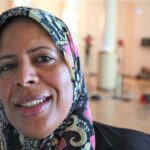
Amal Bayou (C.1957 – 24 October 201) was a respected Libyan microbiologist, university professor, women’s rights advocate, and politician who became one of the most prominent female figures in Libya’s post-revolution political landscape.

PHOTO CAPTION: Amal Bayou. SOURCE: EA Library.
Amal Bayou was born in Libya between 1957 and 1959, she grew up during a period of political transformation that would later shape her commitment to public service and reform.
From an early age, Bayou showed a deep interest in science and education. Determined to pursue advanced studies, she traveled to Germany, where she earned a doctoral degree in microbiology. Her years abroad exposed her to international academic standards and broadened her worldview. After completing her studies, she chose to return to Libya rather than remain overseas, demonstrating her dedication to contributing to her homeland’s development.
In 1995, Amal Bayou began her long academic career as a professor of microbiology at the University of Benghazi. For more than two decades, she taught students, supervised research, and contributed to scientific scholarship. She was known among colleagues and students as a disciplined scholar and a supportive mentor. Her academic background gave her credibility and a strong analytical approach that later influenced her political career.
Bayou entered national politics during one of Libya’s most challenging periods. In the 2014 parliamentary elections, she ran for a seat in the Libyan House of Representatives, representing Benghazi. She won one of the seats reserved for women and received more than 14,000 votes—one of the highest totals in the election. Her strong electoral performance reflected her popularity and the confidence voters had in her integrity and leadership.
As a member of parliament, Amal Bayou quickly gained recognition for her outspoken and independent stance. She was not afraid to criticize government officials, including senior leaders, when she believed they were failing the public. She openly called for reform, transparency, and effective governance at a time when Libya was facing division and armed conflict. During the Libyan political crisis and the Second Civil War, the House of Representatives relocated from Benghazi to Tobruk due to security concerns, and Bayou continued her parliamentary work despite the instability.
One of her most significant contributions was her advocacy for women’s political participation. Although she initially questioned the effectiveness of gender quotas, she later supported reserved seats for women as a necessary step to ensure female representation in a traditionally male-dominated political system. She also spoke at international forums, including events in Europe, highlighting the challenges faced by Libyan women in public life and calling for greater inclusion and equality.
Beyond her parliamentary duties, Bayou was involved in civil society and humanitarian efforts. She supported families affected by violence and instability and worked to promote dialogue and unity among Libyans. Her combination of academic expertise, political courage, and social commitment made her a widely respected public figure, particularly in Benghazi.
Amal Bayou passed away on 24 October 2017 after battling cancer, while still serving as a member of parliament. Her death was deeply mourned across political lines, as many viewed her as a principled leader who sought compromise and national reconciliation. She was buried in Benghazi, the city she represented and served faithfully.
Today, Amal Bayou is remembered as a symbol of educated and courageous leadership in Libya. Her life demonstrated that women can successfully combine academic excellence with meaningful political participation. Through her service, she left a legacy of integrity, reform, and dedication to her country’s progress.
EA EDITORS