THE SONGHAI EMPIRE (c. 1464–1591 CE)
- 21 Min Read
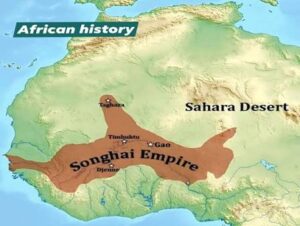
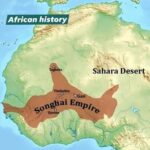
PHOTO CAPTION: Map of the Songhai Empire. SOURCE: EA Library.
OVERVIEW
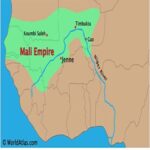
The Songhai Empire was one of the largest and most powerful empires in African history. It originated in the city of Gao, located on the banks of the Niger River in present-day Mali. Under the leadership of Sunni Ali Ber, who ruled from 1464 to 1492, Songhai transformed from a small kingdom into a sprawling empire, encompassing much of the territory previously controlled by the Mali Empire.
Rising to prominence between 1450 and 1600, it became the most expansive empire ever to emerge in West Africa. At its height, the empire stretched across parts of present-day Mali, Niger, and Nigeria, bringing together thousands of diverse peoples under a centralized administration.
The empire owed much of its success to its strategic location along the Niger River, with Gao serving as its capital. Its control of the trans-Saharan trade routes, particularly the trade in gold and salt, generated immense wealth and transformed the empire into a major political, economic, and cultural power. The cities of Gao, Timbuktu, and Djenné became renowned for commerce, scholarship, and Islamic learning.
ORIGIN AND EARLY HISTORY
The origins of the Songhai Empire can be traced to the ancient Kingdom of Gao, one of the earliest and most important kingdoms in West Africa. The Songhai people settled along the fertile banks of the Niger River, where they established farming and fishing communities. Their strategic location on the river enabled them to engage in local and long-distance trade, laying the foundation for the economic prosperity that would later transform their kingdom into a powerful empire.
The city of Gao was founded around 800 A.D. and gradually developed into a thriving commercial centre because of its position on the trans-Saharan trade routes. Merchants travelling between West Africa and North Africa stopped in Gao to exchange goods such as gold, salt, ivory, leather, and agricultural products. The wealth generated from trade enabled the city to grow into an important political and cultural centre.
During the 11th century, King Dia Kossoi established Gao as the capital of the Songhai Kingdom. He is also remembered as one of the earliest Songhai rulers to embrace Islam, largely because of the influence of Muslim traders from North Africa. Although Islam gained acceptance among the royal court and merchants, many ordinary people continued to practise their traditional African religions. Under King Dia Kossoi, the kingdom experienced peace, political stability, and increased commercial activity.
For many years, however, the Songhai Kingdom remained under the influence of more powerful neighbouring empires. During the 13th and early 14th centuries, the expanding Mali Empire conquered Gao and incorporated the Songhai Kingdom into its vast territory. Although Songhai retained some local autonomy, it remained subject to Mali’s authority and paid tribute to its rulers.
The Mali Empire reached its greatest height under Mansa Mūsā I, one of the wealthiest rulers in world history. He ruled from 1307 (or 1312) until either 1332 or 1337 and became famous for his enormous wealth, his construction of the Great Mosque of Timbuktu, and his spectacular pilgrimage (Hajj) to Mecca in 1324. During this pilgrimage, Mansa Mūsā distributed so much gold that it reportedly affected the value of the metal in parts of the Middle East for several years. His reign strengthened Mali’s international reputation and encouraged the spread of Islam and learning throughout West Africa.
Following the death of Mansa Mūsā, the Mali Empire gradually weakened due to succession disputes, internal conflicts, and difficulties in controlling its vast territories. As Mali’s authority declined, the Songhai people seized the opportunity to regain their independence. Gao once again emerged as the centre of an independent Songhai state, and its rulers began rebuilding their military and expanding their influence over neighbouring territories.
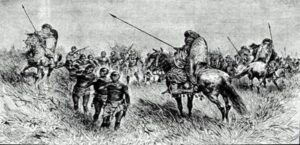
PHOTO CAPTION: Sunni Ali conquered the important cities. SOURCE: EA Library.
The transformation of the Songhai Kingdom into a great empire began in 1464, when Sunni Ali became ruler. Widely regarded as the founder of the Songhai Empire, Sunni Ali was an exceptional military commander and an ambitious statesman. He reorganized the army, strengthened the empire’s cavalry and naval forces on the Niger River, and embarked on a series of successful military campaigns that greatly expanded Songhai territory.
One of Sunni Ali’s greatest achievements was the conquest of Timbuktu in 1468. Timbuktu was one of the richest commercial centres and a renowned centre of Islamic scholarship in West Africa. Shortly afterwards, he captured Djenné, another prosperous trading city that had resisted his forces for several years before finally surrendering. The acquisition of these cities enabled Songhai to control the major commercial routes along the Niger River and the trans-Saharan trade network.
During his thirty-year reign (1464–1492), Sunni Ali transformed Songhai into the dominant power in West Africa. He fortified major cities, built a strong and disciplined military, suppressed rebellions, expanded the empire’s boundaries, and secured control over the lucrative trade in gold, salt, and other valuable commodities. His victories laid the political, military, and economic foundations upon which later rulers—especially Askia Muhammad (Askia the Great)—would build one of the largest and most prosperous empires in African history.
By the end of Sunni Ali’s reign, the Songhai Empire had surpassed the declining Mali Empire as the leading political and economic power in West Africa. Its strategic location, military strength, expanding trade networks, and growing administrative capacity prepared it for a period of remarkable prosperity and territorial expansion under the Askia dynasty.
POLITICAL ORGANIZATION AND GOVERNANCE
The Songhai Empire operated a highly centralized system of government under a powerful emperor known as the Askia after the establishment of the Askia dynasty.
Following the death of Sunni Ali in 1492, his son Sunni Baru succeeded him. However, Askia Muhammad, one of Sunni Ali’s leading generals, challenged his rule, arguing that Sunni Baru was not a devout Muslim. Askia Muhammad defeated him at the Battle of Anfao, established the Askia Dynasty, and ruled for 37 years, earning the title Askia the Great.
Askia Muhammad reorganized the empire’s administration by: Establishing an efficient tax system, appointing competent officials to oversee different regions, strengthening the central government, introducing Muslim judges (qadis) to administer justice according to Islamic law in urban centres.
These reforms created a stable and effective administrative system that enabled the empire to govern its vast territories successfully.
ECONOMIC SYSTEM
The Songhai Empire possessed one of the strongest and most prosperous economies in medieval Africa. Its economic strength was based on agriculture, trans-Saharan trade, gold production, taxation, and a well-organized commercial system. Owing to its strategic location along the Niger River, the empire became a major centre of regional and international trade, connecting West Africa with North Africa, Europe, and the Middle East.
Agriculture
Agriculture formed the foundation of the Songhai economy and provided food for the empire’s growing population. The fertile floodplains of the Niger River supported the cultivation of crops such as millet, sorghum, rice, beans, onions, and vegetables. Seasonal flooding deposited nutrient-rich silt on the land, making farming highly productive.
Most rural communities depended on farming for their livelihood, while many families also kept livestock such as cattle, sheep, goats, and camels. Fishing was another important economic activity, particularly among the Bozo people, who lived along the Niger River. Agriculture not only sustained the population but also supplied surplus food for urban markets and long-distance traders.
Trans-Saharan Trade
Trade was the lifeblood of the Songhai Empire. The empire controlled the major trans-Saharan trade routes, which linked West Africa with the markets of North Africa and the wider Islamic world. These routes enabled merchants to transport valuable goods across the Sahara Desert using camel caravans.
Because the empire controlled key trading centres such as Gao, Timbuktu, and Djenné, it was able to regulate commerce, collect taxes on goods passing through its territory, and generate enormous revenue. The strategic position of these cities made Songhai one of the wealthiest states in Africa.
Gold and Salt Trade
The wealth of the Songhai Empire was largely derived from its control of the lucrative gold and salt trade. Gold was mined in the southern regions of West Africa and was one of the empire’s most valuable exports. Salt, which was scarce in the tropical regions but essential for preserving food and maintaining good health, was brought from the Sahara Desert.
Gold and salt were often exchanged in large quantities, making them the backbone of the empire’s economy. The demand for these commodities attracted merchants from distant lands and strengthened Songhai’s commercial ties with North Africa and beyond.
Other Trade Goods
In addition to gold and salt, the Songhai Empire exported a wide variety of products, including, gold, ivory, ostrich feathers, kola nuts, leather goods, agricultural produce, and enslaved people
In return, merchants imported, salt, horses, camels, fine cloth and textiles, copper glassware, beads, books and manuscripts, luxury goods from North Africa, the Middle East, and Europe
These exchanges enriched the empire and introduced new products, technologies, and cultural influences into West Africa.
Commercial Centres
The cities of Gao, Timbuktu, and Djenné developed into thriving commercial centres that attracted merchants from across Africa, North Africa, and the Middle East.
- Gao, the imperial capital, served as the administrative and commercial headquarters of the empire. It was an important market where traders exchanged goods arriving from different parts of Africa.
- Timbuktu became famous not only for trade but also for education and Islamic scholarship. Merchants frequently combined commercial activities with religious and intellectual pursuits, making the city one of the most influential centres of learning in the medieval world.
- Djenné was a major trading centre where goods from the forests of West Africa were exchanged with products arriving from the Sahara. Its strategic location made it an important link in regional commerce.
These cities contained busy marketplaces, warehouses, caravan stations, and river ports that facilitated both local and international trade.
Taxation and Government Revenue
The Songhai government generated substantial income through an organized taxation system. Under Askia Muhammad, taxes were collected on trade, agricultural produce, and goods transported through the empire. Merchants paid customs duties at important trading centres, while provincial officials supervised the collection of taxes throughout the empire.
Currency and Trade Practices
Although barter remained common in local markets, trade within the empire also involved the use of gold dust, cowrie shells, and other forms of currency, depending on the region and the nature of the transaction. Merchants belonged to organized trading networks and travelled in caravans across the Sahara, exchanging goods with traders from Morocco, Egypt, and other parts of the Islamic world.
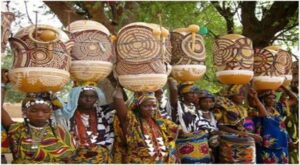
PHOTO CAPTION: Fulani women carrying elaborately decorated traditional calabash vessels. SOURCE: EA Library.
SOCIAL STRUCTURE AND DAILY LIFE
The Songhai Empire was a multicultural society made up of numerous ethnic groups, including the Songhai, Fulani, Tuareg, Mandé, Hausa, and Bozo peoples. Despite their different languages, customs, and traditions, these groups were united under the authority of the emperor and contributed to the empire’s political stability and economic prosperity. The empire’s vast territory encouraged interaction among different communities through trade, migration, and cultural exchange.
Society was generally organized into distinct social classes. At the top was the emperor (Askia), followed by members of the royal family, provincial governors, military commanders, Islamic scholars, judges (qadis), and wealthy merchants. Skilled craftsmen such as blacksmiths, leatherworkers, weavers, potters, and goldsmiths occupied an important position in society because they produced essential goods for everyday life and trade. The majority of the population consisted of farmers, fishermen, herders, and traders, while enslaved people formed the lowest social group and were employed in households, agriculture, mining, and commercial activities.
Life in the Songhai Empire differed significantly between urban and rural areas. Cities such as Gao, Timbuktu, and Djenné were bustling centres of government, commerce, education, and religion. Their markets attracted merchants from across West Africa, North Africa, and the Mediterranean world, creating vibrant multicultural communities. These cities contained mosques, schools, libraries, royal palaces, and busy marketplaces where people bought and sold goods ranging from gold and salt to textiles and livestock.
In contrast, the majority of the population lived in rural villages along the Niger River and its surrounding plains. Farming was the principal occupation, with crops such as millet, sorghum, rice, beans, and vegetables cultivated to feed local communities. The fertile floodplains of the Niger River made agriculture highly productive. Fishing was another important occupation, especially among the Bozo people, while pastoral groups such as the Fulani raised cattle, sheep, and goats. Rural communities were largely self-sufficient, producing food, clothing, and simple household items for their own use.
Family formed the foundation of Songhai society. Extended families often lived together and shared responsibilities for farming, child-rearing, and caring for the elderly. Respect for elders was deeply valued, as they served as custodians of tradition and advisers in community affairs. Marriage was regarded as an important social institution that strengthened family ties and alliances between communities.
Women played significant roles in both family and economic life. They were responsible for managing households, preparing food, raising children, and participating in agricultural activities. Many women also engaged in local trade by selling foodstuffs, cloth, pottery, and other goods in village and city markets. In some communities, women accumulated considerable wealth and influence through commerce.
Education and learning occupied an important place in urban society, particularly under the reign of Askia Muhammad. Children in Muslim families often attended Qur’anic schools, where they learned to read and write Arabic and studied Islamic teachings. Meanwhile, traditional forms of education remained common in rural areas, where young people learned farming, fishing, herding, craftsmanship, and community values through practical experience and oral instruction from elders.
Religion also shaped daily life. Islam became the dominant religion in major towns and among the ruling elite, merchants, and scholars. Mosques served not only as places of worship but also as centres of education and community life. However, many rural inhabitants continued to practise traditional African religions, honouring ancestral spirits and observing indigenous rituals alongside or instead of Islamic practices. This peaceful coexistence of Islam and indigenous beliefs reflected the empire’s rich cultural diversity and religious tolerance.
RELIGION AND BELIEF SYSTEMS
Religion was a central aspect of life in the Songhai Empire, influencing its government, legal system, education, culture, and daily activities. Although the empire was home to people of different religious backgrounds, Islam became the dominant religion among the ruling class, merchants, scholars, and urban populations, while traditional African religions remained widely practised in rural communities. The peaceful coexistence of these belief systems contributed to the empire’s cultural diversity and social stability.
Islam had been introduced into the Songhai Empire through trans-Saharan trade long before the empire reached its height. Muslim merchants from North Africa brought not only goods but also Islamic beliefs, customs, and learning. Over time, many rulers and wealthy traders embraced Islam because it strengthened diplomatic and commercial relations with other Muslim states across North Africa and the Middle East.
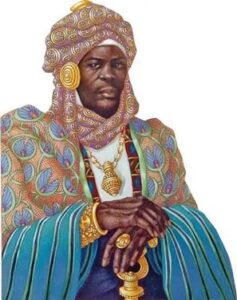
PHOTO CAPTION: Askia the Great. SOURCE: EA Library.
The spread of Islam accelerated significantly during the reign of Askia Muhammad (Askia the Great), who made Islam the official religion of government after seizing power in 1493. A devout Muslim, Askia Muhammad undertook the pilgrimage (Hajj) to Mecca, where he established diplomatic ties with other Muslim leaders and gained recognition as a legitimate Islamic ruler. His pilgrimage also enhanced the international reputation of the Songhai Empire within the Islamic world.
Upon returning from Mecca, Askia Muhammad introduced several reforms to strengthen Islam throughout the empire. He appointed qadis (Islamic judges) to administer justice according to Sharia (Islamic law), particularly in the major towns and cities. These judges handled matters relating to marriage, inheritance, trade, and other civil disputes among Muslims. Islamic principles also influenced government administration, taxation, and public morality.
Askia Muhammad was a strong supporter of Islamic education. He invited distinguished scholars from Morocco and Egypt to settle in the empire and establish schools for the teaching of the Qur’an, Islamic law, Arabic language, theology, and other subjects. He also increased financial support for teachers and scholars, particularly in Timbuktu, which developed into one of the greatest centres of Islamic learning in Africa. Famous institutions such as the Sankore Mosque and University attracted students from across West Africa and the wider Muslim world.
Mosques served as important centres of worship, education, and community life. Besides being places for daily prayers, they functioned as schools where children learned to read and write Arabic and received instruction in Islamic teachings. Friday congregational prayers brought together members of the community and strengthened social unity.
Despite the widespread influence of Islam, traditional African religions continued to flourish, especially in villages and rural areas where most of the population lived. Many people worshipped ancestral spirits, believed in the existence of supernatural forces, and performed rituals to seek protection, fertility, healing, and good harvests. Religious ceremonies often included music, drumming, dancing, sacrifices, and festivals that celebrated important events in the community.
In many parts of the empire, Islam and traditional beliefs coexisted peacefully. Some individuals practised Islam while still observing certain indigenous customs and rituals, resulting in a blend of religious traditions. This religious tolerance allowed people of different beliefs to live together without widespread conflict and contributed to the unity of the vast empire.
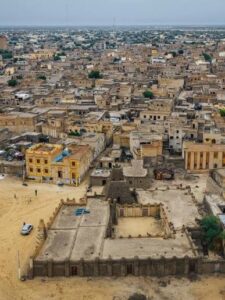
PHOTO CAPTION: View of city of Timbuktu. SOURCE: EA Library.
CULTURAL AND INTELLECTUAL LIFE
The Songhai Empire became one of Africa’s greatest centres of learning and culture. The city of Timbuktu gained international recognition as a centre of Islamic scholarship, attracting students and scholars from across Africa and the wider Islamic world. Its famous schools and libraries preserved knowledge in subjects such as theology, law, mathematics, astronomy, medicine, and literature.
Askia Muhammad greatly promoted education by bringing scholars from Morocco and Egypt, establishing new schools, and increasing the salaries and pensions of teachers and professors in Timbuktu.
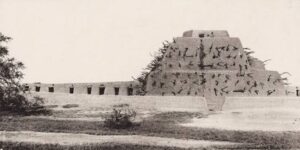
PHOTO CAPTION: The tomb of Askia. SOURCE: EA Library.
Gao also flourished as a cultural centre, with important landmarks such as the Gao Mosque and the Tomb of Askia, the burial place of Songhai rulers.
DECLINE AND FALL
The decline of the Songhai Empire began in the late 16th century and resulted from a combination of internal political instability, economic difficulties, environmental challenges, and foreign invasion. Although the empire had reached its greatest height under Askia Muhammad (Askia the Great), it gradually weakened after his reign as successive rulers struggled to maintain effective control over its vast territories.
Internal Weaknesses
One of the major causes of Songhai’s decline was political instability. After the death of Askia Muhammad, disputes over succession became common, leading to frequent civil wars, palace intrigues, conspiracies, and military coups. Rival members of the royal family competed for the throne, creating divisions within the empire and weakening the authority of the central government.
Many of Askia Muhammad’s successors lacked the administrative ability and military leadership required to govern such an extensive empire. Provincial governors became increasingly independent, while local chiefs often ignored the authority of the emperor. As a result, law and order deteriorated, and the empire became more difficult to administer.
Economic Decline
Political instability also weakened the empire’s economy. Continuous conflicts disrupted agricultural production and trade, reducing government revenue. Merchants became reluctant to travel through insecure regions, causing a decline in commercial activities along the trans-Saharan trade routes.
The empire’s wealth had long depended on its control of the gold and salt trade, but internal disorder reduced its ability to protect these valuable trade networks. As trade declined, the government found it increasingly difficult to finance its army and maintain public administration.
Environmental Challenges
Environmental factors further contributed to the empire’s decline. Periods of drought reduced agricultural output, leading to food shortages in some areas. Outbreaks of disease also affected both the population and livestock, reducing productivity and weakening the empire’s economic base. These hardships placed additional pressure on an already unstable government.
The Moroccan Invasion
While the Songhai Empire was weakened by internal problems, its immense wealth attracted the attention of Sultan Ahmad I al-Mansur Saadi of Morocco. The Moroccan ruler sought to control the rich gold fields of West Africa and dominate the lucrative trans-Saharan trade in gold and salt. He also hoped to strengthen his political influence and establish himself as the leading ruler of the western Sudan.
In 1590, Sultan Ahmad al-Mansur dispatched an expeditionary force across the Sahara Desert under the command of Judar Pasha. Although the Moroccan army was relatively small, it possessed a decisive military advantage: gunpowder weapons, muskets, and cannons. These modern firearms gave the Moroccans a significant advantage over the Songhai army, which relied mainly on swords, spears, bows, arrows, and cavalry.
The Battle of Tondibi (1591)
The decisive confrontation occurred at the Battle of Tondibi in 1591, during the reign of Askia Ishaq II, the last emperor of the Songhai Empire. Despite greatly outnumbering the Moroccan forces, the Songhai army was unable to overcome the superior firepower of its opponents.
Historical accounts state that the Songhai commanders even attempted to drive a herd of cattle toward the Moroccan lines to break their formation. However, the sound of gunfire frightened the animals, causing them to stampede back into the Songhai ranks and create confusion among their own soldiers.
The Moroccan army eventually defeated the Songhai forces, marking one of the most significant turning points in West African history. The defeat shattered the military power of the empire and brought an end to its position as the dominant state in the region.
Aftermath of the Conquest
Following their victory, the Moroccans occupied important cities such as Gao, Timbuktu, and Djenné. However, they soon discovered that conquering the Songhai Empire was much easier than governing it. The empire covered an enormous territory, making communication and administration extremely difficult.
Local rulers and communities continuously resisted Moroccan rule through rebellions and acts of defiance. Persistent resistance disrupted trade, reduced tax revenues, and weakened Moroccan authority. The costs of maintaining troops so far from Morocco also became increasingly burdensome.
Unable to exercise effective control over the region, Moroccan influence gradually declined, and by 1661, most Moroccan forces had withdrawn from the former Songhai territories.
Attempts to Restore the Empire
Although the empire had collapsed, the Songhai people did not completely abandon their political traditions. Several rulers continued to bear the title Askia and attempted to preserve the institutions and heritage of the old empire. These rulers established smaller successor states and sought to restore political unity.
However, their efforts achieved only limited success. Internal divisions, reduced economic resources, and the loss of control over the major trade routes prevented any meaningful restoration of the empire’s former greatness. The once-powerful Songhai Empire remained fragmented into smaller kingdoms and chiefdoms.
Final End of the Songhai Empire
During the 19th century, European colonial expansion reached West Africa. As France extended its colonial rule across the region, the remaining Songhai territories gradually fell under French control. By 1901, the last remnants of the old Songhai political system had been incorporated into the French colonial empire, bringing a definitive end to one of Africa’s greatest civilizations.
Legacy of the Collapse
Although the Songhai Empire disappeared as a political power, its influence endured long after its fall. Its achievements in government administration, commerce, education, Islamic scholarship, architecture, and trans-Saharan trade continued to shape the history of West Africa. The cities of Gao, Timbuktu, and Djenné remained important symbols of African civilization and learning, while the empire’s administrative practices and cultural traditions influenced many later West African states.
The fall of the Songhai Empire marked the end of nearly a thousand years of successive West African empires, Ghana, Mali, and Songhai that had dominated trade and politics in the region. Today, the Songhai Empire is remembered as one of the greatest civilizations in African history, celebrated for its remarkable achievements and lasting contributions to governance, education, commerce, and culture.
CONCLUSION
The Songhai Empire remains one of the most remarkable civilizations in African history. Through strong leadership, efficient administration, flourishing trade, military strength, and a commitment to education and scholarship, it achieved extraordinary political, economic, and cultural success. Although internal conflicts, environmental challenges, and the Moroccan invasion led to its decline, the empire’s legacy continues to inspire admiration. Its contributions to governance, commerce, Islamic scholarship, and West African civilization remain an enduring testament to the achievements of pre-colonial Africa.
EA EDITORS