STRIJDOM, JOHANNES GERHARDUS
- 5 Min Read
Johannes Gerhardus Strijdom (July 14, 1893-August 24, 1958) was an outspoken nationalist leader in the Transvaal who served as prime minister, furthering Afrikaner republicanism, notably by having one flag and anthem declared for all and overseeing the emplacement of the bulwark of legislation that is known as the apartheid system.
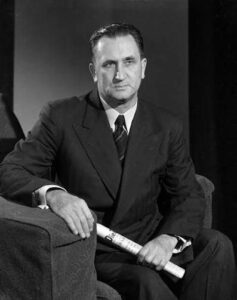
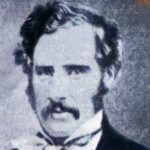
PHOTO CAPTION: Johannes Gerhardus Strijdom. SOURCE: EA Library.
He was born in Klipfontein, one of the 11 children of Pieter Strijdom, a farmer, and Elizabeth (née Nortje). Strijdom grew up as a typical lad of the veld whose first love was, and remained, farming. He attended school at Willowmore and French Hoek and from 1910 to 1912 studied for his B.A. at the Victoria College, Stellenbosch.
On obtaining his degree he returned to Willowmore to take up ostrich farming, but the collapse of the feather market soon forced him to look elsewhere for a livelihood, and he left for Pretoria in 1914 to enter the civil service. As an extramural student at the University of Pretoria he obtained his LL.B. and was admitted to the bar in 1918. He left for Nylstroom where he set up practice as an attorney.
Although he had hitherto shown no political ambitions, shortly after his arrival he was elected secretary of the divisional committee of the National Party (N.P.) and soon proved himself an able organizer. His success as a professional man enabled him to buy the farm Elsjeskraal on the Springbok Flats, and he later practiced cattle farming in partnership with his brother Raymond at Sandvlakte.
By 1929 Strijdom was a well-to-do and leading personality in the district. When, in the same year, the sitting National Party member of Parliament, P. le R. van Niekerk, was made Senator, Strijdom appeared to be his obvious successor. Shortly after his election Strijdom found himself in the political wilderness, for with coalition (1933) and fusion (1934) of the National and South African Parties, he was one of a minority of nationalists who refused to enter fusion. With others he set about rebuilding the National Party.
The outcome was the founding of the Purified National Party. As the N.P.’s only member of Parliament in the Transvaal, he initiated a vigorous campaign to win supporters. He campaigned for many years, using much of his own money to further party interests; lack of time for his own affairs forced him to sell his legal practice.
On the face of it Strijdom was fighting a losing battle, without even the support of a newspaper. This problem was solved when, on the initiative of leading Cape Nationalists, a company was formed, and Die Transvaler made its appearance as an N.P. organ on October 1, 1937.
With the support of the paper, under the editorship of Dr. H.F. Verwoerd, Strijdom redoubled his efforts. Political results were, however, seemingly negligible, for the elections of 1938 still left the member of Waterberg as the Transvaal’s sole N.P. representative in Parliament.
The tide was nevertheless turning, and Strijdom saw the first tangible results of his efforts when in 1943 the N.P. won 11 seats in the Transvaal. These were traumatic years for Strijdom, fighting not only the opposition but also fellow Afrikaner supporters of N.C. Havenga’s Afrikaner Party, Oswald Pirow’s New Order and Hans van Rensburg’s Ossewa-Brandwag, a quasi-military cultural organization that aimed at the establishment of a dictatorship.
His endeavors were not in vain, for the 32 seats won by the N.P. in the Transvaal in 1948 brought his party to power under Dr. D.F. Malan. By then, as leader of the Transvaal Nationalists, the outspoken Lion of Waterberg was a strong man in politics. That was why many of his supporters regarded it as a snub when Malan offered him, and he accepted, the junior portfolio of lands and irrigation in his first cabinet. This slight was redressed in 1954 at the time of Prime Minister Malan’s retirement, when Malan’s attempt to have his friend Havenga take over the prime ministership was foiled. Rather, Strijdom was chosen to lead the National Party.
Strijdom, whose two main political platforms for years had been white mastery (baasskap) and full republican independence, immediately found himself the center of a protracted constitutional crisis concerning the Government’s desire to place the Coloured voters on a separate roll. Under his guidance and by dubious means (a packed Senate and Appeal Court), the crisis was solved for the Government. The Separate Representation of Voters Act was passed by Parliament, and the Coloured voters were removed from the common roll.
Strijdom also brought the Afrikaners closer to their republican ideal by having Parliament proclaim one flag and one anthem for all, including English-speaking South Africans who still cherished the British flag and anthem. Unbeknownst to his rank-and-file followers, Strijdom was already a sick man when he became prime minister.
In 1958 illness prevented him from attending the opening session of Parliament, but he recuperated somewhat and saw his party win the elections of that year by an increased majority, with 48 of the Transvaal seats going to the N.P. Shortly afterwards he had a relapse and died in hospital in Cape Town, to be succeeded by H.F. Verwoerd, his Transvaal compatriot since 1937.
Strijdom is best characterized as an ardent Afrikaner nationalist who sought the eradication of British interests in South African national life and the complete subordination of all black South Africans, Indian, African or Coloured. His five years as Prime Minister were highly eventful, as the policy of “Separate Development” was applied.
The outcome of his leadership included the prohibition of non-racial unions and universities, the complete and total segregation of urban areas, and the prosecution of any dissenting voices raised against these policies. His successor, H.F. Verwoerd, agreed and continued Strijdom’s policies with vigor.
A. J. VAN WYK