NYERERE, JULIUS KAMBARAGE
- 5 Min Read
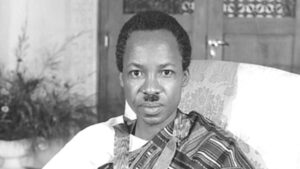
PHOTO CAPTION: Julius Nyerere. SOURCE: juliusnyerere.org
Julius Kambarage Nyerere (April 13, 1922 – October 14, 1999), popularly known as Mwalimu (Swahili for “teacher”), was a Tanzanian statesman, political theorist, and Pan-Africanist. He was a central figure in the African independence movement and the founding father of the United Republic of Tanzania. Nyerere served as Prime Minister of Tanganyika from 1961 to 1962, President of Tanganyika from 1962 to 1964, and first President of Tanzania from 1964 until his voluntary retirement in 1985.
Nyerere was born in Butiama, near the eastern shores of Lake Victoria in north-western Tanganyika (now Tanzania), to Chief Burito Nyerere, a leader of the Zanaki people. He began formal schooling at the age of twelve, attending Musoma Government Primary School, before proceeding to Tabora Boys Government Secondary School, one of the leading missionary and government schools of the period.
He later enrolled at Makerere University College in Kampala, Uganda, then the principal institution of higher learning in East Africa, where he earned a teaching diploma. In 1949, Nyerere received a scholarship to study at the University of Edinburgh in Scotland, becoming the first Tanganyikan to study at a British university. He completed a Master of Arts degree in History and Economics in 1952. During his time in Edinburgh, he became politically active and was influenced by Fabian socialist thought, which shaped his later ideas on African socialism and self-determination.
After returning to Tanganyika in 1952, Nyerere worked as a teacher at St. Mary’s Secondary School in Tabora and later at St. Francis’ College near Dar es Salaam. His commitment to education earned him the enduring title Mwalimu. In 1954, he founded the Tanganyika African National Union (TANU), which unified various nationalist movements and became the primary vehicle for the struggle for independence.
Nyerere emerged as a leading advocate for independence, addressing the United Nations Trusteeship Council and mobilizing popular support across ethnic and regional divisions. Tanganyika achieved independence from British rule in 1961, with Nyerere becoming its first Prime Minister. In 1962, the country became a republic, and Nyerere was elected its first President.
In 1964, following the Zanzibar Revolution, Nyerere played a key role in negotiating the union of Tanganyika and Zanzibar, forming the United Republic of Tanzania, of which he became the first President.
Nyerere’s leadership was marked by the adoption of African socialist principles, articulated in the Arusha Declaration of 1967. Central to this philosophy was Ujamaa (“familyhood”), which emphasized collective responsibility, equality, rural development, and national self-reliance. Nyerere believed that African societies traditionally valued communal cooperation and that these principles could provide a foundation for a just and independent post-colonial state.
While Ujamaa achieved notable successes in literacy expansion, national unity, and access to basic healthcare, its economic outcomes were mixed. Agricultural productivity declined, and Tanzania became increasingly dependent on food imports during the 1970s. These difficulties were exacerbated by droughts, global economic shocks, and the 1979 war with Uganda. Despite acknowledging these shortcomings, Nyerere continued to regard socialism as morally appropriate for developing societies.
Nyerere was a leading advocate of Pan-Africanism and a founding member of the Organization of African Unity (OAU) in 1963. Tanzania under his leadership became a base for several African liberation movements, including the African National Congress (ANC) and Pan Africanist Congress (PAC) of South Africa, FRELIMO of Mozambique, and ZANLA of Zimbabwe.
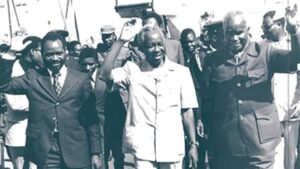
PHOTO CAPTION: President Samora Machel of Mozambique (left), Nyerere and President Kenneth Kaunda of Zambia (right). SOURCE: juliusnyerere.org
Together with President Kenneth Kaunda of Zambia, Nyerere was a prominent leader of the Front-Line States, which supported the struggle for majority rule in southern Africa. In 1979, Tanzania intervened militarily against Idi Amin’s regime in Uganda following cross-border incursions, leading to Amin’s overthrow. Throughout the Cold War, Nyerere pursued a policy of non-alignment, maintaining relations with both Western and Eastern bloc countries.
In 1985, after more than two decades in power, Nyerere voluntarily retired, becoming one of the earliest African heads of state to transfer power peacefully. He was succeeded by Ali Hassan Mwinyi, under whose leadership Tanzania began gradual economic liberalization. Nyerere remained Chairman of Chama Cha Mapinduzi (CCM) until 1990 but refrained from direct involvement in government policy.
In retirement, Nyerere returned to his home village of Butiama while remaining active internationally. He chaired the South Commission, advocating for equitable global development, and served as chief mediator in the Burundi peace process from 1996. In addition to political writings, he translated William Shakespeare’s Julius Caesar and The Merchant of Venice into Swahili.
Nyerere died of leukemia on 14 October 1999 in London, aged 77. He is remembered for his role in nation-building, promotion of education, commitment to social justice, and moral leadership. Although his economic policies remain debated, his emphasis on unity, peaceful governance, and African self-reliance has secured his place as one of the most respected figures in modern African history.
EA EDITORS