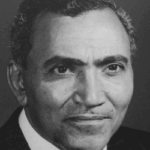
GBANYA LANGO
- 4 Min Read
Gbanya Longo (18?-1878) was the last great ruler of the Kpaa-Mende (the western branch of the Mende, in south central Sierra Leone) in the pre-colonial period. He distinguished himself in the third quarter of the 19th century as an outstanding organiser of professional warriors.
By the 1850s he had already gained prominence in warfare and had carried out many campaigns on behalf of Genjei, his uncle, who was then the ruler. In accordance with Mende law, on the death of Genjei, he took one of his late uncle’s widows, Yoko, as his wife. She in turn was to succeed to the rulership of the Kpaa-Mende when Gbanya died in 1878.
From 1860 onwards, Gbanya was described officially as a “friendly ally with the Government.” In 1861 he was asked to come to the assistance of Col. Sir Stephen John Hill, governor from 1854-62, who had annexed part of Koya Temne (a chiefdom east of Freetown) to the Colony in order to stop Temne attacks on peaceful traders. When a Loko (a Mande group in northwest Sierra Leone) trader under British protection reported being molested by the Temne, Hill “bought war” from Gbanya, who led several hundred Mende to defeat the Temne.
His help was again asked in 1873, when Garnet Joseph Wolseley (1833-1913), (later Lord Garnet Wolseley), commander-in-chief of the colony, engaged in war against the Asante (Ashanti) of what is now Ghana, ostensibly to check an invasion of the British Gold Coast protectorate. A Mende contingent was raised- 125 from Waterloo, 27 km (17 mi) southeast of Freetown, and 35 sent by Gbanya from Taiama on the Tai (Jong) River, once the capital of the Kpaa-Mende. Gbanya’s force was led by his son, Kong Gbanya.
Gbanya had meanwhile moved his administrative capital from Taiama further east to Senehun. Technically speaking, Senehun was in Sherbro country, but the territory had been given to the Kpaa-Mende by R.C.B. Caulker, in return for a wife, several years earlier. A Krio (Creole) trading center on the Bumpe River, Senehun provided a waterside point to which tradesmen from the interior came to exchange their produce for European merchandise (it remained the capital of Kpaa-Mende until 1902, when it was moved to Moyamba.)
In 1875, Gbanya became implicated in a serious dispute which arose between Chief George Stephen Caulker of Shenge (a chiefdom on the coast opposite the Plantain Islands), and his speaker (deputy) and cousin, John. John hired Kpaa-Mende mercenaries to fight for him under his chief associates, Kinigbo and Vana, in a war which became known as the Kinigbo war. Ignoring the so-called British frontier, Gbanya’s mercenaries swooped into Bagru country (a Sherbro chiefdom in southern Sierra Leone) in a campaign of plunder and destruction.
Samuel Rowe, acting governor (who was later to serve as governor from 1877-80 and from 1885-88), held Gbanya responsible for allowing his warriors to take part in the war, and sent the commandant of Bonthe, Darnell Davis, on a punitive expedition which was beaten off. Rowe himself then took to the field with a force of regulars, police, and Kru labourers (migrant workers from Liberia), using for the first time colonial force in Bagru and Kpaa-Mende.
Rowe used typically high-handed methods; he had Gbanya flogged when he came to protest his innocence of the raid. He also burned towns whose people he suspected of being accomplices in the raid. He summoned a meeting of chiefs at Senehun where an agreement was signed in which rulers were under threat of losing their jurisdiction if they did not honour the terms, one of which was that all disputes must be submitted to the governor. The Mende raiders were fined 10,000 bushels of rice. The ring-leaders, John Caulker, Kinigbo, and Vana, were found guilty of murdering a policeman on British territory, and were hanged at Bendu, opposite Sherbro Island.
Gbanya was nonetheless still considered one of the greatest allies of the British, though he was neither in treaty with them, nor received a stipend from them. Lord Kimberley, British Secretary of State for the Colonies from 1871-74, noted that: “Gbanya has been long distinguished for his friendly disposition to this Government.” Before his death in July 1878, Gbanya gave permission for the opening of a Church of God mission at Senehun.
ARTHUR ABRAHAM