TAFAWA BALEWA, ABUBAKAR
- 4 Min Read
Abubakar Tafawa Balewa (1912-1966) was a Nigerian statesman, politician, deputy leader of the Northern People’s Congress (NPC), and Nigeria’s first federal Prime Minister during both the colonial and independent periods. He had the singular distinction of being the only one to have held that position in the history of Nigeria. He advocated for African unity and was a founding member of the Organisation of African Unity (OAU), now known as the African Union (AU), which aimed to foster cooperation and solidarity among African nations.
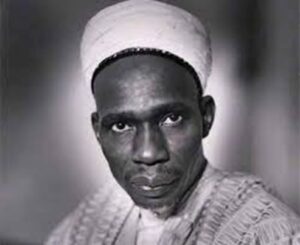
PHOTO CAPTION: Tafawa Balewa. SOURCE: Historyville.
Balewa was born to Yakubu Dan Zala, a Gere tribal man, in December 1912 in what is now Bauchi State, within the Northern Nigeria Protectorate. His mother, Fatima Inna, was of mixed Gere and Fulani descent. His father worked in the house of the district head of Lere, a district in the Bauchi Emirate.
He received his primary education in Tafawa Balewa Province from 1922 to 1925 and then attended Bauchi Middle School in Bauchi from 1925 to 1928. Afterwards, Balewa went to Katsina Teachers Training College from 1928 to 1933, where he earned his teaching certification. He became a teacher and was one of the first Northern Nigerians to study at the London University Institute of Education in 1945. He returned to Nigeria in 1946. Upon his return, he took on the role of Inspector of Schools under the colonial administration.
Balewa thereafter entered public service and politics; he was elected to the House of Assembly of the Northern Region, marking his formal entry into legislative work. The following year, in 1947, he became one of the Northern Region’s representatives to the Central Legislative Council in Lagos.
In 1952, Balewa was appointed Federal Minister of Works, and in 1954, he became Minister of Transport. As Prime Minister, Balewa helped shape Nigeria’s early foreign policy. In 1960, he was instrumental in negotiating a settlement between factions in the Congo Civil War.
After Nigeria attained self-government, Tafawa personally took charge of the portfolio of external relations of the country. He doubled as the Foreign Affairs advocate of Nigeria from 1960 to 1961, leading his government in a vocal protest of the Sharpeville Massacre in South Africa. He attempted unsuccessfully to persuade other British Commonwealth nations to expel South Africa because of its apartheid policies.
After Nigeria attained independence from British colonial rule on October 01, 1960, Balewa continued as Prime Minister of the newly independent nation, while Dr. Nnamdi Azikiwe served as Governor‑General and later as President when Nigeria became a republic in 1963.
By the mid-1960s, political tensions had grown stronger. Disputes over elections, regional issues, and ethnic mistrust led to a military coup on January 15, 1966, which abruptly ended the First Republic. Sir Abubakar Tafawa Balewa was removed from office and, along with other political leaders, assassinated in an army coup by a group of young military officers unhappy with the country’s political situation, just six years after Nigeria gained independence from Britain. This marked the end of Nigeria’s first civilian government.
Balewa was one of the African leaders who encouraged the formation of the Organisation of African Unity (OAU), currently referred to as the African Union.
His commitment to social justice and economic development led to the establishment of various national projects, including the Nigerian Television Authority (NTA) and the Central Bank of Nigeria. These initiatives aimed to empower Nigerians and promote national unity through shared values and aspirations.
He presided over Nigeria’s transition from British colonial rule to full independence and its early years as a sovereign nation. His leadership spanned a crucial period in which Nigeria established its federal structure, navigated regional diversity, and positioned itself in early post‑colonial African diplomacy.
Abubakar Tafawa Balewa’s legacy extends far beyond Nigeria’s borders. His principled stance on African liberation and anti-colonialism earned him the respect of fellow African leaders and the international community.
EA EDITORS