
MAZI MBONU OJIKE
- 4 Min Read
Mazi Mbonu Ojike (1912-1959) was an outspoken and fearless Nigerian nationalist, pan-Africanist, African cultural crusader, author, and activist for social justice and racial equality. He coined the famous phrase “Boycott the Boycottables”, urging Nigerians to reject unnecessary European imports and embrace indigenous foods, clothing, and traditions, which earned him the title “Boycott King.”
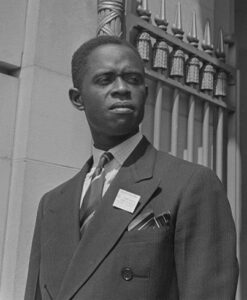
PHOTO CAPTION: Mazi Mbonu Ojike. SOURCE: EA Library.
Mazi was born in 1914 into the family of Mgbeke and Mbonu Emeanlulu in Arondizuogu, South-east Nigeria. He had his elementary education at CMS School, Arondizuogu. In 1929, he entered CMS Teachers Training College, Awka, to train as a teacher, finishing training in 1931. Ojike soon gained employment at Dennis Memorial Grammar School, Onitsha. At the school, he was a choirmaster, Sunday school supervisor, and school organist. Due to discrimination, Ojike led an agitation for more pay for junior teachers at Dennis Memorial Grammar School, stressing that “the salaries of junior teachers ought to have been increased when salaries of their senior colleagues were increased.” He resigned from the teaching job at the school and worked as an agent for West African Pilot.
Motivated by the writings of James Aggrey and Azikiwe, Ojike decided to pursue further education abroad. In November 1938, he left Nigeria for higher education. He eventually bagged a Bachelor’s in Economics from the University of Ohio, United States of America. His colleagues were Dr. Kwame Nkrumah, who later became President of Ghana, and other pioneer members of the African Students Association of America and Canada.
Ojike also pursued studies at Ohio and Chicago universities, obtaining both B.A. and M.A. degrees. As a student activist, he served as President of the African Students Union at Lincoln University, Secretary‑General of the African Academy of Arts and Research founded by Mbadiwe, and participated as an observer at the historic United Nations Conference on International Organisations in San Francisco in 1945.
While in the United States, He published three books in his three years there: Portrait of a Boy in Africa (1945), My Africa (1946), and I have Two Countries (1947). Ojike masterfully and succinctly portrayed for his foreign audience the identity and integrity of African culture in his first two books, and his penetrating analysis, as one writer put it, was further pointed in his third book when, in recording his American experience, Ojike probed beneath the glitter of the American dream to draw illuminating comparisons with life in Africa.
The message in his third book was said to be for both his country and to all humanity: “I am not proud of what our world has been nor of what it is; I am proud to join men and women of goodwill to make our civilisation what it ought to be.”
After returning to Nigeria, Ojike entered politics under the mentorship of Azikiwe. He became an automatic member of the National Council of Nigerian Citizens (NCNC), which Azikiwe also belonged to, and used the platform to denounce colonial rule
He rose quickly to positions of prominence in the NCNC and regional government. He was an adviser to the NCNC delegation to the 1949 constitutional conference, deputy mayor of Lagos, NCNC National Vice President, member of Eastern House of Assembly, and Eastern Regional Minister of Works and later, Finance. In journalism, he was the General Manager of West African Pilot. He was also a successful businessman.
He became renowned during the struggle for independence through his weekly column in the West African Pilot newspaper, “Weekend Catechism.” This medium served as an avenue to orient the perceptions of his readers on the cultural perspectives of independence. His thoughts were that the attachment of British culture was another form of enslavement.
He popularised the use of “Mazi” as a cultural honorific, replacing “Mr.”, and championed Africanisation in everyday life. His writings and speeches inspired confidence in African identity at a time when colonial influence was pervasive.
He died on November 29, 1956, at Parklane Hospital, Enugu and was buried the next day.
EA EDITORS