QUEEN NZINGA MBANDE
- 3 Min Read
Queen Nzinga Mbande (c.1583 – 17 December 1663) was one of the most formidable female leaders in African history, renowned for her diplomatic brilliance, military leadership, and unyielding resistance to Portuguese colonial expansion in Central Africa. Ruling the kingdoms of Ndongo and Matamba (in present-day Angola), she emerged as a powerful symbol of African sovereignty, political resilience, and anti-colonial resistance during the seventeenth century. Over a reign spanning more than four decades, Queen Nzinga successfully defended her people’s autonomy against European domination and the transatlantic slave trade.
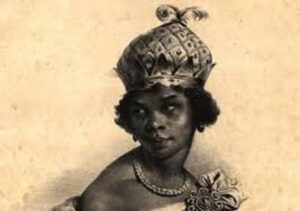
PHOTO CAPTION: Queen Nzinga Mbande. SOURCE: EA Library.
Born in 1583 in the kingdom of Ndongo, Nzinga was the daughter of King Kiluanji Kia Samba and Queen Kangela. Raised within the royal court, she received a rigorous education uncommon for women of her time, mastering statecraft, military strategy, and multiple languages, including Portuguese.
Her early exposure to governance and diplomacy prepared her for the complex political challenges that would later define her rule. From a young age, she demonstrated exceptional intelligence, confidence, and an acute understanding of power relations.
Nzinga first rose to prominence in 1622 when she represented her brother, King Ngola Mbande, in diplomatic negotiations with the Portuguese in Luanda. During these talks, she famously asserted her equality by refusing to sit on the ground as protocol demanded, instead using the back of an attendant as a seat, an act that became emblematic of her defiance and political acumen. Her negotiations temporarily secured peace and recognition of Ndongo’s sovereignty, though Portuguese aggression soon resumed.
Following her brother’s death in 1624, Nzinga assumed power amid intense internal and external opposition. Declaring herself queen, she strategically relocated her base to the kingdom of Matamba, which she transformed into a strong, centralised state and a haven for those fleeing enslavement.
As ruler, she reorganised the military, formed alliances with neighbouring African states, and later aligned with the Dutch to counter Portuguese influence. Her leadership combined military resistance with calculated diplomacy, enabling her to sustain independence for decades.
Queen Nzinga was also a shrewd political strategist who adapted to changing circumstances. At various points, she converted to Christianity for diplomatic advantage, adopting the name Ana de Sousa, while continuing to uphold indigenous political traditions.
Her reign was marked by continuous warfare, negotiation, and state-building, all aimed at protecting her people from subjugation and exploitation. Through her leadership, Matamba became one of the most powerful and stable states in the region.
She died on 17 December 1663 at approximately 80 years of age, having ruled for over forty years. At the time of her death, Queen Nzinga had secured the survival and sovereignty of her kingdom in an era when many African states succumbed to colonial domination. Her passing marked the end of a remarkable life dedicated to resistance, leadership, and self-determination.
Queen Nzinga’s legacy endures as a symbol of courage, intelligence, and uncompromising resistance to oppression. She is celebrated across Africa and the African diaspora as a pioneering female leader who challenged both colonial power and patriarchal norms. She remains an enduring inspiration for movements advocating African unity, women’s leadership, and historical justice. Her life stands as a testament to the power of strategic resistance and visionary leadership in the face of overwhelming odds.
EA EDITORS