
MASINDE, ELIJAH
- 3 Min Read
Elijah Masinde (c. 1910 –1987) was a Kenyan Bukusu prophet, religious reformer, and anti-colonial activist who founded Dini ya Musambwa meaning “Religion of the Ancestors” or “Religion of the Spirits”, an indigenous faith movement that rejected Christian missions and British authority while reviving traditional Luhya spiritual practices, including ancestor veneration and ritual circumcision.
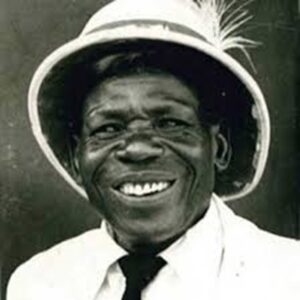
PHOTO CAPTION: Elijah Masinde. SOURCE: Paukwa.
Elijah Masinde was born in the early 20th century in Kimilili, located in present-day Bungoma County, Kenya. He belonged to the Bukusu people, a sub-ethnic group of the Luhya ethnic community in western Kenya.
Masinde grew up immersed in Bukusu traditions, where male initiation rites are centred on circumcision without anesthesia which marked the transition from boyhood to manhood, emphasising courage, stoicism, and communal responsibilities.
He was a talented footballer who captained local teams and is widely reported to have represented Kenya in the Gossage Cup, including a match against Uganda around 1930 before visions prompted his shift to spiritual leadership around the mid-1930s.
He established Dini ya Musambwa in the early 1940s in Maeni village, Kimilili Sub-County, Bungoma County, Kenya, among the Bukusu people. This was not just a religious group, it was a bold protest movement against British colonial rule and the missionary churches that sought to suppress African traditions. The movement emerged during World War II under British colonial rule, as a hybrid faith integrating traditional Bukusu ancestor veneration with selective Christian elements, particularly Old Testament narratives reinterpreted to affirm African cultural identity.
Masinde believed that Christianity, Western education, and European legal systems were being used as instruments to spiritually and economically subjugate Africans. He therefore preached that Africans must resist these influences and reclaim their cultural and religious independence. His teachings attracted thousands of followers across western Kenya and parts of Uganda.
He strongly condemned colonial policies such as land alienation, forced labour, taxation, and the destruction of African shrines and customs. As a result, he came into direct confrontation with colonial authorities. Masinde clashed not only with the British colonial administration but also with African collaborators and Christian missionaries.
In response, the British authorities labelled him a dangerous rebel and a “witch doctor,” a common strategy used to discredit African spiritual leaders. He was arrested multiple times, detained, and persistently harassed by the colonial government.
Masinde was imprisoned for opposing the colonial regime around 1948. Even after Kenya gained independence in 1963, his troubles didn’t end. The new Kenyan government, under President Jomo Kenyatta, also viewed Masinde as a threat because he continued to speak against land injustices and political betrayal of the freedom struggle.
Elijah Masinde died in 1987 and was buried at his home in Kimilili. He is remembered not only as a freedom fighter, but as a spiritual revolutionary, a cultural nationalist, and a man who refused to be broken by either colonialism or neocolonial betrayal.
EA EDITORS