
ANNAN, KOFI ATTA
- 4 Min Read
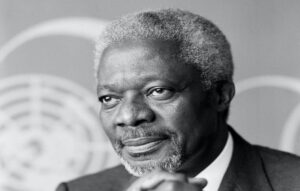
PHOTO CAPTION: Kofi Atta Annan. SOURCE: wmo.int
Kofi Atta Annan (April 8, 1938 – August 18, 2018) was a Ghanaian diplomat and international statesman who served as the seventh Secretary-General of the United Nations from January 1, 1997, to December 31, 2006. He was awarded the Nobel Peace Prize in 2001, jointly with the United Nations, for his work in revitalising the organisation and advocating for human rights, development, and peace.
Kofi Annan was born in Kumasi, in the Gold Coast (now Ghana), into an aristocratic family of Ashanti and Fante heritage. His father, Henry Reginald Annan, and his mother, Victoria Annan, belonged to families whose grandfathers and uncles had held positions as tribal chiefs. His middle name, Atta, meaning “twin” in Akan, reflected his birth alongside his twin sister, Efua Atta, who passed away in 1991.
Annan received his early education at Mfantsipim School, a prestigious all-boys Methodist boarding school in Cape Coast, which he attended from 1954 to 1957. There, he imbibed the values of global responsibility, famously stating that “suffering anywhere, concerns people everywhere.”
In 1958, he enrolled at the Kumasi College of Science and Technology (now Kwame Nkrumah University of Science and Technology) to study economics but completed his undergraduate studies at Macalester College in Saint Paul, Minnesota, in 1961 under a Ford Foundation scholarship. He continued his studies in international relations at the Graduate Institute of International and Development Studies in Geneva, Switzerland, and later earned a master’s degree in management from the Sloan Fellows programme at the MIT Sloan School of Management.
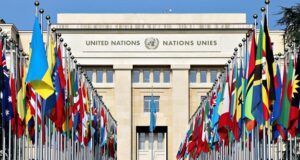
PHOTO CAPTION: United Nations, Geneva. SOURCE: un.org
Annan began his career at the United Nations in 1962 as a budget officer for the World Health Organisation in Geneva. He briefly served as Ghana’s Minister of Tourism before returning to the UN, where he spent the rest of his career. He held progressively senior roles, including Head of Personnel at the Office of the UN High Commissioner for Refugees (1980), Director of Administrative Management Services at the UN Secretariat in New York (1983), Assistant Secretary-General for Human Resources Management and Security Coordinator (1987), and Assistant Secretary-General for Programme Planning, Budget and Finance (1990).
In 1992, he joined the Department of Peacekeeping Operations under Under-Secretary-General Marrack Goulding and succeeded him in March 1993 as Under-Secretary-General. His leadership during crises such as Operation Deliberate Force in Bosnia in 1995 enhanced his international reputation and positioned him as a leading candidate to succeed Secretary-General Boutros-Ghali.
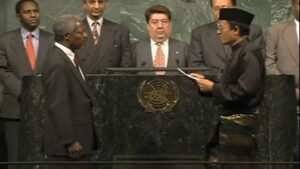
PHOTO CAPTION: Moment Kofi Annan was sworn in as UN secretary general in 1996. SOURCE: EA Library.
Kofi Annan became UN Secretary-General on January 1, 1997, after being approved by the Security Council on December 13, 1996, and confirmed by the General Assembly. He introduced comprehensive management reforms, including the creation of a Deputy Secretary-General position, the consolidation of UN operations, and strategic management initiatives. His 1997 report, Renewing the United Nations: A Programme for Reform, and subsequent Millennium Summit initiatives strengthened the UN’s institutional capacity.
Annan was reappointed for a second term on June 29, 2001, and continued to advocate for peace, human rights, and development. He presented several key reports and policy proposals, including In Larger Freedom (2005) and Mandating and Delivering (2006), addressing UN reforms, the Security Council, and human rights protection. He delivered his farewell address to world leaders on September 19, 2006, and retired on December 31, 2006.
Following his UN career, Annan established the Kofi Annan Foundation in 2007 to promote sustainable development, human rights, and the rule of law. He chaired the Africa Progress Panel and the Global Commission on Elections, Democracy and Security, advocating for equitable development and election integrity worldwide. Between 2016 and 2017, he chaired the Advisory Commission on Rakhine State, working to improve conditions in Myanmar.
Kofi Annan passed away on August 18, 2018, in Bern, Switzerland, after a short illness. His body was returned to Ghana on September 10, 2018. A state funeral was held on September 13, 2018 in Accra and he was buried with full military honours.
Annan is remembered as a champion of diplomacy, human rights, and global governance. His legacy includes reforming the UN system, strengthening international peacekeeping, promoting equitable development in Africa, supporting democratic processes, and advocating for climate action and youth leadership. He remains celebrated as one of the most influential global figures in contemporary international affairs.
EA EDITORS