
KABORE, PHILIPPE ZINDA
- 4 Min Read
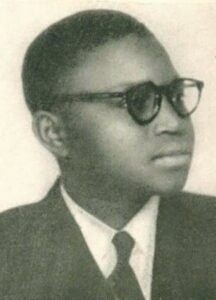
PHOTO CAPTION: Philippe Zinda Kaboré. SOURCE: leFaso.net
Philippe Zinda Kaboré (18 November 1920 – 25 May 1947) was an early nationalist leader and anti-colonial activist from Upper Volta (present-day Burkina Faso). Despite a life cut short at the age of twenty-six, he is remembered as one of the most significant pioneers of organised political resistance to French colonial rule in the territory. He was actively involved in anti-colonial political movements associated with the Rassemblement Démocratique Africain (RDA), a pan–West African political organisation advocating self-determination, political equality, and social justice.
“Zinda” was the name given to him at birth in 1920 in the village of Imasgo, in the Konkistenga district of the Koudougou region. Bestowed by his father, a traditional Mossi ruler, the name means “the enemies are preparing; the enemies are at our gates.” This symbolic name came to be widely interpreted as foreshadowing the militant political destiny that awaited him.
Kaboré distinguished himself early in his education at the public primary school in Ouagadougou, where he displayed exceptional intellectual curiosity and an independent spirit that unsettled both classmates and teachers.
In 1934, he entered the Bingerville Higher School in Côte d’Ivoire, gaining admission with distinction and consistently graduating at the top of his class. In 1937, he was admitted to the prestigious William Ponty School as a substitute candidate. He completed his studies there in 1942 with outstanding results, training as a pharmacist, a profession to which he was deeply committed.
He later pursued further studies at the Dakar School of Medicine, specialising in pharmacy. In this capacity, he worked within the African branch of the autonomous medical services, contributing to efforts aimed at combating sleeping sickness. Upon completing his training, Kaboré confronted firsthand the arbitrary practices and structural injustices of the colonial system.
One of the first measures he openly resisted was his administrative assignment to Dahomey (present-day Benin), a posting intended by colonial authorities to remove him from his homeland, where he was increasingly viewed as politically dangerous. Through determined advocacy, he ultimately succeeded in securing a transfer to Bobo-Dioulasso.
At the time, the French colonial administration had dissolved the colony of Upper Volta, partitioning its territory among neighbouring Côte d’Ivoire, French Sudan (present-day Mali), and Niger. This decision deprived the Mossi and other peoples of the region of a unified political and administrative identity.
Following the legislative elections of 10 November 1946, Kaboré was elected deputy alongside Ouezzin Coulibaly and Félix Houphouët-Boigny, aligning himself with the communist parliamentary group in the French National Assembly. From this position, he made the restoration of Upper Volta his principal political mission.
Kaboré campaigned tirelessly in Paris for the reconstitution of the colony’s territorial integrity. His efforts, undertaken in collaboration with figures such as Nazi Boni and the traditional Mossi ruler, Moogho Naaba Saaga II, contributed decisively to the eventual reversal of the partition policy.
He died prematurely on 25 May 1947, reportedly from a heart attack in Abidjan, at the age of twenty-six. Despite his brief life, Philippe Zinda Kaboré left a profound and enduring legacy. He is widely regarded as a symbol of resistance, political courage, and nationalist awakening in Burkina Faso. His ideas and sacrifices inspired subsequent generations of political leaders and movements that culminated in the country’s independence in 1960.
In recognition of his historical significance, the Lycée Philippe Zinda Kaboré High School in Ouagadougou, one of the most prestigious secondary schools in the country, bears his name. He is honoured as a national hero who died at the very moment when his vision for his country was beginning to take tangible form.
EA EDITORS