KAUNDA, KENNETH
- 3 Min Read
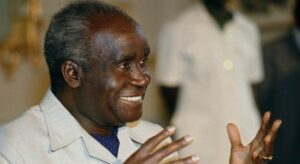
PHOTO CAPTION: Zambia’s independence hero, Kenneth Kaunda.
Kenneth David Kaunda (April 28, 1924 – June 17, 2021) was a Zambian statesman and nationalist leader who served as the country’s first president from 1964 to 1991. A leading figure in Africa’s decolonisation era, he belonged to the last generation of liberation leaders committed to the political emancipation of the continent. Kaunda played a discreet yet influential role in supporting liberation movements in Southern Africa, notably in Zimbabwe, South Africa, Namibia, and Mozambique, and was widely regarded as a principled advocate of Pan-African unity.
Kaunda was born at Lubwa Mission, near Chinsali, in Northern Rhodesia (now Zambia). His father, the Reverend David Kaunda, was an ordained minister of the Church of Scotland and a teacher, while his mother, Helen Nyirenda Kaunda, was also a teacher and the first African woman to teach in colonial Northern Rhodesia.
The family worked largely among the Bemba people of northern Zambia. Following the early death of his father, Kaunda grew up in modest circumstances. His academic ability enabled him to attend the first secondary school established in Northern Rhodesia, and in the mid-1940s, he became a teacher in Tanganyika (now Tanzania).
During his early adulthood, Kaunda became increasingly involved in nationalist politics. He joined the African National Congress (ANC), the first major nationalist movement in Northern Rhodesia, and was elected to its leadership in 1953, at a time when white settler dominance over the territory appeared firmly entrenched. In 1955, he was imprisoned with hard labour for distributing material deemed subversive by the colonial authorities.
Disillusioned with the ANC’s cautious approach to African political rights, he broke away to form the Zambian African National Congress, which was soon banned, leading to a further period of imprisonment. By 1960, Kaunda had emerged as leader of the United National Independence Party (UNIP).
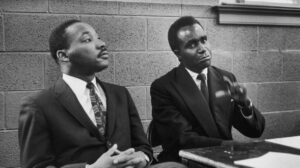
PHOTO CAPTION: Kenneth Kaunda meets Martin Luther King Jr.
Influenced by Christian ethics and the non-violent philosophy of Martin Luther King Jr., whom he met in the United States, he led a campaign of civil disobedience that culminated in constitutional negotiations with Britain. Following elections in 1962 and 1964, UNIP secured a decisive victory, and Kaunda became president upon Zambia’s independence in 1964.
As head of state, he promoted national cohesion through his philosophy of Zambian Humanism and the slogan “One Zambia, One Nation,” while pursuing an independent foreign policy aligned with Pan-African ideals.
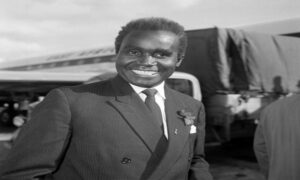
PHOTO CAPTION: Kenneth Kaunda, the prime minister of Zambia (then known as Northern Rhodesia), arriving in London in May 1964, shortly after becoming the British Commonwealth’s youngest prime minister.
Kaunda relinquished power peacefully after losing multi-party elections in 1991, establishing an important democratic precedent in Africa. Although his later years in office were marked by economic difficulties and political restrictions, his contribution to national unity and regional liberation remained significant.
He died on June 17, 2021, at Maina Soko Military Hospital in Lusaka at the age of 97, after being admitted with pneumonia. His death marked the passing of one of the founding generations of the Organisation of African Unity. He is remembered as the founding father of the Zambian nation and a respected elder statesman of modern Africa.
EA EDITORS