MUGABE, ROBERT GABRIEL
- 4 Min Read
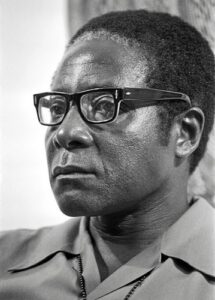
PHOTO CAPTION: Robert Gabriel Mugabe. SOURCE: EA Library.
Robert Gabriel Mugabe (February 21, 1924 – September 6, 2019) was a Zimbabwean anti-colonial nationalist, revolutionary leader, educator, and politician who played a central role in the struggle against British colonial rule in Southern Rhodesia. A prominent figure in African liberation movements, he served as Zimbabwe’s first Prime Minister (1980–1987) and later as Executive President (1987–2017), making him one of the longest-serving heads of government in Africa. Mugabe was known for his Pan-Africanist ideology, advocacy of African self-determination, and persistent criticism of Western imperialism.
Mugabe was born at Kutama Mission, Zvimba District, near Salisbury (now Harare), in Southern Rhodesia (present-day Zimbabwe). He was the son of Gabriel Matibili Mugabe, a carpenter and migrant worker originally from Nyasaland (now Malawi), and Bona Mugabe, a Shona Roman Catholic catechist. Educated at Catholic mission schools, he qualified as a teacher after graduating from St Francis Xavier College, Kutama, in 1945.
He taught in Southern Rhodesia, Northern Rhodesia (now Zambia), and Ghana, and pursued higher education in South Africa and through correspondence. He earned a Bachelor of Arts degree from the University of Fort Hare in 1952 and later obtained additional degrees through distance learning while in detention. During his time in Ghana, he was strongly influenced by Kwame Nkrumah’s ideas on African nationalism and socialism.
Mugabe entered nationalist politics in 1960 as publicity secretary of the National Democratic Party (NDP). After the NDP was banned in 1961, it was succeeded by the Zimbabwe African People’s Union (ZAPU). Ideological and leadership disputes led to a split in 1963, after which Mugabe became a founding member of the Zimbabwe African National Union (ZANU).
In 1964, ZANU was banned, and the colonial government detained Mugabe. He spent roughly 11 years in prison (1964–1974), during which he continued teaching and studying by correspondence. Following his release, he joined the armed liberation struggle known as the Second Chimurenga (Rhodesian Bush War) and later became a leading figure within ZANU. Mugabe was a principal negotiator at the Lancaster House Conference in 1979, which paved the way for majority rule and independence.
After ZANU’s victory in the 1980 general elections, Mugabe became Prime Minister when Zimbabwe attained independence on April 18, 1980. His early years in office were marked by policies of national reconciliation and substantial investment in education, health care, and social services, contributing to Zimbabwe achieving one of the highest literacy rates in Africa by the late 1990s.
In 1987, ZANU merged with ZAPU under the Unity Accord, forming ZANU-PF, and constitutional changes replaced the office of Prime Minister with an executive presidency, consolidating Mugabe’s authority. He was an influential figure within the Organisation of African Unity (OAU) and later the African Union (AU).
From the late 1990s onward, Mugabe’s rule became increasingly controversial. Fast-track land reform programmes after 2000, while addressing historical land inequities, were widely criticised for violence, economic disruption, and declining agricultural production, contributing to severe economic contraction and hyperinflation.
The 2008 elections, held amid economic collapse, produced disputed results, political violence, and international condemnation. A Southern African Development Community (SADC)-brokered Global Political Agreement led to a power-sharing government in 2009, with Morgan Tsvangirai serving as Prime Minister. After the adoption of a new constitution, Mugabe won the 2013 elections, though the process was criticised by opposition parties and observers for irregularities.
In November 2017, following internal party conflict and a military-backed intervention, Mugabe was forced to resign on November 21, 2017, and was succeeded by Emmerson Mnangagwa. He died on September 6, 2019, in Singapore, aged 95. Mugabe remains a deeply polarising historical figure, widely honoured for his role in Zimbabwe’s liberation and Pan-African leadership, yet criticised for authoritarian governance, economic mismanagement, and human-rights abuses during his later years in power.
EA EDITORS