NONGQUASE
- 4 Min Read
Nongquase (1841-1898) was the niece of the Gcaleka (Xhosa) prophet Mhlakaza, who lived during the reign of Sarili. She was the source of the prophecy which led, in 1857, to the starvation of hundreds of thousands of Xhosa, and prevented them from offering further resistance to British expansion at a time when five frontier wars had sapped Xhosa strength and led to the diminution of Xhosa lands.
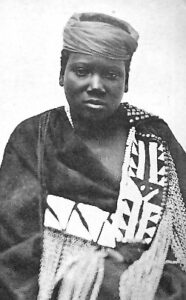
PHOTO CAPTION: Nongquase. SOURCE: EA Library.
Chief Sarili at that time sought to avenge the death of his father, Hintsa, and the loss of his lands to the white settlers. Hintsa had been scapegoated by the British in Natal, coerced into signing a “peace treaty.” and then murdered by British soldiers. Sarili sought a dramatic move which would put the Xhosa into a strong fighting spirit, and had discussed this with Mhlakaza.
One day, the 15-year-old Nongquase was drawing water on the banks of the Gxara, a stream which flows into the Kei River, in what is now the Kentani district. She had a vision in which she heard the voices of her ancestors and saw human faces in the water.
As interpreted by her uncle, they were the former chiefs and warriors of the Xhosa, bringing a prophecy. The Xhosa were to slaughter all their cattle and destroy all their grain as an act of faith, and on February 18, 1857 the ancestors would come back to earth and drive away the white man.
A blood-red sun would rise and set again in the east, a hurricane would sweep away the white invaders, and dead warriors, bringing plenty of cattle and grain, would rejoin the living. At the time, Xhosa morale was low, because of a disastrous cattle disease which had swept the area, and as a result of defeats and loss of land to the British in war. Sarili may have hoped that if his soldiers were starving, they would fight more determinedly.
Chiefs from other tribes sent their izinyanga (traditional healers) to verify the vision, and most of them reported it to be true. Gcaleka commissioner Charles Brownlee, the missionaries present and many among the Xhosa themselves, tried to dissuade the large majority who believed in the prophecy, but in vain. Because of his campaign to end the killing, Brownlee was called “Napakade” (Never). The Ngqika chief, Sandile, attempted to hold out against the prophetic fervour, but ultimately gave in both to internal and external pressures.
February 18, 1857 brought no miracle, but starvation. It is estimated that at least 25,000 died of hunger. The population of the region were reduced from over 100,000 to only 37,000. Many thousands of Xhosa were forced to seek work in Cape Colony in the aftermath of the starvation, and the Xhosas’ strength was lost, as were the 300,000 to 400,000 cattle they had slaughtered.
Nongquase fled, but was taken prisoner near the Mbashe River. For a time she was held on Robben Island, but, as it was understood that she had been influenced by her uncle, she was freed. She married, raised a family, and spent the rest of her life in the Alexandria district.
Nongquase changed her name to Victoria Regina, to avoid being recognised, for as long as she lived she feared attempts on her life. Nongquase died in 1898 at Shepstone. Through her act as prophetic medium to Mhlakaza, the young woman had guaranteed herself a place of notoriety in the history of the Xhosa and of southern Africa as a whole. Her name is still current in the Xhosa proverb, “Uteta injenga Nongquase” (“You are talking like Nongquase” i.e.: you are speaking of things not likely to happen).
LAURA SKY BROWN