
ODEEFUO BOA-AMPONSEM III
- 3 Min Read
Odeefuo Boa-Amponsem III (11th November, 1932 – 2nd December, 2016), was a prominent Ghanaian Traditional ruler and President of the National House of Chiefs, who reigned as a Paramount Chief of Denkyira Traditional area in the Central Region of Ghana for 61 years, from 1955 to 2016. He is acknowledged as Africa’s second-longest serving monarch. He was also an active member of the constituent Assembly that drafted the Constitution of the Fourth Republic of Ghana.
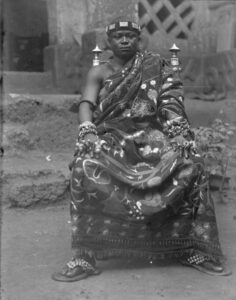
PHOTO CAPTION: Odeefuo Boa-Amponsem III. SOURCE: EA Library.
Odeefuo Boa Amponsem III was born on 11 November 1923 in Jukwa, in Ghana’s Central Region, with the birth name John Kwame Amofa Appiah. He was the son of Odehyie Abena Tweneboaa, a member of the Denkyira royal family eligible for the Omanhene stool, and Nana Kwesi Appiagyei (or Kwasi Apeagyei), from the Kwadwomfie lineage.
He received his primary education at the Roman Catholic Primary School in Dunkwa-on-Offin from 1940 to 1948, culminating in the Gold Coast Primary School Leaving Certificate. He later obtained the qualifications necessary to teach at Dunkwa Catholic Senior High School in 1953, indicating completion of secondary-level studies equivalent to the Senior Cambridge School Certificate.
Odeefuo Boa Amponsem III was enstooled as Denkyirahene on 11 February 1955, succeeding Nana Owusu Bori II following the latter’s death. This installation established him as the paramount chief of the Denkyira Traditional Area in Ghana’s Central Region, with Jukwa serving as the primary seat of authority.
After his enstoolment as Denkyirahene, he pursued higher education abroad, earning a Diploma in Public Administration from Lincoln University in Pennsylvania, United States.
Upon returning from studies in the United States in September 1957, Odeefuo Boa Amponsem III assumed active duties as Denkyirahene amid a fragmented traditional authority, following the abdication of his predecessor, Nana Owusu Bori II, which had left internal divisions and required reunification efforts across the Denkyira kingdom. To address these challenges, he embarked on an extensive tour from 1959 to 1960, visiting every settlement to connect with chiefs, elders, and the people. During these visits, he worked to identify disputes and gather suggestions for peace-building, all aimed at restoring unity within the Denkyira kingdom.
In 1997, while serving as Omanhene, he enrolled in the Master of Arts program in History at the University of Cape Coast to further his academic credentials
He was noted for his bravery, particularly in bringing the dominion stool from Jukwa within the Hemang Lower Denkyira space to the higher Denkyira space, specifically at Dunkwa-On-Offin, after Owusu Bori II; his predecessor, renounced the stool in 1953.
He was elected as President of the National House of Chiefs in 1999 and marked his Golden Jubilee in Dunkwa-on-Offin and in Jukwa in 2005. In this role, he emphasized the apolitical nature of traditional leadership, aligning with constitutional prohibitions on chiefs’ involvement in party politics, and contributed extensively to discussions on chieftaincy reforms and institutional integrity.
He died at age 94 after a period of ill health. Boa Amponsem Senior High School was named after him and it was established in 1961.
Odeefuo Boa Amponsem III is remembered for his steadfast commitment to insulating traditional chieftaincy from partisan politics, most notably through his advocacy for Article 276 of Ghana’s 1992 Constitution, which explicitly prohibits chiefs from engaging in active party political activities to maintain the institution’s neutrality and focus on customary roles.
EA EDITORS