RANSOME-KUTI, FUNMILAYO
- 5 Min Read
Funmilayo Ransome-Kuti (October 25, 1900 – April 13, 1978) stands as a towering figure in Nigeria’s history of resistance and reform. A fearless nationalist, educator, and feminist, she devoted her life to challenging colonial injustice and championing women’s rights. She founded and led the Abeokuta Women’s Union, mobilising thousands of women to protest unjust taxation and oppressive governance, a struggle that led to the abolition of taxes on women and contributed to the abdication of the Alake of Abeokuta in 1948. A passionate advocate for girls’ education and women’s political participation, she also represented Nigerian women on international platforms, earning recognition as one of Africa’s most influential women leaders of the twentieth century.
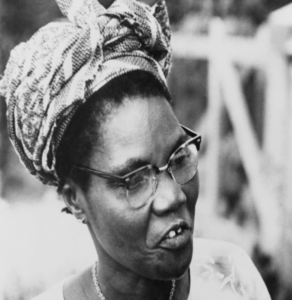
PHOTO CAPTION: A photo of Funmilayo Ransome-Kuti.
Funmilayo Ransome-Kuti, born Frances Abigail Olufunmilayo Thomas on October 25, 1900, in Abeokuta, Ogun State, Nigeria, came from a family that valued education, moral integrity, and social responsibility. Her father, Daniel Olumeyuwa Thomas, was a schoolteacher and Protestant minister, while her mother, Lucretia Phyllis Omoyeni Adeosolu, came from a family of traders and progressive thinkers.
Growing up in this supportive and intellectually vibrant environment, Funmilayo was encouraged to pursue education and develop a strong sense of independence. These early influences shaped her lifelong commitment to women’s empowerment, social justice, and political activism, laying the foundation for her role as one of Nigeria’s most formidable feminists and nationalists.
She attended local schools in Abeokuta and went on to train as a teacher at the Abẹokuta Grammar School and the Teacher Training College in Lagos, becoming a certified educator. She also studied in England, where she gained exposure to progressive ideas on women’s rights, suffrage, and social justice. Her education, both in Nigeria and abroad, equipped her with the knowledge, confidence, and vision to challenge societal norms and colonial policies.
Funmilayo began her professional life as a teacher, dedicating herself to the education of girls and young women. Beyond teaching, she emerged as a community leader, using her organizational skills to found the Abeokuta Women’s Union (AWU). Through the AWU, she mobilised thousands of women to protest unfair taxation and oppressive governance, contributing to the abolition of taxes on women and the abdication of the Alake of Abeokuta in 1948. Her influence extended beyond Nigeria as she represented Nigerian women at international conferences, advocating for gender equality and social justice on a global stage.
Funmilayo Ransome-Kuti’s life demonstrates how education, courage, and leadership can transform society, and she remains one of Africa’s most celebrated feminists, nationalists, and social reformers.
In 1928, she started a self-improvement group for young women. After she and her husband purchased a car in 1936, she became the first woman in her town of Abeokuta to drive.
In 1944, Ransome-Kuti founded the Abeokuta Ladies’ Club, which later evolved into the Abeokuta Women’s Union (AWU), a move that illustrated her commitment to women’s political, social, and economic rights. Five years later, in 1949, she earned the moniker The Lioness of Lisabi after leading the women of Egba in a riot to take on both the British colonial administration and the traditional ruler, the monarch of Egba, Oba Ademola II.
She and her followers challenged both overprice controls and taxation after decades of gender discrimination. Tax policies began in 1918 and required girls as young as 15 to pay 3 shillings a year as an income tax. Men did not have to pay the tax until 18. Government agents often raided the girl’s homes, stripping them naked to ascertain their age to tax them. Agents worked on commission, and extortion was common. His palace was under siege, and the ruler accused of abuse of authority, Ademola II, resigned and fled.
In the wake of the Abeokuta Women’s Revolt, Ransome-Kuti was elected the first president of the AWU, whose membership included both elite, Western-educated Christian women and illiterate market women. She turned the AWU into a national organization under the name Nigerian Women’s Union (NWU) in 1949 and then the Federation of Nigerian Women’s Societies (FNWS) in 1953.
In 1959, Ransome-Kuti created the Commoner’s People’s Party in opposition to the colonial administration after being expelled from the Council of Nigeria and Cameroons (NCNC). She led the campaign for extending the right to vote to women and simultaneously championed Nigerian independence, which came in 1960. Under surveillance from Nigerian and foreign governments, accused of communism, and enduring rampant sexism, her passport renewal was denied, and her entry into the U.S. was prohibited. Despite these measures, Ransome-Kuti continued to travel around the country and abroad to fight for women’s rights.
She is remembered for mobilising women, challenging injustice, advancing girls’ education, and representing African women on the international stage, leaving an indelible mark on Nigeria’s social and political history.
At the age of seventy-six, she was thrown from a second-floor window during a military raid on her son Fela Kuti’s compound on February 18, 1977. She sustained severe injuries from which she never recovered and died at Lagos General Hospital on April 13, 1978, at the age of seventy-seven.
EA EDITORS