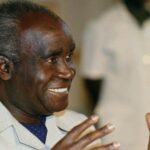
TCHICAYA, JEAN-FELIX
- 4 Min Read

PHOTO CAPTION: Tchicaya, Jean-Felix. SOURCE: Pari Editeur.
Jean-Félix Tchicaya (1903–1961) was a Congolese politician and the first from Congo-Brazzaville elected to the French National Assembly in 1945. Founder of the first political party in Congo-Brazzaville, the Congolese Progressive Party, he championed African representation during decolonisation. He is remembered as a key nationalist figure in Congo’s path to independence.
Tchicaya, Jean-Felix (1903-1961), Congolese (Brazzaville) politician, was born into a prominent Vili-speaking Congolese family that had immigrated to Libreville, Gabon. Many people from coastal Congo-Brazzaville moved to Libreville in the late nineteenth and early twentieth centuries. Tchicaya’s father, Makosso Tchicaya worked as a tailor while his mother was Marie-Antoinette Ngouamba Portella. He came from a prominent family with deep roots in the Kingdom of Loango, Congo. He lost his parents at a very young age and was taken in by his maternal grandfather, Louis Portella, who was a respected merchant and notable leader.
Tchicaya attended the Catholic mission and the local official school in Libreville. His intellectual talent greatly impressed his teachers, leading to a scholarship in 1918 to study at the Ecole William Ponty in Dakar, Senegal, the most prestigious public school in all of French West Africa, where he was trained as a teacher. From 1918 to 1921, he stayed in Dakar. After finishing his studies, he returned to Libreville, where he taught at a primary school in the early 1940s.
He then left teaching and ventured into a career in administration as a finance clerk, where he was assigned to the supply store for the workforce of the Brazzaville/Pointe-Noire railway linking the Congo River to the Atlantic Ocean over 512 km, until the end of the construction work of the CFCO (Congo-Ocean Railway). At his new station, he witnessed the horrors of forced labour in the French “colonies” of Africa.
Tchicaya also formed a musical and social group, L’Harmonie de Pointe-Noire, and coauthored petitions demanding greater rights for Western-educated Africans.
Jean-Félix Tchicaya ventured into politics in the mid-1940s, during the rise of nationalist movements in Africa after World War II.
In 1945, he was elected as the first Congolese deputy for Middle Congo and Gabon at the two National Constituent Assemblies in Paris (1946-1958) and held this seat until the end of the Fourth Republic. He founded the Parti Progressiste Congolais (PPC), translated as Congolese Progressive Party, in 1946, the first political party in Congo-Brazzaville, as a section of the African Democratic Rally, an influential anti-colonial coalition across French-speaking Africa.
During his tenure as the first Congolese deputy for Middle Congo and Gabon at the two National Constituent Assemblies, he consistently spoke against the injustices of colonial rule, advocated for greater African participation in governance, and worked toward reforms that would pave the way for self-determination. His speeches in Paris highlighted the grievances of the Congolese people, focusing on issues such as forced labour, taxation, and the need for social progress. His political activities also strengthened grassroots mobilisation at home, giving Congolese people a stronger voice in their future.
Jean Félix-Tchicaya passed away on 15 January 1961 in Pointe-Noire, Congo, shortly after the country had begun its transition to independence. His death came at a time of great political change, and though he did not live to witness the full consolidation of Congolese independence, his influence was deeply felt in the country’s early nation-building years.
Tchicaya is remembered as one of the founding fathers of Congolese politics. By establishing the PPC, he laid the foundation for organised political opposition to colonialism in Congo-Brazzaville. His role in the French National Assembly gave Africans a platform in the heart of colonial power, and his persistent advocacy helped build momentum toward independence.
Beyond politics, his legacy endures through his family—most notably his son, Tchicaya U Tam’si, who became one of Africa’s most celebrated poets. Today, Jean Félix-Tchicaya’s name remains honoured in Congolese history, with schools and streets bearing his name, ensuring that his contributions to the struggle for justice and representation are not forgotten.
EA EDITORS