KÉRÉKOU, MATHIEU
- 3 Min Read
Mathieu Kérékou (2 September 1933 – 14 October 2015) was a Beninese military officer and politician who served as president of Benin for 29 years from 1972 to 1991 and from 1996 to 2006.
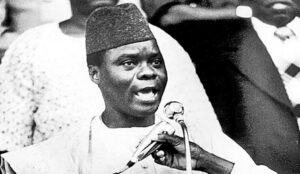
PHOTO CAPTION: Mathieu Kérékou. SOURCE: EA Library.
Mathieu Kérékou was born in 1933, in Kouarfa, northern Benin, to a humble rural family. He grew up in a typical agricultural environment where discipline, hard labour, and community involvement shaped his character. His father’s military history had a significant impact on his early life.
Mathieu Kérékou (1933-2015) obtained a military education from educational institutions in Senegal, Mali, and France before becoming Benin’s long-serving leader. He attended Saint-Louis Secondary School (Senegal), Fréjus Military Training College (France), and Saint-Raphael Military School (France), before entering the French Army in 1960. This training prepared him for a professional military career and paved the way for his future climb to national prominence.
Kérékou went into politics through the military. On October 26, 1972, he launched a military coup that brought him to power in Dahomey (now Benin), which was experiencing severe political turmoil. In 1974, he declared Marxism-Leninism the state’s official ideology, establishing a one-party system and renaming the country the People’s Republic of Benin.
His early years in power were defined by rigorous state control, industrial nationalization, and limits on political freedom. Economic difficulties and social discontent escalated throughout the 1980s, resulting in widespread strikes and a financial crisis.
In response, Kérékou held a National Conference in 1990, which resulted in democratic changes and the adoption of a new constitution. In 1991, he lost the presidential election and surrendered power peacefully, a remarkable step for an African military ruler at the time. After several years out from politics, he returned to power through democratic methods. He was elected president in 1996 and re-elected in 2001, serving until 2006, when he stepped down to comply with constitutional term limitations.
Mathieu Kérékou’s most significant success was his involvement in transitioning Benin from a military dictatorship to a stable multiparty democracy. His acceptance of electoral defeat in 1991 and subsequent comeback through democratic elections gained him national and international recognition. He contributed to Benin’s culture of political tolerance, constitutionalism, and peaceful power changes. Due to his ideological swings, Kérékou is widely regarded as a key figure in African democratization.
Despite his accomplishments, Kérékou’s leadership encountered several hurdles. His early leadership was condemned for authoritarianism, human rights violations, and economic incompetence. Even throughout his democratic administration, Benin struggled with poverty, unemployment, slow economic growth, and reliance on international aid.
Mathieu Kérékou passed away in Benin on October 14, 2015, at the age of 82. His death was announced in a statement by President Thomas Boni Yayi. The cause of death was not specified.
EA EDITORS