QUEEN AMINA
- 2 Min Read
Queen Amina (c. 1533 – c. 1610) was the legendary Hausa warrior queen of the city-state of Zazzau (present-day Zaria, Nigeria) who reigned for 34 years and expanded her kingdom’s influence to its historical zenith.
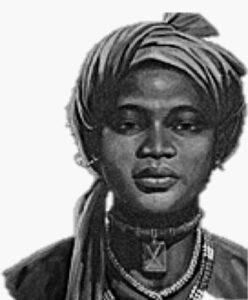
PHOTO CAPTION: Queen Amina. SOURCE: EA Library.
Born around 1533 in the city-state of Zazzau, she was the eldest daughter of Queen Bakwa Turunku, the founder of the Zazzau Kingdom. Her father was a powerful ruler whose lineage trace back to the original Hausa Bakwai.
Growing up in a royal household defined by wealth and military expansion, she was trained from childhood in the art of warfare and statecraft, often accompanying her father’s soldiers to the field.
Unlike many of her peers, she chose to refine her skills as a warrior within the Zazzau cavalry rather than pursuing traditional domestic expectations, earning the respect of the military elite long before she ascended to the throne.
Following the death of her brother, Karami, in 1576, she ascended to the throne and immediately launched a series of military campaigns that lasted over three decades. Commanding an army of 20,000 foot soldiers and 1,000 cavalrymen, she conquered the cities of Kano and Katsina, forcing them to pay tribute in slaves and kola nuts.
Beyond the battlefield, she revolutionized regional architecture by introducing “Amina’s Walls” (Ganuwar Amina), a series of fortified earthen embankments that secured her conquered territories and trade routes. Her reign effectively turned Zazzau into a hub for the trans-Saharan trade, introducing new crops and luxury goods to the Hausa heartland and significantly boosting the economic prosperity of her people.
Queen Amina died around 1610 in Atagara (near modern-day Idah), allegedly during one of her many military expeditions. Her legacy endures as a symbol of female strength and African sovereignty; she remains the subject of countless Hausa folk songs and legends. The defensive walls she pioneered can still be seen in parts of Zaria, and her image as a sword-wielding queen on horseback continues to inspire modern Nigerian culture, representing a golden age of Hausa power and independence.
EA EDITORS