CARDEW, FREDERIC
- 8 Min Read
Frederic Cardew (1839-July 6, 1921) was governor of Sierra Leone from 1894-1900. During his energetic governorship, a Protectorate was declared over the British sphere of influence in the interior, and construction of the first railroad in British West Africa—the Sierra Leone Railway—was begun. But he became alienated from most Sierra Leoneans, and introduced a policy progressively excluding Krios (Creoles) from senior government posts.
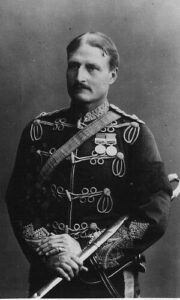
PHOTO CAPTION: Cardew Frederic SOURCE: EA Library
In 1858 Cardew had joined the Indian Army as an ensign in the 50th Bengal Native Infantry. He was in the Indian Army for 20 years, serving in the North West Frontier campaign of 1868, as well as in China. Promoted colonel in 1887, he then spent five years in South Africa, serving in the Zulu and Transvaal campaigns of 1879-81. He was resident commissioner in Zululand from 1890-94.
On March 14, 1894, he arrived in Freetown as interim governor. In May he was awarded the Order of St. Michael and St. George (C.M.G.), and on December 3 was appointed governor. He was later to be knighted in June 1897.
Cardew was 55 years old upon his arrival in Sierra Leone. His health was excellent, and he neither smoked nor drank. He quickly demonstrated his energy by making three tours of the hinterland. The first took him through Mende country to Panguma in the east, then northwards to Falaba, returning by the Scarcies. En route, he visited Waima, where he made arrangements for the upkeep of the graves of British soldiers killed in a clash with the French in a tragic mishap which had occurred in the previous year, 1893.
His second tour, in 1895, took him eastwards to Kailahun near the Liberian border, then across the entire territory, through Kono, Koranko, Limba, Loko, and Temne country-to Kambia, near the border of what was then French Guinea to the northwest, and back to Freetown by way of the Great Scarcies. His third tour, undertaken in 1896, took him along the Rokel River northeastwards to the region of the Niger sources, then southwards along the Anglo-Liberian frontier, and then back to Freetown by way of Bonthe on the coast.
Cardew’s aim, in these tours, was to prepare for the proclamation of a Protectorate over what was at that time the British sphere of influence in the hinterland. This implied not only making administrative preparations, but also reaching agreements on exact boundaries with the French (with respect to French Guinea), and with the Liberians.
By 1896, agreement had been reached with the French on the Guinea boundary. Rough agreement had previously been reached with the Liberians, in 1886, but as Monrovia’s control over the hinterland was uneasy at that time, the Liberian government was unwilling to negotiate an exact boundary line. In practice, however, the Liberians permitted Cardew to ignore the boundary for the purposes of stopping wars which might spread into Sierra Leone. Cardew also claimed to have found vestiges of slavery in the interior. The prospect of slavery being eliminated from the proposed Protectorate discouraged some criticisms of the move that might otherwise have been made.
A British Protectorate over the interior was therefore proclaimed on August 31, 1896. While some of the chiefs in the Protectorate had concluded treaties of cession or of friendship with the British, or received British stipends, some were not consulted, or did not understand the implications. The term “Protectorate” remained ill-defined in Sierra Leone, no less than in Europe, and in practice could be interpreted by the British to mean what they chose.
Cardew also initiated, with the support of Joseph Chamberlain, Colonial Secretary from 1895-1903, the construction of the first stage of the Sierra Leone Railway. It ran southeast, from Freetown harbour to Songo Town, and work began in 1896. The railroad was planned to run through Mende country, and was eventually extended to Pendembu, near the Liberian border.
The Protectorate was divided into five districts, a district commissioner being appointed to administer each. Cardew proposed to defray the costs of administration and of policing the frontiers by imposing a tax on houses, graduated on the number of rooms in each house. The house tax -subsequently to be known by its critics as the Hut Tax-was to become effective on January 1, 1898. The chiefs were entrusted with collecting the tax in their chiefdoms, and the district commissioners, in turn, were to collect from the chiefs.
Opposition to the new tax was widespread, either on grounds that it was too high, or else that the chiefs and people did not recognise British sovereignty. The British Colonial Office also had some misgivings as to the advisability of its imposition at that time. By the end of 1897, however, Cardew, taking some of the criticisms into account, modified the original proposals by imposing a flat rate of five shillings per dwelling, and by exempting two of the remoter districts, Panguma and Koinadugu. But when the Frontier Police were sent to collect the tax by force, the protests quickly became widespread, developing into open uprisings over large areas.
In Mende country, the uprising took an anti-Western turn. Not only Frontier Police were attacked, but European missionaries and traders, and many Krios, themselves a Westernising influence, were massacred. Eventually, by the end of 1898, the uprising was quelled by force, with 96 of its leaders being hanged. In addition, three prominent chiefs—Bai Bureh, Bai Sherbro, and Nyagua were exiled to the Gold Coast (now Ghana).
Sir David Chalmers, a royal commissioner, arrived in Sierra Leone from London to investigate. He ascribed the uprising to the Hut Tax, and made a number of recommendations, including a review of the powers of the district commissioners. His conclusions were contested by Cardew. In the event, the Colonial Office supported Cardew, rejecting Chalmers’ more extreme recommendations.
Upon his arrival in the colony, Cardew had at first enjoyed good relations with Sir Samuel Lewis, the famous lawyer, who was the leading Krio personality in Freetown, and had recommended him for his knighthood. But following a series of scandals involving Krios in government office, Cardew became antagonistic to Krios in general, and his relations with Lewis also deteriorated. When Lewis undertook to become the advocate for African petitioners in a land dispute at a village named Mokassi, thereby challenging the government, Cardew became resentful, and the two men clashed repeatedly in the Legislative Council.
In June 1898, at Cardew’s prompting, an ordinance was passed which encroached upon jury rights in noncapital cases, giving discretionary powers to judges when, in the opinion of the judge, a gross miscarriage of justice had occurred. This development, no less than others, was a setback to the Krios, whose prestige in the hinterland had also been affected by the Mende attacks upon them in the same year. Furthermore, angered by his legal battles with Lewis, and disenchanted with the misconduct of certain Krios, including the postmaster, Cardew asserted that no Krio was fit to be head of a government department.
He also referred to Krios in offensive terms. It was at this time that he initiated a policy that was increasingly to result in the exclusion of Krios from senior governmental posts, and of their progressive replacement by European officers. In 1892, two years before Cardew was governor, Krios had held almost 50 percent of the senior governmental positions in the Colony. Some years later, by 1912, however, the proportion was down to 15 percent, and it was to drop still further in later years. Among other things, Cardew sought to promote agriculture by establishing a botanical station (the precursor of the present Ministry of Agriculture and Natural Resources), by offering incentives to produce better crops and livestock, and by introducing agricultural subsidies on a small scale.
Cardew’s governorship was a milestone in the development of Sierra Leone, both because of the proclamation of the Protectorate over the hinterland, and because of the economic expansion that occurred at that time, symbolised by the coming of the railway.
He was temperate, and religious, and had the directness of a soldier. But he believed in rapid solutions to complex problems and had little time for what he saw as legal niceties. Once he had made a decision, he showed intolerance of other viewpoints. He soon became alienated from most Sierra Leoneans, and his ethnocentrism did not enhance good race relations in the colony. The strain of office also seems to have told upon his health. Whereas upon his arrival in 1894, he enjoyed full health and vigour, three years later, in 1897, he was suffering from neuralgia, insomnia, and shingles. His wife was active in social work in Freetown.
After his Sierra Leone service ended, he retired into private life until his death on July 6, 1921.
CYRIL P. FORAY