GRUNITZKY, NICOLAS
- 3 Min Read
Nicolas Grunitzky (April 5, 1913 – September 27, 1969) was the second President of the Republic of Togo and a prominent political figure in the country’s early post-independence history. He played a significant role in Togolese politics during the transitional period following independence, serving both as Prime Minister and later as President. His principal achievements include efforts to promote political reconciliation, maintain national stability during a turbulent era, and foster diplomatic relations between Togo and the international community.
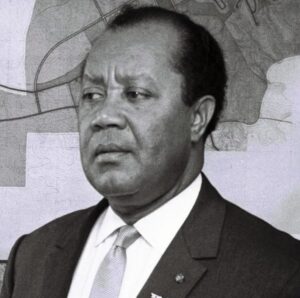
PHOTO CAPTION: Nicolas Grunitzky. SOURCE: EA Library.
Born on 1913 in Atakpamé, in present-day Togo. His father, Harry Grunitzky was an officer of Polish descent who served in the German army and Colonial administration in the territory. His mother, Sossime, belonged to a local royal dynasty in the Atakpamé region.
His background placed him at the intersection of European and African culture. Raised in a multicultural environment, Grunitzky received his early education in Togo before continuing his studies in France, studying civil engineering at the École Spéciale des Travaux Publics (ESTP) in Paris, a grande école specialising in public works, construction, and industry. He later pursued higher education in political science and administration, which prepared him for public service. In his early working life, he was employed in administrative and commercial roles, gaining experience in governance and public administration before entering active politics.
Grunitzky founded the Parti Togolais du Progrès (PTP), a conservative, pro-French political party that promoted Togolese interests within the French Union and advocated gradual autonomy. Following Togo’s establishment as an autonomous republic, he was appointed prime minister on 1956, marking his entry into executive leadership.
Following the political upheaval that led to the overthrow of President Sylvanus Olympio in 1963, Grunitzky rose to prominence and was appointed President of Togo. His administration sought to pursue moderate and inclusive policies, encouraging political pluralism and reconciliation among competing factions. Although his presidency faced significant internal challenges, his leadership contributed to shaping the early political framework of the Togolese state.
Grunitzky died on September 27, 1969, in Paris, France, from severe injuries sustained in a car accident in Côte d’Ivoire. He passed away two years after being removed from office in a military coup led by Gnassingbé Eyadéma in 1967.
Grunitzky’s legacy is that of a transitional leader whose tenure reflected the complexities of post-independence governance in Africa. He is remembered for his efforts at political accommodation and for his role in the formative years of Togo’s political development.
EA EDITORS