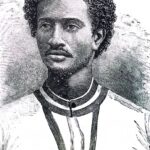
LANKWAN, ABBE ADOLPHE
- 3 Min Read
Abbé Adolphe Lankwan (1926-June 6,1965), a highly esteemed Catholic priest in the Kwilu area, became involved with partisans of the Mulele rebellion which swept the region from 1963 to 1967. While it is not clear if he willingly supported the uprising, Lankwan’s opposition to the excesses of Mulele’s followers, cost the priest his life.
Of Mbuun ethnic origins, Lankwan was born at Impanga, 125 km (75 mi) east of Kikwit, to a family of six boys. Like Mulele, he entered the Jesuit Minor Seminary at Kinzambi, near Kikwit, but unlike Mulele, he successfully completed this preliminary cycle of studies. In 1946, he was admitted to the Major Seminary at Mayidi, 90 km (50 mi) south of modern Kinshasa, where he studied philosophy and theology. After the seminary, he returned to his home diocese, where he was ordained a priest on August 8,1954 at Mwilambongo, 125 km (75 mi) east of Kikwit.
The young priest’s many pastoral duties took him to different missions: Mwilambongo, Ipamu, Bethanie. In 1959, he was named superior of the Mission of Ngoso, 50 km (30 mi) northeast of Kikwit, a post he held until 1961. In addition to his acknowledged pastoral qualifications, his superiors recognised his aptitude for public relations. Thus, as independence approached, Lankwan’s bishop ordered him to make rounds in the heart of the diocese and explain to the Christians the implications of the changes the country was experiencing as independence approached. This tour was interpreted by some as political propaganda for the “Parti Solidaire Africain” (“Party of African Solidarity,” or P.S.A.) a party based primarily in the Kwilu area.
When Pierre Mulele returned from China in 1963 to begin his revolutionary activities in Kwilu, Lankwan was serving at Ipamu, 130 km (80 mi) northeast of Kikwit, where he was headmaster of the Collège Saint Pierre (now the Institut Nto-bi), a school he had founded a year earlier. When panic started to sweep over Ipamu as Mulele’s partisans advanced, the Abbé Lankwan remained calm, reassuring everyone, both African and European. Because his attitude was so reassuring, some have alleged he must have been in contact with Mulele well before the Muielist attack on Ipamu in February 1964.
The violence of Mulele’s bands forced everyone, including Lankwan, to evacuate the area. Although Lankwan sought refuge in Léopoldville (now Kinshasa), his absence from the diocese was short. One of the first to return to the Kwilu, Lankwan went to Idiofa, 90 km (50 mi) east of Kikwit, the headquarters of the diocese.
Around May 15, 1964 the Abbé Lankwan disappeared on the road between Idiofa and Ifwanzondo, a few kilometers to the south. Whether this was an abduction or a deliberate defection no one knows. In any case, Lankwan later resurfaced in Mulele’s entourage where he was assigned, under surveillance, to technical tasks such as operating the radio receiver. Later, probably because of the revolutionaries’ excesses which he witnessed, he maintained his distance from Mulele and tried to help students, seminarians, and young teachers to leave the zone controlled by the partisans.
When Lankwan’s activities became known, he was condemned by the Mulelists and buried alive at Kifuza on June 6, 1965. It is not known, however, if Lankwan’s execution had been ordered by Mulele. In popular opinion, Lankwan is remembered as a priest, who, unlike his colleagues, believed in the need for revolution and supported Mulele’s action. In 1972, the Catholic Church honoured Lankwan’s memory by renaming the Collège Notre Dame of Idiofa- a school which prospered remarkably after the Mulele rebellion- the Collège Lankwan.
NDAYWEL è NZIEM