MANDELA, NELSON
- 10 Min Read

PHOTO CAPTION: Nelson Mandela.
Nelson Rolihlahla Mandela (July 18, 1918 – December 5, 2013) was a South African anti-apartheid activist, freedom fighter, unifier, political strategist, Black nationalist, lawyer, and Nobel Peace Prize winner who served as the first black president of South Africa from 1994 to 1999.
Nelson Mandela was born into the Madiba clan in Mvezo, Transkei, South Africa. His mother was Nonqaphi Nosekeni, and his father, Nkosi Mphakanyiswa Gadla Mandela, served as an advisor to the Acting King of the Thembu people, Jongintaba Dalindyebo.
Mandela was the first member of his family to receive a formal education. After completing primary school, he enrolled at the University of Fort Hare, the only Western-style higher education institution available to black South Africans at the time, where he studied English, anthropology, politics, native administration, and Roman-Dutch law. He was expelled in 1940 for participating in a student protest and did not complete his degree at Fort Hare. Mandela later completed his studies through the University of South Africa.
Mandela was given the name “Nelson” by his primary school teacher, Miss Mdingane. At the age of 12, following the death of his father, he was placed under the care of the Regent at the Great Place in Mqhekezweni. He attended the best available schools for black students at the time and later began studies toward a Bachelor of Arts degree at Fort Hare University.
After his expulsion from Fort Hare University for participating in a student protest, Mandela was advised by the Regent to either return to the area or marry. Instead, in 1941, he moved to Johannesburg with his cousin. His first employment was as a security guard at a gold mine, followed by work as a legal clerk at the law firm Witkin, Edelman and Sidelsky. This relocation exposed him to the realities of industrial urban life and the systemic racial injustices of South African society. Mandela began working closely with Walter Sisulu, a prominent black businessman and activist within the African National Congress (ANC).
In 1943, Mandela enrolled in the LLB program at the University of the Witwatersrand (Wits University). Academically, he struggled, but from 1944 he became increasingly active in politics after helping to establish the African National Congress Youth League (ANCYL). That same year, he married and sought employment to support his family. In 1947, Mandela was elected to his first position within the ANC, serving on the Executive Committee.
Following the 1948 general election, the National Party came to power in South Africa, instituting the formal system of apartheid, which enforced racial classification and segregation. This system severely restricted the rights of nonwhite South Africans and excluded them from political participation to maintain white minority rule. Mandela’s political involvement and commitment to the ANC intensified in response to these developments.
By mid-1952, when the University of the Witwatersrand required him to settle an outstanding tuition fee of 27 pounds or leave, Mandela was already the father of three children. He resumed his legal studies only in 1962, while imprisoned, and ultimately earned his LLB degree through the University of South Africa (Unisa) 27 years later.
In 1952, Mandela was appointed National Volunteer-in-Chief of the Defiance Campaign, a mass action initiative against apartheid legislation. In June 1952, he led the Campaign for the Defiance of Unjust Laws, during which groups across South Africa engaged in acts of civil disobedience in major cities, marking the first large-scale, multiracial political mobilisation against apartheid.
That same year, Mandela had become President of the ANC Youth League (ANCYL) and attracted significant attention from the South African government. As a result, he was served with a banning order restricting his freedom of speech and movement, preventing him from attending public meetings or discussing political matters with more than one person at a time. The government intended the order to weaken the ANC. Mandela and 19 other participants in the Defiance Campaign were charged and sentenced to nine months’ imprisonment, suspended for two years.

PHOTO CAPTION: Nelson Mandela with Oliver Tambo.
In August 1952, Mandela, together with Oliver Tambo, established South Africa’s first black law firm, Mandela & Tambo, which specialised in cases affected by apartheid legislation. Throughout this period, Mandela opposed the apartheid system both politically and professionally.
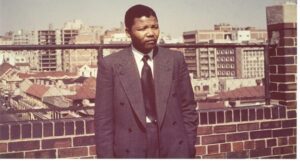
PHOTO CAPTION: Nelson Mandela on the roof of Kholvad House in 1953.
Facing increasing pressure from the South African government, the African National Congress (ANC) experienced a major crackdown on December 5, 1956, when Mandela’s home was raided and he, along with 155 other activists, was arrested and charged with high treason. The subsequent Treason Trials lasted approximately four and a half years, concluding on March 29, 1961, when all defendants were acquitted.
On March 21, 1960, South African police opened fire on a large, organised demonstration against the Pass Laws in Sharpeville, killing 69 unarmed protestors. The incident prompted a national state of emergency and the arrest of numerous activists. In response, Mandela publicly burned his passbook in front of journalists.
The following month, the ANC was banned, leading Mandela and other leaders to go underground and establish a military wing, “Umkhonto we Sizwe” (MK, “Spear of the Nation”). Mandela was appointed its first commander-in-chief, overseeing training, operations, and the acquisition of weapons. During this period, he became known as the “Black Pimpernel”.
On May 31, 1961, Mandela urged the South African government not to declare the country a republic but to negotiate a non-racial constitution. When his appeal was ignored, he called for a general strike from March 29 to 31. In June 1961, Mandela was appointed head of the ANC’s armed wing, Umkhonto we Sizwe (MK), which launched its operations on December 16.

PHOTO CAPTION: Madiba travelled with an Ethiopian passport.
On January 11, 1962, he secretly left South Africa to undergo military training and secure support from other African nations for the armed struggle. Upon his return, he was arrested on August 5, 1962, and charged with leaving the country illegally and organizing strikes.
During his court appearance, Mandela wore traditional Xhosa attire as a statement of African nationalism. On November 7, 1962, he was convicted and sentenced to five years’ imprisonment for incitement and leaving the country without valid documents.

PHOTO CAPTION: Nelson Mandela (top row, second from left) on the steps of Wits University.
While Mandela was in prison, South African police raided the ANC underground headquarters on July 11, 1963, located on a farm in Rivonia, and arrested its military leaders. Mandela was subsequently brought to stand trial alongside them in what became known as the Rivonia Trial. On October 9, 1963, he and his co-accused were formally charged with sabotage and attempting to overthrow the state by violent means.

PHOTO CAPTION: Nelson Mandela raising his fist while making a speech shortly after his release from prison.
The trial continued for several months, and on April 20, 1964, Mandela delivered his renowned speech, declaring that he was “prepared to die” for a free and democratic South Africa. The trial concluded on June 12, 1964, with Mandela and the other defendants found guilty of sabotage and sentenced to life imprisonment.
During his imprisonment, Mandela’s mother and eldest son died, and he was not permitted to attend their funerals. He spent 18 years on Robben Island before being transferred to Pollsmoor Prison in Cape Town. In 1985, while receiving treatment at a hospital, Mandela met with Justice Minister Kobie Coetsee, during which he explored the possibility of initiating dialogue between the government and the ANC.
In 1988, Mandela was hospitalised for tuberculosis. Three months later, he was transferred to Victor Verster Prison, where he spent his final 14 months in custody. The South African government had constructed a maximum-security facility specifically for political prisoners to isolate them from the general population, as authorities feared their influence on other inmates.
At Victor Verster, prisoners were classified from A to D based on conduct, and Mandela was assigned Category D, which carried the fewest privileges. Under this classification, he was permitted to send and receive one letter every six months and to receive only one visitor.

PHOTO CAPTION: Nelson Mandela revisited his former prison cell on Robben Island in 1994, shortly after his release and election as South Africa’s first black president.
During his imprisonment, Mandela progressed through the prison classification system, which allowed him limited privileges, including up to four visits per year. His mother visited him before she died in 1967. Mandela and other political prisoners were assigned to labour at the Lime Quarry on Robben Island, where they undertook physically demanding work breaking limestone for road construction.
The work conditions were harsh, and prolonged exposure to the glare from the white limestone adversely affected prisoners’ eyesight. Mandela was released from prison on February 11, 1990, shortly after the unbanning of the African National Congress (ANC) and the Pan Africanist Congress (PAC).

PHOTO CAPTION: A picture captured during a rare visit from Mandela’s comrades at Victor Verster Prison.
Following his release, other political prisoners were freed, and many exiles returned to South Africa. The African National Congress (ANC) entered into negotiations with the government regarding the country’s political future. On February 11, 1990, after 27 years of imprisonment, Nelson Mandela was released, marking a significant turning point in South Africa’s transition away from apartheid.
President F. W. de Klerk initiated the repeal of apartheid legislation, including the lifting of bans on major liberation movements. On the day of his release, Mandela addressed a large public gathering at Cape Town City Hall. He subsequently resumed active political engagement through meetings, speeches, and diplomatic initiatives, and in 1991 he was elected President of the ANC.

PHOTO CAPTION: Nelson Mandela and F. W. de Klerk.
In 1993, Mandela and President F. W. de Klerk were jointly awarded the Nobel Peace Prize in recognition of their efforts to dismantle apartheid and establish a multiracial democracy.
On April 27, 1994, Mandela participated in South Africa’s first democratic elections, and on May 10, 1994, at the age of 77, he was inaugurated as the country’s first democratically elected Black president at the Union Buildings in Pretoria. He served a single term in office before voluntarily stepping down. In retirement, Mandela remained active in public life, focusing on humanitarian and social causes, including education, healthcare, HIV/AIDS awareness, children’s welfare, and leadership development.
In 2009, marking his 91st birthday, the United Nations designated July 18 as Nelson Mandela International Day in recognition of his contribution to the promotion of peace, reconciliation, and freedom. In 2010, Mandela returned to his home in Qunu, Eastern Cape, where he received visits from various national and international figures. His final public appearance occurred on July 11, 2010, when he attended the FIFA World Cup final at Soccer City in Johannesburg. Mandela died at his home in Johannesburg on December 5, 2013, following a prolonged respiratory illness.
Nelson Mandela is widely regarded as one of the most influential figures of the twentieth century. His leadership contributed significantly to the attainment of political freedom and democratic governance in South Africa. Mandela’s legacy includes efforts to expand access to education and housing, as well as the introduction of social welfare measures to support economically disadvantaged communities.
EA EDITORS