MATSWA, ANDRÉ
- 3 Min Read
André Grénard Matswa (January 17, 1899 – January 13, 1942) was a Congolese anti-colonial and politico-religious leader who inspired the messianic movement known as Matswanism, which emerged in Brazzaville, the capital of French Equatorial Africa in the 1920s. He became an anti-colonial activist, using politico-religious strategies to combat French colonists.
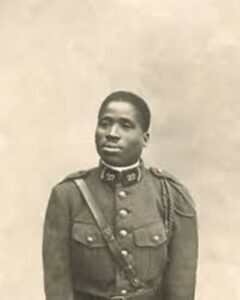
PHOTO CAPTION: André Grénard Matswa. SOURCE: EA Library.
He was born in 1899 at Manzaka-Kinkala in then the Middle Congo. He was the eldest son in his family. His father was N’Goma and his mother N’Kusu (N’Kousou in French). He received a Catholic education at M’Bamou with the Holy Ghost Fathers and became a catechist at the Kindamba mission in the M’Pangala-Mayama area, where he gained increasing popularity among locals and mission staff.
However, his concerns went beyond purely religious matters; he became more interested in relations between whites and blacks in the colonies and in the future of his region, the Congo. Curious and eager to develop intellectually, he left his apostolic work for Brazzaville.
Determined to travel to France, he passed through Antwerp and Bordeaux before finally obtaining a temporary pass to Marseille in 1923. In the spring of 1925, he joined the 22nd Regiment of Senegalese Infantry. He served during the Rif War and was promoted to a non-commissioned officer. This unjust colonial war awakened his conscience as an African and a Black man. He left the army with the rank of sergeant.
In 1926, while living in Paris, he founded the Amicale des Originaires de l’AEF, a self-improvement association. This association evolved gradually into a religious & political movement. He participated in events organised by the French Communist Party and helped develop grassroots Black trade unions. Many came to regard him as a divine prophet sent by God to liberate the Congolese from French rule.
When Matswa returned to Africa in 1930, he was tried by the colonial government in Brazzaville for anti-colonialism. He was sentenced to exile for ten years in Chad, where he escaped in 1935 and fled to France. He was arrested in 1940 and sentenced to forced labour in Brazzaville in February 1941.
Matswa died in prison at Mayama in 1942. After his death, his followers (Matswanists-Ngunza) continued to resist and to carry on Matswa’s message. The French colonial administration was unable to break this resistance movement. At the end of the 1950s, the intense conflict between colonial authorities and the Matswanists was entangled with the process of political transition which led to independence of Congo-Brazzaville in 1960. There is a statue honouring him in Kinkala.
EA EDITORS