NGALIEMA
- 8 Min Read
Ngaliema (circa 1850-circa 1900), a former slave, rose to become the richest and most powerful merchant at Malebo Pool (formerly Stanley Pool) in the late 19th century, at the time when Europeans were entering the area. Belonging to the Tio or Teke people, originally living north and west of the Pool, Ngaliema acted as a middleman between the Bobangi traders from upriver and the caravan leaders from the lower Zaire (present day Congo) river region.
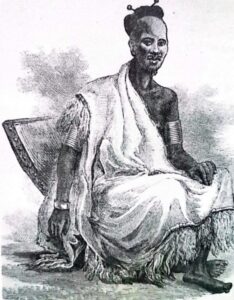
PHOTO CAPTION: Ngaliema. SOURCE: EA Library
In order to take advantage of the growing trade, many subjects of the Makoko, the Tio chief, withdrew from his authority to create a new source of authority, based on wealth and weapons, in Hum territory on the southern bank of the Pool. When the Europeans came to settle the country in 1881, Ngaliema was among the most powerful men at the Pool. But the people he controlled finally took advantage of the European presence to challenge his power which was thus undermined by the Europeans, who introduced trade controls and taxation.
Ngaliema was born in Tio country, on the northern bank of the Pool. Like two of his brothers, he became a slave of one Bamaku, a Tio trader who had settled south of the Pool. After the death of his master, Ngaliema was freed and even inherited part of his master’s property. Ngaliema’s case was not unusual, for among the Tio slavery was an extremely prominent institution, as families purchased slaves in order to increase their numbers. On the other hand, it was also extremely easy for a free Tio to fall into slavery.
In order to pay debts or fines, Tio families frequently sold one of their own kin to another family wishing to buy and adopt a new member. Merchants also acquired slaves who worked in their businesses.
At that time, the whole of the southern bank of the Malebo Pool was occupied by several Tio villages notably, Kimpoko, Kimbangu, Kindolo, Kinshasa, and Kintambo. The rich traders in these towns had become practically independent and no longer obeyed the Makoko of Mbe, (the nominal Tio capital north of the Pool). South of the Pool, the Hum people, who had controlled the land, allowed the powerful Tio traders to settle in their villages.
Following his master’s death in the early 1870s, Ngaliema quickly enriched himself through the ivory trade. Like other Tio brokers, he bought goods from the Bobangi river traders and resold the products to Bakongo and Bazombo caravan leaders who linked the Pool to the Atlantic coast.
Following a dispute with Nchuvila, the Hum chief of Kinshasa village, located south of the Pool, on the site of modern Brazzaville, Ngaliema went to settle at Mfua, and continued his trade there. The inhabitants of Mfua resented his success, however, and trade at Mfua was not as profitable as it had been at Kinshasa.
Thus, Ngaliema decided to relocate at Kintambo on the present Mount Ngaliema. Kintambo village, inhabited by a certain number of Tio, was under the leadership of the Hum chief Ngako, the brother of Nchuvila. Before settling there, Ngaliema had to recognise Hum authority over the land by giving an ivory tusk to each local chief.
Before long, Ngaliema gained enormous wealth through the ivory trade. His riches enabled him to buy slaves and rifles for his caravans. Through alliances based on marriages, he befriended a number of the Hum rulers of Lemba and Kimbangu villages, located between the Funa and Njili streams. These relationships strengthened his position in the country, to the detriment of Chief Nchuvila of Kinshasa. After Nchuvila had died and been succeeded by the ineffective Ngako, Ngaliema became the most important Tio chief, and the master of Kintambo.
Ngaliema’s followers included a considerable number of Tio sub-chiefs, who had attached themselves to his commercial enterprise. Ngaliema’s subjects, estimated at 3,000 men in 1881, had about 450 rifles, while Ngaliema himself had 150. Thus, the Tio were easily able to dominate the other peoples, who did not have many guns. Nevertheless, the Tio, whose only occupation was trade, depended on the local Hum for their food supplies, especially manioc. Through this relationship, the Hum was able to exert some control over the more powerful Tio.
Although when the Europeans arrived in the region in 1877, Ngaliema had not yet gained complete control over the inhabitants of the area, he was recognised as the richest and most important chief. Like many Tio leaders who had become rich through trade, Ngaliema had created a kind of royal court with ceremonies, strict protocol, and special dress. The insignia of his authority were no longer traditional.
In March 1877, Ngaliema who also used the name Itsi, met the Anglo-American explorer, Henry Morton Stanley (1841-1904), who had been sent to central Africa by the New York Herald and the London Daily Telegraph in order to complete Livingstone’s work. Introducing himself as the chief of Kintambo, Ngaliema made a blood pact with Stanley, gave the explorer gifts, and provided necessary information about travel toward Boma.
When Stanley returned to Malebo Pool in August 1881, as a leader of King Leopold’s Comité d’Etudes du Haut-Congo (Study Committee for the Upper Congo River) he faced opposition from the Tio, who had signed treaties with the Franco-Italian explorer Savorgnan de Brazza (1852-1905). Opposition also came from the Bakongo and Bazombo caravan leaders, who feared the whites were destroying their monopoly over transport between the coast and the Pool.
Chief Ngaliema and his followers, however, welcomed Stanley, doubtlessly in hopes of gaining an advantage over the chiefs of Kinshasa and Mfua, and perhaps also out of respect for obligations of hospitality towards a blood brother. After receiving gifts from Stanley, Ngaliema promised him land for future settlement.
Ngaliema was therefore attacked by the Tio, Hum, Bakongo, and Bazombo, who resented direct European intrusion into the commercial domain. In the face of strong African opposition to working with the whites, Ngaliema temporarily reversed himself by sending Stanley’s subordinates out of the Pool area. For some time he opposed white settlement in his territory.
After a time, the Hum people, who were the owners of the land, expressed tolerance for the Europeans. Ngaliema took advantage of this shift to encourage white settlement. In November 1881, the whites located at a nearby hill the Africans called Konzo Ikulu. At first, the Europeans referred to the hill as “Mount Léopold.” Later it became “Mount Stanley.”
Relations between Ngaliema and his newly arrived neighbours were at first uneasy, being characterised by mutual distrust. The Europeans, who sought to consolidate their position, avoided armed confrontation and played on the rivalries between the various African groups. Nevertheless, for a time, the Bakongo and Bazombo buyers continued their trade as in the past. Ngaliema therefore benefited from the ivory trade as well as from the rent which Stanley’s station paid. But he was no longer free to impose his will on the other African groups since the Europeans regulated local political affairs.
After 1885, European competition began to affect traditional patterns of trade around the Pool. Taking advantage of agreements reached at the 1885 Berlin Conference, other commercial houses from the coast and the lower Congo River—the Dutch company N.A.H.V., the French company Daumas and Co., as well as new companies like the Société Anonyme Belge pour le Commerce du Haut-Congo (Belgian Commercial Company for the Upper Congo) became established at Malebo Pool. Increasingly, Bazombo and Bakongo brokers played a lesser role, and the Tio were undercut as middlemen between the upriver Bobangi carriers and the European trading stations.
In the end Ngaliema regretted having allowed the whites to settle at the Pool. But it was too late for military action. He no longer had reliable supplies of arms. Eventually, as commercial companies introduced river steamers, they were able to bypass both the Tio and the Bobangi.
Politically diminished and economically ruined, all the Tio chiefs, including Ngaliema, began a massive exodus from their villages on the southern bank of the Pool in 1891. Refusing to submit to the demands of taxation and forced labour which had been introduced by the Congo Free State, Ngaliema crossed the Pool in September 1891 and returned to his old home. From then until his death, he never regained his commercial power.
In order to perpetuate Ngaliema’s memory, the government of modern Congo erected a monument to him on the hill where, 95 years earlier, Stanley had founded the first Upper-Congo station, near the village of Kintambo, and which had become known as “Mount Stanley.” This hill, the headquarters of Congo’s state institutions, was re-named Mount Ngaliema, in honour of the great Tio merchant.
MUMBANZA mwa BAWELE na NYABAKOMBI ENSOBATO