OLYMPIO, SYLVANUS
- 2 Min Read
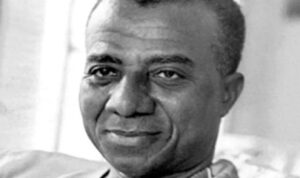
PHOTO CAPTION: Sylvanus Olympio. SOURCE: EA Library.
Sylvanus Olympio (September 6, 1902 – January 13, 1963) was the first President of the Republic of Togo and a leading figure in the country’s struggle for independence. A principled nationalist and statesman, he played a decisive role in guiding Togo from colonial administration to full sovereignty in 1906. His greatest achievements include leading the independence movement, establishing the foundations of the Togolese state, and promoting democratic governance, economic discipline, and national self-reliance during the formative years of the nation.
Born in 1902, in Kpando, then part of German Togoland (now in present-day Ghana). He was the son of Epiphanio Olympio, a prominent Afro-Brazilian trader, and Charlotte Olympio. Born into a well-established and influential family, he was exposed early to commerce, leadership, and public affairs. He received his early education in Lomé before pursuing higher education abroad.
Olympio studied economics at the London School of Economics, where he developed a strong intellectual foundation in administration and economic management. Following his studies, he began his professional career with the United Africa Company, a subsidiary of Unilever, where he gained significant experience in international business and colonial economic systems.
Olympio worked in various capacities with the United Africa Company across West Africa and Europe, rising to senior managerial positions. His professional exposure deepened his understanding of economic governance and colonial administration. Politically, he became actively involved in the nationalist movement and later founded the Comité de l’Unité Togolaise (CUT), which led the campaign for self-government and independence.
His political career was marked by determination and resistance to external domination. After independence in 1961, he served as Prime Minister before becoming President. As President, Olympio pursued policies aimed at fiscal discipline, reduced reliance on foreign aid, national unity, and institutional development, leaving a lasting impact on the political and economic direction of Togo.
Sylvanus Olympio died on January 13, 1963, in Lomé, Togo. He was assassinated during a military coup, making him the first African president to be killed following independence. His death marked a critical turning point in Togolese history and exposed the vulnerabilities of newly independent African states. Despite his untimely death, Olympio is remembered as the father of Togolese independence, a symbol of principled leadership, and a pioneer of nation-building whose legacy continues to shape political thought and historical discourse in Togo.
EA EDITORS