TAMBO, OLIVER
- 5 Min Read
Oliver Tambo (October 27, 1917-April 24, 1993), known to many of his friends and colleagues as ‘O.T.,’ will be remembered as one of the handful of young African professionals responsible for the revitalization of the African National Congress (ANC) in the later 1940s, and as the man charged with taking the ANC into exile following the turbulent 1950s and the rise and apparent demise of the ANC’s military wing, Umkhonto we Sizwe, in early 1960s South Africa.
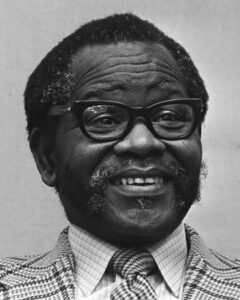
PHOTO CAPTION: Oliver Tambo. SOURCE: EA Library.
Tambo was born in Bizana, Pondoland, in the Transkei region of South Africa in 1917. The son of peasant parents, Tambo early exhibited intellectual acumen and was sent to St. Peter’s Secondary School, Johannesburg, where he pursued his high school studies, matriculating in 1938 with a first-class pass.
Tambo then began his university studies at Fort Hare College, now recognized as the training ground for many of the greatest African nationalist minds of the 20th century. There, Tambo completed a bachelor’s degree in science in 1941, and there he met Nelson Mandela, with whom Tambo would form a friendship, a legal practise and a political partnership that would endure until Tambo’s death. Both Tambo and Mandela engaged in student politics at Fort Hare, and only in 1942, when Tambo was expelled for participating in a student strike, did his political activities there cease. Nor was he able to complete a Diploma in Education.
Tambo moved back to his old school in Johannesburg, St. Peter’s, to take up a position as a maths and science instructor. Several other men who would become important African political figures were teaching at St. Peter’s, including Anton Lembede, considered by many the father of Africanism Congress, Mbatha and Ashley Peter Mda, who would become a leader of the ANC’s Youth League. Nelson Mandela had moved to Johannesburg, and Tambo renewed their friendship, also making the acquaintance of Walter Sisulu, who, with Tambo and Mandela, would form the core younger generational leadership of the ANC throughout the 1950s and beyond.
Tambo was elected to the ANC’s National Executive in 1949 and from that time helped to shape ANC policy and philosophy. While working with Mandela in the ANC, Tambo and Mandela had formed the first African law partnership in South Africa in 1952, the year of the Defiance Campaign.
A leading ANC member throughout the campaign period of the 1950s, Tambo was elected Secretary-General of the ANC in 1958, following the dropping of his name from the Treason Trial rosters in 1957. Later in the same year, Tambo was elevated to Deputy President-General.
Following the Sharpeville Massacre in March 1960 and the commotion that followed, it was decided that Oliver Tambo would slip out of South Africa and into self-imposed exile, there to set up an external ANC office to interpret ANC policy to the world. Tambo left South Africa in early 1960 for Botswana. He eventually ended up in London, establishing the ANC’s primary external presence there. It was while in exile that Tambo was elected the President of the ANC following Albert Lutuli’s death in 1967.
As President, Tambo presided over 30 crucial years of ANC history. He sent the first armed ANC guerrilla force, in concert with Rhodesian ZAPU forces, into the Wankie area of present-day Zimbabwe, with the ultimate mission of re-infiltrating South Africa. The mission was a failure.
In 1969 Tambo presided over the Morogoro Conference in Tanzania, which he called to air grievances of ANC forces in exile. There the ANC’s revolutionary council was formed, and the decision taken to offer non-Africans official ANC membership. In 1975, Tambo would face the challenge of disciplining the ‘Group of 8,’ ANC members who disagreed with decisions taken at Morogoro. During the 1976-77 Soweto period, Tambo took the initiative of reaching out to young adherents of Black Consciousness, and ultimately saw many of them join the ANC, at home or in exile.
In the 1980s, Tambo was one of those responsible for shaping the policy that would be formalized in the 1989 Harare Declaration, which would serve as a position paper structuring negotiations with the Nationalist Party government. Having suffered a stroke in the late 1980s, Tambo stepped down as ANC President in 1990.
A devout Christian, Tambo’s strengths will be remembered as those of a diplomat, a conciliator and great listener who was able to hold the ANC together during its years in the wilderness. Conversely, Tambo’s will to conciliation will probably be remembered in the context of the revelations regarding abuses in Umkhonto we Sizwe and ANC exile camps, which he either was unable to stop or chose to disregard.
Oliver Tambo lived long enough to see his best friend, Nelson Mandela, walk out of prison and retake command of the ANC. He was survived by his wife Adelaide, a stalwart of the Congress movement, daughters Tembi and Tselana, and son Dali.
JOSHUA LAZERSON