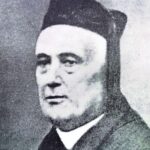
VAN RENSBURG, JOHANNES FREDERIK JANSE
- 4 Min Read
Johannes (Hans) Frederik Janse Van Rensburg (Winburg, OFS, September 24, 1898-Cape Town, September 25, 1966) was leader of the far right Afrikaner cultural and semi-political National-Socialist-inspired Ossewabrandwag (Oxwagon Sentinel). Van Rensburg was educated at the Winburg High School and the University of Stellenbosch. At Stellenbosch he completed the M.A. degree in German, and he later obtained the L.L.B. and L.L.D. degrees.
PHOTO CAPTION: Johannes Frederik Janse Van Rensburg. SOURCE: EA Library.
Van Rensburg started his career as an attorney in Pretoria. He was later appointed private secretary to Tielman Roos, Minister of Justice. In 1930 he became undersecretary in the office of the Attorney-General and three years later Secretary for Justice.
In 1936 Van Rensburg returned to his native Orange Free State to take up the important post of Administrator of the province. Shortly before the outbreak of World War II, Van Rensburg undertook an extensive tour of Europe. During his visit to the German Third Reich, he met prominent Nazi leaders including Hitler himself. Van Rensburg was impressed by Hitler’s national-socialist rhetoric and the discipline he saw exhibited among Hitler’s followers. Van Rensburg, who was always very anti-British, became a staunch supporter of the Nazi ideology and especially of the German “blood and soil” concept.
The Oxwagon Sentinel was founded shortly before the outbreak of World War II. The main aim of this movement was to promote Afrikaner nationalism based on the German “blood and soil” concept. The movement was vehemently opposed to what was regarded as the tyrannical influence of British imperialism and Jewish capitalism. The Sentinel, born of the patriotic stirring among Afrikaners sparked by the Oxwagon Trek Centennial Celebrations of 1938, was to be both a keeper of the cultural flame and a national mobilizing organization with a broad political agenda.
The Sentinel looked to the founding of a Republic based in Christian National principles.
In 1940 Van Rensburg resigned as Administrator in order to become the chief leader (commandant general) of the Ossewabrandwag. Van Rensburg never wanted the movement to become a political party and strove to keep it a volksbeweging (a movement of the nation). Because the Ossewabrandwag openly supported the German cause during the war, the Smuts government had many of the members interned, and this conflict politicized the organization further.
After the war the Ossewabrandwag slowly declined and in 1952 Van Rensburg resigned as commandant general. Until shortly before his death, Van Rensburg served on several govern-lay in art, and particularly in sculpture; he attended night classes at the Rotterdam Academy.
In 1889 Van Wouw emigrated to South Africa and settled in Pretoria where he was employed as a gunsmith. He also gave drawing lessons and accepted small commissions for paintings. Van Wouw’s first large assignment came in 1896 when Samuel Marks, the wealthy industrialist, commissioned the sculpture of President Kruger which today stands in Church Square.
Pretoria. The statue and the four surrounding Boer figures were completed in Italy, but before they could reach the Transvaal, the Anglo-Boer War had commenced, and the sculpture lay in storage in Lourenço Marques (Maputo) for the duration of the war.
His next major commission was for the bronze figures of the Women’s Memorial in Bloemfontein, commemorating the women and children who had died in concentration camps during the Anglo-Boer War. His other large sculptures include those of “Onze Jan” Hofmeyr, President Steyn, General Louis Botha and General C.T. Lukin as well as those for the grave of Khama III. His last major commission was a statue of a woman with two children at the Voortrekker Monument in Pretoria.
Although Van Wouw is generally known for his large commissioned works, he actually excelled in small studies, which he made on his own initiative. These include works of Afrikaner men, women and children which give the viewer a glimpse of the character and individuals of a past era. Van Wouw also completed a large number of studies of Africans which are among the most impressive and sensitive works produced by him.
His work is mainly realistic and highly finished. Although it may be said that his works often lack imagination, he was frequently capable of catching the emotion of his subject: the dejectedness of a Boer soldier hearing of defeat, the fiery determination of the Boer leader, General de Wet, the joy in his study of the “Laughing Black Man.” Van Wouw was not only one of South Africa’s greatest sculptors but he is also remembered as an artist who left succeeding generations with an image of the Afrikaner during an emotional period of his history.
L.J. HEYDENRYCH