VERWOERD, HENDRIK FRENSCH
- 7 Min Read
Hendrik Frensch Verwoerd (Amsterdam, September 8, 1901-Cape Town, September 6, 1966), controversial prime minister from 1958-66, was considered synonymous with the concept of “apartheid.” Verwoerd was the son of Wilheimus Johannes Verwoerd, whose missionary zeal brought the family to South Africa in 1903. The young Verwoerd attended school at Wynberg, Bulawayo and Brandfort, then furthered his studies at the University of Stellenbosch and at various universities in Europe and America. At the age of 26 he was appointed to the chair of applied psychology at the University of Stellenbosch (1928), and subsequently to the chair of sociology (1932).
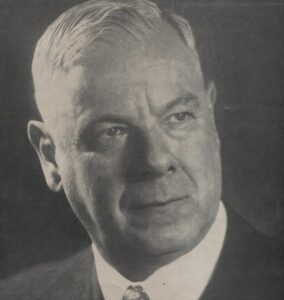
PHOTO CAPTION: Hendrik French Verwoerd. SOURCE: EA Library.
Verwoerd had ample scope for the practical application of his knowledge as a sociologist, for the “Poor White” problem was begging a solution.
He featured prominently at a National Congress held in Kimberley in 1934 to debate ways and means of alleviating the plight of hundreds of thousands of impoverished whites. Verwoerd was largely responsible for the creation of South Africa’s Department of Social Welfare in 1937. In 1937 he entered politics by accepting the editorship of Die Transvaler, a newspaper that was established in Johannesburg to serve as an organ for the National Party, at that time in opposition to the United Party Government of Gens. J.B.M. Hertzog and J.C. Smuts. The first edition of the paper appeared on October 1, 1937.
In the Transvaal, Verwoerd was soon working in close co-operation with J.G. Strijdom, the province’s sole National Party representative in the House of Assembly. They formed an indefatigable team, with Verwoerd supplying Party propaganda through his paper and Strijdom expounding their political creed from platform to platform. With the Hertzog-Smuts war vote of 1939 over the question of South Africa’s entry into World War I on Britain’s side, Verwoerd supported Hertzog’s motion of neutrality, which was defeated.
He kept up his anti-war campaign, while at the same time fanning the flickering flames of Afrikaner nationalism by advocating the ideal of a republic and sovereign independence for South Africa. Much spade-work had to be done, for political issues had split the Afrikaners into different parties and factions, with in-fighting among them almost endemic. In conjunction with the National Party leadership, he attacked the powerful Ossewa-Brandwag, a cultural body that was encroaching on the political field, and succeeded in breaking its power before the decisive elections of 1948.
Verwoerd used his paper with skill to further his own and National Party ideals. In the 1940s he was a strong proponent of Republicanism, and an avowed foe of the National Socialists. Had it not been for Verwoerd and his paper, the National Party might not have come to power in 1948.
Shortly after the election of 1948, Verwoerd, by then a leading intellectual and dominant figure in the National Party, was elected senator. In 1950 he was included in Malan’s Cabinet as Minister of Native Affairs. This portfolio suited him, because for years he had been concerned with two main issues: how to preserve white civilization and at the same time provide for the national aspirations of the Africans.
For him both answers were to be found in the doctrine of apartheid. He regarded this as the only means to prevent racial friction and chaos. Thus in a statement on December 5, 1950, he declared that “if mixed development” of black and white is to be allowed “it will lead to the most terrific clash of interests imaginable.” What was necessary, he said, was for both races to “adopt a development divorced from each other. That is all that the word apartheid means … the present Government adopts the attitude that it concedes and wishes to give to others precisely what it demands for itself.
It believes in the supremacy (baasskap) of the European in his sphere but, then, it also believes equally in the supremacy (baasskap) of the Bantu in his own sphere.” With Verwoerd as architect, the edifice of apartheid was institutionally structured by a complicated series of laws placed on the Statute Book. In actuality, Verwoerd’s rhetoric translated into the maximum degree of segregation possible in the context of the utilization of black labor in white areas.
One of Verwoerd’s main objectives was to physically separate the races to guarantee a future white South Africa. Verwoerd envisaged a reversal in the influx of Africans from the rural to the urban areas. With this in mind, influx control was tightened and the free movement of Africans restricted.
The cornerstone of Verwoerd’s “separate development” was the provision of Bantustans, ethnic “homelands” to which every African belonged and to which the majority of urban Africans would ultimately be removed, regardless of birth or employment. When the Tomlinson Report of 1954 noted that millions of pounds of development money would be necessary to make the Bantustans viable for such an influx, Verwoerd largely ignored the report.
While these developments were taking place, Verwoerd strove to satisfy the republican demands of his fellow Afrikaners. In January 1960 he announced that a referendum was to be held on the issue. Before this could take place, several critical events ruffled the electorate. In February of that year the British Prime Minister, Harold Macmillan, on a visit to South Africa, criticized apartheid in an address to both houses of Parliament. In his impromptu reply to what came to be known as Macmillan’s “winds of change” speech.
Verwoerd conceded that justice should be done to the blacks but appealed for the whites to be also allowed a place in the African sun. “Justice to all,-he said, “does not only mean being just to the black man of Africa but also being just to the white man of Africa . .. (We) have such a stake here that this has become our only motherland. We have nowhere else to go.” Shortly afterwards, on March 21, 69 Africans were killed and over 100 were wounded while staging an anti-pass apartheid protest at Sharpeville, known today as the Sharpeville Massacre.
While news of this act of bloodshed was still reverberating around the world, Verwoerd was shot at and seriously wounded by a deranged farmer, David Pratt, at a public gathering in Johannesburg on April 9. To the surprise of many, he recovered in a matter of weeks and on May 29 made his first public appearance after the attempt on his life.
By now the republican campaign was in full swing and on October 5, 1960, the white electorate voted in favor of South Africa becoming a republic within the Commonwealth. In March 1961 at the Commonwealth Conference in London, Verwoerd formally applied for the republic’s continued membership in the Commonwealth.
The feeling against South Africa, on account of her racialistic policies, exploded at the Conference and, unable to meet the heavy demands made by member states, Verwoerd withdrew his application. On May 31 of that year, South Africa became a republic outside the Commonwealth. At last the long-cherished ideal of republican independence had been realized. Afrikaner nationalism was victorious.
The declaration of a Republic added to the feeling of gloom among many blacks. The people’s leading organizations, including the ANC and the PAC, were banned, as were hundreds of anti-apartheid activists. Others were in prison or soon to flee the country, and the mood among black political leadership was one of greatly increased anger and frustration, and lessened hope for a peaceful and just resolution to South Africa’s gigantic problems.
Verwoerd, having failed in his attempts to incorporate the British Protectorates of Swaziland, Basutoland and Bechuanaland, was not prepared to relinquish control of South West Africa. Indeed, his Government was committed to the economic development of the area at a cost of millions of rands.