EL-HAKIM, TEWFIK
- 2 Min Read
Tewfik El-Hakim (October 9, 1898 – July 26, 1987) was a giant of modern Arabic literature and widely regarded as the “father of modern Arabic drama.” He was the first to successfully establish the play as a respected literary genre in the Arab world, introducing sophisticated Western dramatic techniques while remaining deeply rooted in Egyptian heritage. Over a career spanning six decades, he authored more than 50 plays and several landmark novels, earning international acclaim for his ability to blend social realism with philosophical symbolism.
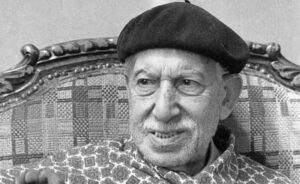
PHOTO CAPTION: Tewfik El-Hakim. SOURCE: EA Library.
He was born in Alexandria, Egypt, in 1898 to a wealthy landowning family. His father was an Egyptian judge, and his mother was the daughter of a Turkish aristocrat, providing him with a privileged but strictly disciplined upbringing.
He received his early education in Alexandria and Cairo, eventually attending the School of Law in Cairo where he graduated in 1925. Following his father’s wishes, he moved to Paris to pursue a doctorate in law, but he spent most of his time there immersed in French theater, cinema, and music, which profoundly influenced his artistic vision and his later efforts to modernize Egyptian stagecraft.
Upon returning to Egypt, he worked as a deputy prosecutor in the rural provinces from 1928 to 1934, an experience that provided the material for his celebrated satirical novel, Diary of a Country Prosecutor. He later held several high-ranking cultural positions, including Director of the Egyptian National Library and Egypt’s representative to UNESCO in Paris.
His literary career reached its zenith with the publication of The People of the Cave (1933), which brought high-brow intellectual drama to the Arabic language. He became a leading figure in the “intellectual theater” movement, creating works that explored the struggle between time, reality, and human will, and his novel The Return of the Spirit became a cultural touchstone for the generation that led the Egyptian Revolution of 1952.
He died in Cairo on July 26, 1987, at the age of 88, leaving behind a legacy that fundamentally reshaped the Arabic literary landscape. He was the recipient of the State Literature Award in 1961 and the highest civilian honor in Egypt, the Cordon of the Republic. Today, he is remembered not only for his technical innovation in drama but for his courage in addressing complex political and social issues, ensuring that the modern Arabic theater would be recognized as a vital part of world literature.
EA EDITORS