
LAB’OU TANSI, SONY
- 3 Min Read
Sony Lab’ou Tansi (July 5, 1947 – June 14, 1995) was a prolific Congolese novelist, playwright, and poet who became one of the most innovative and influential voices in contemporary African literature. As the founder of the Rocado Zulu Théâtre and author of the groundbreaking novel La Vie et demie, he revolutionized the use of the French language to create a “dismembered” style that captured the absurdity and brutality of post-colonial life. Regarded as a pioneer of the “New African Writing,” his work bridged the gap between surrealist satire and urgent political activism, earning him international acclaim as a defender of human dignity against authoritarianism.
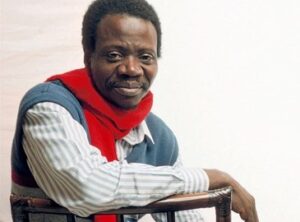
PHOTO CAPTION: Sony Lab’ou Tansi. SOURCE: EA Library.
He was born Marcel Ntsoni in 1947 in Kimwenza, a village near Leopoldville (now Kinshasa) in the Belgian Congo, as the eldest of seven children. His father was a businessman from the former Belgian Congo and his mother was from the former French Congo, providing him with a cross-border cultural heritage from birth. After his family moved to the Republic of Congo (Brazzaville) when he was twelve, he attended secondary school at the École Normale Supérieure d’Afrique Centrale. He completed his higher education in Brazzaville, specializing in English and French literary studies, and began his early working life as a teacher of English and French in Kindauba before moving into government administration.
Throughout his adult life, Tansi balanced roles as a civil servant, working in the Ministry of Youth and later the Ministry of Culture, with a relentless creative output. In 1979, he achieved a double breakthrough: the publication of his masterpiece La Vie et demie and the founding of the Rocado Zulu Théâtre, a troupe that became a cornerstone of Central African performing arts.
His career saw a meteoric rise as he produced over a dozen plays and several novels, including L’Anté-peuple, which won the Grand Prix Littéraire d’Afrique Noire in 1983. In his later years, his impact shifted toward direct political action; he joined the Mouvement Congolais pour le Développement et la Démocratie Intégrale (MCDDI) and was elected to the Congolese Parliament in 1992, using his platform to voice the grievances of the oppressed.
Following a period of intense political persecution and failing health, he died of AIDS-related complications in June 1995, just days after the death of his wife. His legacy endures through his radical transformation of the French language, which he famously claimed to “write in French across French” and his influence on a generation of African writers who view literature as a tool for political resistance.
Today, he is remembered not only as a literary giant but as a moral conscience of the Congo, with his plays still staged globally and his manuscripts serving as vital subjects of academic study in African post-colonial theory.
EA EDITORS