NASSER, GAMAL ABDEL
- 3 Min Read
Gamal Abdel Nasser (January 15, 1918 – September 28, 1970) was an Egyptian military officer, revolutionary, and statesman who served as the second President of Egypt from 1956 until his death in 1970. He was one of the most influential Arab leaders of the twentieth century, leading the 1952 Egyptian Revolution that ended the monarchy and established a republic. Nasser championed Arab nationalism, Pan-Arabism, and anti-colonialism, and played a key role in the formation of the Non-Aligned Movement. His nationalization of the Suez Canal in 1956 made him a symbol of resistance against colonial domination and greatly enhanced his influence across Africa and the Middle East.
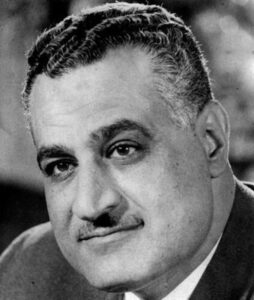
PHOTO CAPTION: Gamal Abdel Nasser. SOURCE: EA Library.
Gamal Abdel Nasser was born on January 15, 1918, in Alexandria, Egypt. He was the eldest son of Abdel Nasser Hussein, a postal clerk, and Fahima Hamad. His family originated from the village of Beni Mur in Upper Egypt and belonged to a modest middle-class background. Because of his father’s work, Nasser attended several schools in different parts of Egypt before completing his secondary education in Cairo.
He later entered the Royal Military Academy in Cairo in 1937, graduating as an army officer in 1938. His military education and experiences during the 1948 Arab–Israeli War strengthened his nationalist convictions and inspired his determination to end British influence and monarchical rule in Egypt.
During his adult life, Nasser became a founding member of the Free Officers Movement, which overthrew King Farouk in the Egyptian Revolution of 1952. Initially serving under General Mohamed Naguib, he emerged as Egypt’s dominant political leader and became President in 1956. He introduced major reforms, including land redistribution, industrialization, expansion of education, and the nationalization of the Suez Canal.
Nasser also promoted Arab unity, leading to the formation of the United Arab Republic with Syria between 1958 and 1961, and was a founding leader of the Non-Aligned Movement. His leadership significantly influenced anti-colonial struggles across Africa and the Arab world, despite setbacks such as Egypt’s defeat in the Six-Day War of 1967.
Gamal Abdel Nasser died of a heart attack on September 28, 1970, in Cairo, Egypt, shortly after mediating peace talks between Arab leaders. His funeral attracted millions of mourners from Egypt and across the Arab world, reflecting his immense popularity.
Nasser’s legacy endures as one of the most significant figures in modern Middle Eastern and African history. He is remembered for ending the Egyptian monarchy, promoting Arab nationalism and social reform, challenging colonial powers, and inspiring independence movements throughout Africa and the developing world.
EA EDITORS