NDLOVU, MASOTSHA
- 3 Min Read
Masotsha Ndlovu (c. 1890 – July 2, 1982) was a trailblazing Zimbabwean trade unionist and nationalist leader who fought for the rights of African workers and the pursuit of political self-determination in colonial Southern Rhodesia. He played a vital role in labor organization and the rise of successive independence movements.
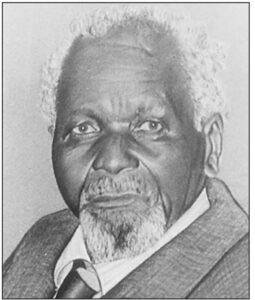
PHOTO CAPTION: Masotsha Ndlovu. SOURCE: EA Library.
Masotsha Ndlovu’s early life was shaped by hardship and inequality. Born around 1890 in Matabeleland, Southern Rhodesia (now Zimbabwe), he grew up in a rural African community under colonial rule. His parents, who were subsistence farmers, likely faced constant economic hardship.
With limited access to formal education, Ndlovu began working at a young age, experiencing harsh labour conditions, racial discrimination, and exploitation as a labourer and migrant worker.
In 1910, at age 20, he migrated to Bulawayo, the industrial hub of Southern Rhodesia, where he secured employment as a messenger, a common entry-level role for Africans in administrative and commercial sectors that required basic literacy and mobility.
By the late 1910s, Ndlovu became aware that his modest educational background was limiting his chances in the growing industrial economy. In response, he moved south in 1919 to South Africa to pursue a Western-style education that was largely unavailable in Rhodesia. He settled in Cape Town, where he worked and studied. He passed his standard six and proceeded to do an English course at matriculation level with the International Correspondence College.
While in Cape Town, Ndlovu was exposed to the African National Congress, the South African Communist Party, and the Industrial and Commercial Workers’ Union (ICWU), which later came to be known as the ICU, as well as the ideas of Marcus Garvey.
In June 1928, he was dispatched by the ICU’s South African founder, Clements Kadalie, to establish a branch of the ICU in Bulawayo, where he focused on organizing urban black laborers facing exploitative colonial conditions, including low wages and pass laws.
Ndlovu quickly built the Bulawayo branch by recruiting prominent activists, including Job Dumbutshena, whom he directed to form a Midlands branch in Gatooma (now Kadoma), and Charles Mzingeli (later known as Nkomo), assigned to organize in Salisbury (now Harare) and Mashonaland.
In 1930, Ndlovu ascended to the position of secretary-general of the ICU. Under his stewardship, the ICU inspired subsequent worker movements across Southern Rhodesia by advocating for better pay, working conditions, and political rights.
Despite facing repeated arrests, imprisonment, and repression by colonial authorities, Ndlovu’s activism made a significant contribution to the growth of African political awareness, the strengthening of trade unionism, and the foundations of later nationalist movements. His efforts left a lasting impact on both the labour movement and the broader struggle for African rights and self-determination in Zimbabwe.
Masotsha Ndlovu died on 2 July 1982 in Zimbabwe, bringing to an end a long life devoted to the advancement of African workers and resistance to colonial oppression. He was buried at National Heroes Acre (Zimbabwe) in Harare, and has several roads named in his honour.
Although he did not live to see the full realisation of the ideals for which he fought, his contributions to trade unionism and nationalist politics laid an important foundation for subsequent liberation movements.
Ndlovu is remembered as a pioneering figure whose sacrifices and activism played a significant role in shaping Zimbabwe’s political and labour history.
EA EDITORS