P’BITEK, OKOT
- 3 Min Read
Okot p’Bitek (7 June 1931 – 20 July 1989) was a celebrated Ugandan poet, scholar, and cultural advocate who gained wide international recognition for his groundbreaking poetic works. He is best known for his long dramatic poem Song of Lawino, a powerful literary piece that explores the tensions between African tradition and Western influence in post-colonial Africa.
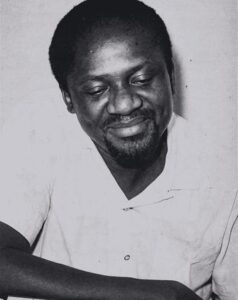
PHOTO CAPTION: Okot p’Bitek. SOURCE: EA Library.
He was born on 7 June 1931 in Gulu District in northern Uganda. Raised in an Acholi family, he grew up immersed in the oral traditions, songs, and folklore of his people—experiences that later shaped his literary style and intellectual outlook. His father was a schoolteacher, and his mother was a traditional singer, influences that combined formal education with a deep appreciation for indigenous culture.
He began his education at King’s College, Budo, one of Uganda’s most prestigious schools. After completing his early studies, he travelled abroad for higher education. He studied at the University of Bristol in the United Kingdom and later at University College of Wales, where he pursued studies in law and social anthropology. His academic background helped him develop a critical understanding of African societies, colonialism, and the impact of Western education on African identity.
Okot p’Bitek rose to international fame in 1966 with the publication of his long narrative poem Song of Lawino. Originally written in Acholi and later translated into English, the poem tells the story of Lawino, a traditional African woman who criticizes her Westernized husband for abandoning African customs in favour of European ways.
Through humour, satire, and powerful imagery, the poem defends African cultural values and questions blind imitation of the West. Its success established him as a leading voice in African literature. He later wrote companion poems such as Song of Ocol, Song of Prisoner, and Song of Malaya, further exploring themes of culture, politics, and social change.
Beyond poetry, Okot p’Bitek was also an essayist and scholar. His critical work, African Religions in Western Scholarship, challenged European interpretations of African belief systems and argued that African cultures should be understood on their own terms. He strongly believed that African writers should draw inspiration from oral traditions and write in ways that reflect African realities rather than European literary models.
Throughout his career, he worked as a teacher, broadcaster, and cultural administrator. He played an important role in developing arts and culture institutions in East Africa, including serving as director of the National Theatre in Uganda. However, political instability during the 1970s, particularly under the regime of Idi Amin, affected intellectual and artistic life in Uganda, and like many scholars of his time, he experienced periods of exile.
Okot p’Bitek died on 20 July 1982 in Kampala, Uganda, at the age of 51. Despite his relatively short life, his influence on African literature remains profound.
He is remembered as a pioneer who successfully blended oral tradition with written poetry and as a courageous intellectual who defended African identity during a time of rapid social and political change. His works continue to be studied across Africa and the world, inspiring new generations of writers to value and preserve their cultural heritage.
EA EDITORS