TUTU, DESMOND MPILO
- 3 Min Read
Desmond Mpilo Tutu (October 7, 1931–December 26, 2021) was a South African Anglican cleric, theologian, human rights advocate, and anti-apartheid leader whose moral leadership and unwavering commitment to nonviolent resistance made him one of the most influential figures in South Africa’s struggle against racial oppression.
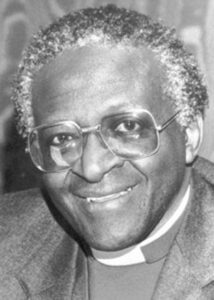
PHOTO CAPTION: Desmond Mpilo Tutu. SOURCE: EA Library.
Born on 7 October 1931 in Klerksdorp, Transvaal (now North West Province), South Africa, Tutu was the son of a teacher. Although he aspired to become a physician, financial constraints led him to train as a teacher, graduating from the University of South Africa in 1954. Disillusioned by the discriminatory Bantu Education Act, he left teaching in 1957 to study theology at St. Peter’s Theological College in Johannesburg. He was ordained an Anglican priest in 1961 and later earned a master’s degree in theology from King’s College London in 1966.
After teaching theology and serving with the World Council of Churches, Tutu became the first Black Dean of St. Mary’s Cathedral, Johannesburg, in 1975, Bishop of Lesotho in 1976, and General Secretary of the South African Council of Churches in 1978. From this position he emerged as the country’s foremost religious opponent of apartheid, condemning racial segregation as morally indefensible while advocating peaceful protest, equal civil rights, a common education system, the abolition of the pass laws, and international economic pressure against the apartheid regime.
Tutu’s international stature grew during the 1980s. In 1984 he received the Nobel Peace Prize for his leadership of the nonviolent campaign against apartheid. The following year he became Bishop of Johannesburg, and in 1986 he was elected Archbishop of Cape Town and Primate of the Church of the Province of Southern Africa, becoming the first Black South African to hold the office. Throughout this period he remained an outspoken advocate for democracy, reconciliation, and racial equality, consistently advocating nonviolent resistance, even as he acknowledged why some anti-apartheid leaders resorted to armed struggle.
Following South Africa’s transition to democracy, President Nelson Mandela appointed Tutu as Chair of the Truth and Reconciliation Commission in 1995. Under his leadership, the Commission investigated human rights abuses committed during the apartheid era and promoted truth-telling, accountability, forgiveness, and national healing rather than retribution. Tutu also helped popularize the idea of South Africa as the “Rainbow Nation,” reflecting his vision of a democratic society founded on equality, diversity, and mutual respect.
After retiring as Archbishop in 1996, Tutu remained an influential global voice for peace, human rights, social justice, and conflict resolution. He co-founded The Elders in 2007, a group of international leaders dedicated to addressing global challenges through dialogue and mediation. He received numerous international honours, including the United States Presidential Medal of Freedom (2009) and the Templeton Prize (2013), and authored several influential works, notably “No Future Without Forgiveness” (1999) and “God Has a Dream” (2004).
Desmond Tutu died in Cape Town on 26 December 2021 at the age of 90, leaving behind a rich legacy as a champion of justice, reconciliation, human rights, and peace.
EA EDITORS