VAN DER BIJL, HENDRIK JOHANNES
- 3 Min Read
Hendrik Johannes Van der Bijl (November 23, 1887-December 2, 1948) was one of the chief architects of South Africa’s industrial development during the first half of the 20th century.
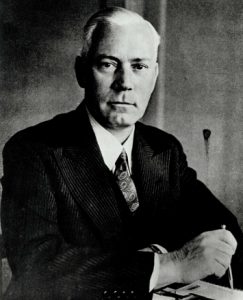
PHOTO CAPTION: Hendrik Johannes Van der Bijl.
Van der Bijl commenced his university studies at Stellenbosch where he excelled in physics. He subsequently completed postgraduate work in Germany and received a Ph.D. in 1913 for a dissertation on electro-technology. His extensive knowledge of photo-electricity brought him to the attention of American industrialists, and he was offered and accepted a post in the United States, where he remained until 1921.
During this time he researched radio-telephones for the American Telephone and Telegraph Company and the Western Electric Company and wrote The Thermionic Vacuum Tube, which became a standard work on the subject for the following 20 years.
Van der Bijl believed implicitly in South Africa’s enormous industrial potential, and when General Smuts, then Prime Minister, invited him in 1921 to become Technical Advisor to the Department of Mines in South Africa, he eagerly accepted.
Van der Bijl soon realized that what South Africa’s industries lacked was an operational basis which inexpensive electricity and steel could provide, and he set about rectifying this deficiency. In 1923 he was instrumental in preparing the legislation for an Electricity Bill, and after its acceptance in parliament he became the first chairman of the Electricity Supply Commission (ESCOM). As a result of its provision of inexpensive electricity, this body greatly stimulated the industrial development of the country.
Van der Bijl now turned his attention to steel, the other pillar of industrial development. Despite widespread opposition, he succeeded in 1931 in establishing the South Africa Iron and Steel Corporation (ISCOR), which within three years was able to provide the cheapest steel in the world and thus give an enormous impetus to South African industry.
Van der Bijl next put his experience and knowledge to the service of general industrial planning, becoming chairman of the Industrial Development Corporation, a post which he filled with distinction. Van der Bijl was the recipient of many awards in the latter half of his life. In 1943 he became a member of the National Academy of Sciences in the United States. He was also an honorary member of the Nederlandse Koninklijk Instituut van Ingenieurs, and served the British government as a mediator in 1946.
He died in 1949 at the peak of his outstanding career and lived long enough to witness the success of ISCOR in Pretoria and Van Der Bijl Park, and of ESCOM as the largest electricity supply company in the southern hemisphere.
L.J. HEYDENRYCH